


Charles Jourdan: The French Shoe Visionary

Charles Jourdan is defined as the pioneering French shoemaker who transformed footwear into high fashion, founding his luxury shoe brand in Romans-sur-Isère in 1921. From those early workshops in the Drôme region of France, Jourdan built a name synonymous with artisanal craftsmanship, daring design, and genuine glamour.
His shoes were never merely functional. They were statements. Collaborations with Christian Dior and Pierre Cardin, alongside legendary advertising campaigns with surrealist photographer Guy Bourdin, cemented the brand’s place in fashion history. For collectors and vintage enthusiasts today, a pair of authentic Charles Jourdan shoes represents far more than footwear. It is a piece of living fashion heritage.
What makes Charles Jourdan shoes so distinctive?
Charles Jourdan shoes are defined by a handful of signature design innovations that set them apart from every other luxury shoe brand of the twentieth century. The most recognisable is the transparent Plexiglas heel, a bold modernist flourish that felt genuinely futuristic when it first appeared. Alongside it, the spool-shaped heel drew inspiration from Louis XV silhouettes, giving the shoes a sense of historical elegance reinterpreted for a contemporary wardrobe.
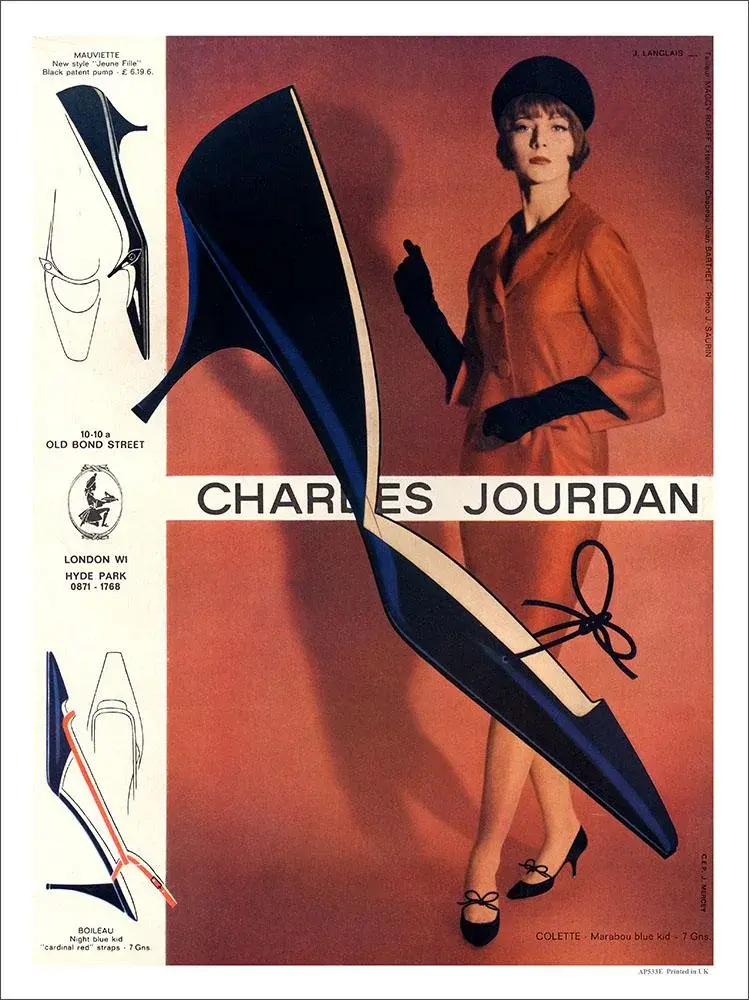
The materials Jourdan chose were equally considered. His collections moved fluidly between supple leather, patent finishes, velvet, suede, and richly woven jacquard fabrics. Each material was selected to complement the heel shape and toe design rather than simply fill a production quota. The result was footwear that felt cohesive and intentional from every angle.
Hallmark buckles and carefully sculpted toe shapes were consistent across the Charles Jourdan collection. These details were not decorative afterthoughts. They were structural signatures that collectors now use to authenticate pieces. The brand also prioritised comfort within its high heel designs, balancing the visual drama of a spool or Plexiglas heel with a wearable fit. That combination of fantasy and function is precisely what redefined luxury footwear as a central fashion statement rather than a painful compromise.
Transparent Plexiglas heels: A modernist signature that appeared across multiple decades of the collection.
Spool-shaped heels: Inspired by Louis XV aesthetics, offering elegant balance and visual interest.
Diverse materials: Leather, patent, velvet, suede, and jacquard fabrics used with deliberate intention.
Hallmark buckles: Consistent design details that serve as key authentication markers for collectors.
Comfort-forward construction: High heels engineered for wearability, not just visual impact.
Pro Tip: When examining a pair of vintage Charles Jourdan shoes, look at the heel construction first. The spool and Plexiglas heels are the most copied elements, but authentic pieces show precise finishing on the heel base and a consistent taper that cheaper imitations rarely achieve.
How did collaborations and advertising shape the brand’s prestige?
The Charles Jourdan brand gained its luxury status not only through design but through two decades of exceptionally bold partnerships. The licensing relationship with Christian Dior began in 1959, bringing the Jourdan name directly into the orbit of Parisian haute couture. Pierre Cardin followed, further anchoring the brand within the upper tier of French fashion. These were not passive licensing arrangements. They required Jourdan to produce footwear that genuinely complemented the vision of two of the most demanding designers in the world.

The advertising campaigns, however, are what truly elevated the brand into cultural mythology. Working with Guy Bourdin through the 1960s and 1970s, Charles Jourdan produced some of the most arresting fashion imagery ever printed. Bourdin’s surrealist photography placed the shoes within dreamlike, often provocative narratives. The campaigns were bold, artistic, and irreverent, positioning the brand as something far beyond a shoemaker.
The Dior licensing deal (1959): Placed Charles Jourdan footwear within the most prestigious fashion houses in Paris, raising the brand’s profile internationally.
The Pierre Cardin partnership: Extended the brand’s reach into the space-age modernism that defined 1960s fashion.
Guy Bourdin’s campaigns: Created a visual language for the brand that was surrealist, provocative, and utterly memorable.
Celebrity endorsement: The brand attracted a devoted following among style icons and cultural figures throughout the 1960s and 1970s.
“Charles Jourdan’s advertising blended self-assured fantasy imagery with practical design, influencing luxury footwear marketing in ways that are still felt today.” — Le Bon Marché
The advertising style combined artistic fantasy with a confidence that was rare in luxury fashion at the time. Most brands sold aspiration through elegance. Jourdan sold it through provocation. That distinction made the brand unforgettable and gave its vintage pieces a cultural weight that goes well beyond their physical beauty.
What is the history of the Charles Jourdan brand?
Charles Jourdan founded his company in 1921 in Romans-sur-Isère, a town in the Drôme department of France with a long tradition of shoemaking. By 1923, the business employed over 30 workers, with production centred on Boulevard Voltaire. Growth was rapid. The quality of the product and Jourdan’s instinct for design attracted attention well beyond the local market.
His three sons, Roland, René, and Charles Jr., joined the business and helped drive its international expansion. The brand opened flagship boutiques across Europe and North America, becoming a fixture in the wardrobes of women who understood that shoes were as important as any other element of a carefully considered outfit. The 1960s and 1970s were the brand’s creative and commercial peak, fuelled by the Dior and Cardin partnerships and the Bourdin campaigns.
Decade | Key development |
1920s | Founded in Romans-sur-Isère; rapid factory growth |
1950s–60s | Dior licensing begins; international expansion |
1960s–70s | Guy Bourdin campaigns; creative and cultural peak |
1980s | Leadership transitions; more conservative design direction |
2002 | Bankruptcy declared; over $9 million in debt |
Post-2002 | Ownership changes; fragmented brand legacy |
The 2002 bankruptcy was a significant turning point. Annual sales had fallen to around 65,000 pairs, and the company carried debts exceeding $9 million. Subsequent ownership changes shifted production away from the original family-run factories. The brand’s legacy became fragmented, and the quality and character of later pieces diverged noticeably from the heritage collection.
Pro Tip: Pieces produced before 2002 from the original Romans-sur-Isère factories carry the strongest provenance. Always check the insole stamp and country of origin marking when assessing a vintage pair.

How can collectors identify authentic vintage pieces?
Authenticating vintage Charles Jourdan pieces requires attention to a specific set of physical and historical markers. The signature heel shapes, particularly the spool and Louis XV lines, are the starting point. These are not simply stylistic choices. They are structural signatures that reflect the manufacturing standards of the original family-owned factories in Romans-sur-Isère.
Detailed buckles are equally telling. Authentic pieces from the 1960s and 1970s feature buckles with a weight and finish that later licensed products rarely replicate. The insole branding is another key indicator. Pieces produced during the Christian Dior or Pierre Cardin licensing periods will carry dual branding, which is itself a mark of authenticity for those specific eras. Collectors prize these dual-branded pieces particularly highly.
The 1960s–70s designs linked to the surrealist advertising era are historically the most sought after. Post-1981 pieces moved toward more conservative styling, and post-2002 production shifted away from the original factories entirely. That transition created a clear quality break that experienced collectors can identify by examining stitching consistency, heel finishing, and leather quality.
Feature | Authentic vintage (pre-2002) | Later licensed production |
Heel construction | Precise taper, consistent finish | Variable quality, less refined |
Buckle weight | Substantial, detailed | Lighter, simpler |
Insole branding | Clear stamp, often dual-branded | Inconsistent or absent |
Leather quality | Supple, well-grained | Variable |
Country of origin | Romans-sur-Isère, France | Multiple, often unlisted |
Check the heel base: Authentic spool and Plexiglas heels show clean, precise finishing at the base.
Examine the stitching: Original factory pieces use consistent, tight stitching throughout the upper.
Look for dual branding: Dior or Cardin co-branded insoles confirm a specific and valuable production era.
Assess the leather: Pre-2002 pieces use leather with a distinctive suppleness and grain depth.
Verify provenance: Receipts, original boxes, or documentation from Romans-sur-Isère add significant value.
Pro Tip: Post-bankruptcy ownership changes caused real fragmentation in the brand’s legacy and quality. If a seller cannot confirm pre-2002 production, treat the piece as a later licensed item and price it accordingly. Provenance verification is not optional for serious collectors.
The joy of collecting vintage Charles Jourdan lies in that detective work. Each authentic pair carries the fingerprints of a specific era, a specific factory, and a specific creative vision. For a deeper look at how these shoes fit within the broader world of vintage designer footwear, the history of the brand offers an endlessly rewarding study. You might also enjoy exploring our guide to top vintage shoes and boots for further context on what makes certain pairs truly collectible.
Vintage Charles Jourdan at My Vintage
At My Vintage, we share your passion for the pieces that tell a real story. Authentic vintage footwear from the golden era of French luxury design is exactly the kind of find that makes collecting so rewarding.

Whether you are searching for a pair with those iconic spool heels or hunting for something from the Dior licensing years, our curated vintage collection is worth a browse. We carefully select pieces for quality, character, and provenance, so you can shop with confidence. Take a look at our vintage homeware and accessories alongside our fashion finds, and visit My Vintage to see what is currently available. Rare pieces go quickly, so it is always worth checking back regularly.
Key Takeaways
Charles Jourdan defined luxury footwear by combining avant-garde design, surrealist advertising, and artisanal French craftsmanship across a century of fashion history.
Point | Details |
Founding and growth | Charles Jourdan established his brand in Romans-sur-Isère in 1921, employing over 30 workers by 1923. |
Signature design features | Transparent Plexiglas heels, spool shapes, and hallmark buckles are the key authentication markers for collectors. |
Cultural collaborations | Licensing with Christian Dior from 1959 and Guy Bourdin’s surrealist campaigns defined the brand’s peak prestige. |
Most collectible era | The 1960s–70s pieces, linked to surrealist advertising and avant-garde materials, are the most prized by collectors. |
Provenance matters | Pre-2002 factory production from Romans-sur-Isère confirms authenticity; post-bankruptcy pieces require careful scrutiny. |
Frequently Asked Questions
Who was Charles Jourdan?
Charles Jourdan was a French shoemaker and designer who founded his luxury brand in Romans-sur-Isère in 1921. He is credited with elevating footwear to the status of a high-fashion statement piece.
What are the most collectible Charles Jourdan designs?
The most collectible pieces come from the 1960s and 1970s, particularly those linked to the Guy Bourdin advertising campaigns and avant-garde materials such as transparent Plexiglas heels.
How do I authenticate a vintage pair of Charles Jourdan shoes?
Look for the signature spool or Louis XV heel shapes, detailed buckles, and a clear insole stamp confirming French factory origin. Pieces from the Christian Dior or Pierre Cardin licensing periods carry dual branding, which is a strong authenticity indicator.
What happened to the Charles Jourdan brand?
The company declared bankruptcy in 2002 with debts exceeding $9 million. Subsequent ownership changes fragmented the brand’s legacy and shifted production away from the original family-run factories.
Where can I find vintage Charles Jourdan shoes today?
Specialist vintage retailers, auction houses, and curated online platforms are the best sources. Always verify provenance and look for pre-2002 production markers to confirm you are buying an authentic heritage piece.
Recommended


Comments