


Dress Clips: The Forgotten Vintage Accessory

Open an old jewellery box and there is every chance you will recognise most of what you find. A brooch has its familiar pin, earrings are usually fairly self-explanatory and a necklace does not present much of a mystery. Then, occasionally, something appears with a broad hinged fitting on the back that looks almost like a piece of hardware rather than jewellery.
There is a good chance you have found a dress clip.
Once a fashionable and remarkably versatile accessory, the dress clip has become one of those pieces of vintage jewellery that many people can recognise visually without necessarily knowing its name or purpose. During its fashionable heyday, however, a sparkling clip could transform a neckline, decorate a lapel, sit at the edge of a pocket or add interest to an otherwise simple dress. Some were inexpensive costume pieces, while others were made by the greatest jewellery houses of the period using diamonds and precious stones.
Perhaps most fascinatingly, some came in pairs and could be combined into a completely different piece of jewellery. For an accessory that has slipped surprisingly far from everyday memory, the dress clip was wonderfully clever.
What Is a Vintage Dress Clip?
A dress clip is an ornamental piece of jewellery designed to grip directly onto clothing using a spring-loaded clip mechanism rather than the long pin and catch normally found on the back of a brooch. The fitting is usually one of the quickest ways to understand what you are looking at, although, as ever with vintage jewellery, the entire piece should be considered rather than relying on one feature alone.
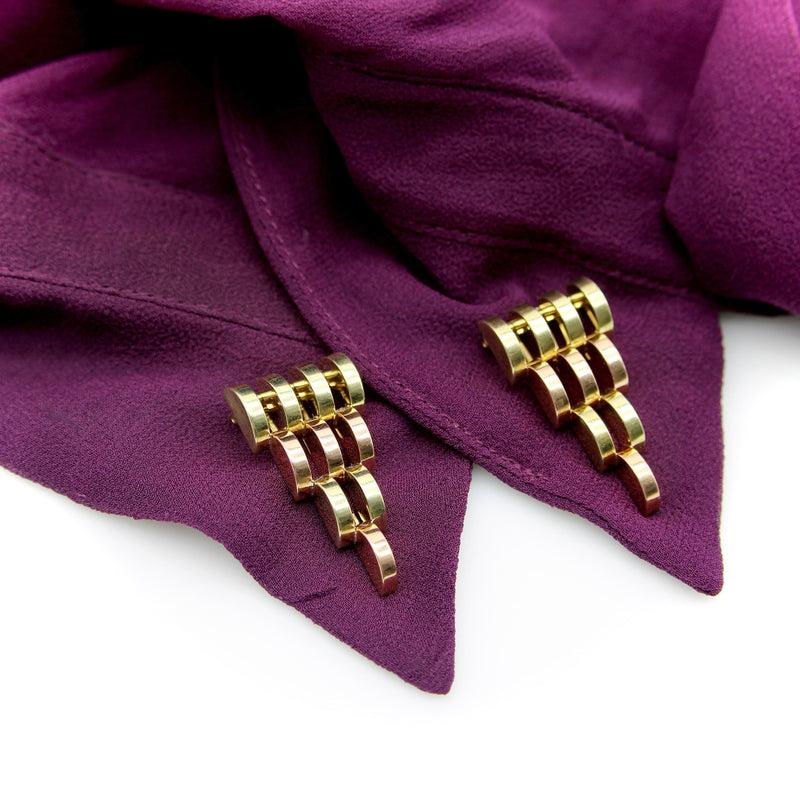
The mechanism made the dress clip particularly adaptable. Rather than being restricted to somewhere that could comfortably accommodate a brooch pin, it could be attached to the edge of a neckline, collar, lapel, pocket or other suitable part of a garment. Period fashion also allowed jewellery to become part of the construction and visual balance of an outfit, so clips could be positioned symmetrically or used to emphasise the shape of a dress.
This versatility helps explain why dress clips made such sense during the years in which they became particularly fashionable. They were jewellery, certainly, but they were also a styling device.
Why Did Dress Clips Become So Popular in the 1930s?
Although clip mechanisms and removable dress ornaments have a broader history, surviving museum collections make the importance of the 1930s particularly clear. The Metropolitan Museum of Art holds numerous fashion clips from the decade, including American, French and German examples, as well as pieces associated with the House of Chanel.
Their popularity fitted beautifully with the fashion of the period. As the dropped waists and comparatively straight silhouettes of the 1920s gave way to longer, more body-conscious lines during the 1930s, attention increasingly returned to the shoulders, neckline and upper body. Eveningwear could be sleek and fluid, giving jewellery an opportunity to provide concentrated areas of sparkle and decoration.
The wider Art Deco aesthetic was equally compatible with the dress clip. Geometry, symmetry, polished surfaces and bold contrasts were all important strands of 1920s and 1930s design, and the V&A notes the influence of geometric forms across both Art Deco fashion and jewellery. A clip provided a relatively compact canvas on which jewellers could play with those ideas.
Yet it would be misleading to imagine every dress clip as a diamond-encrusted Art Deco masterpiece. Surviving examples demonstrate an enormous range of materials and price points, allowing the idea to move from fine jewellery into fashionable costume jewellery.
From Diamonds to Early Plastics
At the luxury end of the market, dress clips could be spectacular. Cartier produced examples using diamonds, sapphires, rubies, emeralds, citrine and platinum, including highly geometric designs that now epitomise Art Deco jewellery. A Cartier citrine and diamond dress clip dating to around 1930 survives alongside sapphire-and-diamond and colourful “Tutti Frutti” examples from the same broad period.
The story becomes even more interesting when we look beyond precious jewellery. The Met's collection includes 1930s clips made from metal and glass, rhinestones, Bakelite and cellulose nitrate, showing that fashionable clips existed at very different levels of the market. Chanel was also producing clips in costume-jewellery materials; one Met example dating to around 1938 combines metal and glass.
That range is important because it places the dress clip firmly within the broader story of twentieth-century costume jewellery. New and increasingly adventurous materials allowed jewellery to become larger, more colourful and more playful without requiring the financial commitment of precious stones. A fashionable effect could be achieved through clever design rather than intrinsic value alone.
For today's vintage collector, it also means there is no single material that defines a dress clip. A sparkling rhinestone example and a carved plastic clip may belong to the same broad fashion story while looking completely different.
The Clever World of Double Dress Clips
This is where dress clips become particularly fun. Jewellers developed systems in which two separate clips could be fitted onto a frame and worn together as a single brooch. Remove them from the fitting and the wearer had two individual clips that could be positioned separately on clothing. One piece of jewellery could therefore produce several different looks.

Surviving Cartier examples demonstrate the idea beautifully. Christie's has documented Art Deco double-clip brooches dating to around 1930 in which the two elements detach from their brooch fitting and can be worn independently as clips. One Cartier London example uses circular and baguette-cut diamonds, while other versions explore symmetrical geometric and curved forms.
This convertibility was part of a wider fascination with adaptable jewellery during the Art Deco era. The Gemological Institute of America notes that convertible jewellery allowed women to wear a single piece in different ways and records 1930s examples by major houses including Cartier and Boucheron.
It is easy to see the appeal. Two clips could decorate opposite sides of a neckline during the evening, then be reunited as a substantial brooch for another occasion. The jewellery was not simply decorative; the wearer could participate in its design.
What About Duettes?
Anyone researching vintage dress clips will encounter the word Duette, and this is where terminology can become muddled.
Today, sellers and collectors sometimes use “duette” rather loosely for jewellery consisting of two clips that can be joined and worn as a brooch. In vintage jewellery, however, names associated with particular commercial systems and manufacturers can have more specific histories, so it is wise not to assume that every double dress clip is automatically a particular branded or patented design.
The safest descriptive approach is wonderfully simple: if two clips detach from a frame and can also be worn together as a brooch, double dress clip, double-clip brooch or convertible clip brooch describes what the object actually does without making an unsupported attribution.
That distinction becomes especially important when buying or selling vintage jewellery. A descriptive term tells us about construction; a maker's name or branded term makes a claim about origin. Those are not quite the same thing.
How Were Vintage Dress Clips Worn?
One of the joys of dress clips was that there was no single correct position. They could be attached at the centre or side of a neckline, clipped to a collar or lapel, placed at a pocket or used in pairs to create symmetry across a garment.
The shape of the clothing mattered. A V-neck could be emphasised with a clip at its point, while a pair could draw attention towards the shoulders or frame a neckline. On relatively simple evening dresses, a substantial clip introduced jewellery directly onto the garment without requiring a necklace to compete with its lines.
This also helps explain why dress clips can look slightly puzzling when separated from clothing. Unlike a pendant or bracelet, their purpose is most obvious when you imagine them interacting with fabric. The garment effectively becomes part of the jewellery's composition.
There is plenty of scope for wearing them today too, although care is essential. A strong vintage clip can place considerable pressure on delicate material, and older mechanisms may have sharp teeth or substantial spring tension. A sturdy jacket lapel, coat edge or suitably robust neckline may tolerate a clip beautifully, whereas fine silk or fragile vintage fabric could be damaged by one.
As much as we love combining vintage pieces, sacrificing a 1930s dress to demonstrate a 1930s dress clip would rather defeat the object.
Is a Dress Clip the Same as a Brooch?
Not quite, although the distinction becomes blurred when convertible jewellery enters the picture.
A conventional brooch normally uses a pin that passes through the fabric and secures into a catch. A dress clip grips onto the garment with its clip fitting instead. A convertible double-clip piece can complicate matters because its two dress clips may attach to a separate framework that allows the assembled object to function as a brooch.


This is why looking at the back of vintage jewellery is often every bit as interesting as looking at the front. Turn over what appears to be an ordinary Art Deco-style brooch and you may discover that it comes apart into two separate pieces.
At the same time, the fastening should never be used as a magical dating device. Findings can be repaired, replaced or altered, and jewellery designs and mechanisms overlap in date. Construction is evidence to consider alongside materials, style, workmanship, marks and provenance rather than a shortcut to an exact year.
Dress Clips Beyond Art Deco
The extraordinary association between dress clips and the 1930s can make it tempting to treat every example as Art Deco, but the surviving record is broader. The Met, for example, holds an American pair of plastic and rhinestone clips dated more widely to 1930–49, demonstrating that the form continued beyond the narrowest definition of the Art Deco period.
Styles naturally changed too. Not every clip followed the crisp geometry we now associate with the decade. Costume jewellery embraced figurative, floral, colourful and increasingly playful designs, while different makers interpreted the mechanism according to their own market and aesthetic.
That variety is useful to remember when shopping for vintage examples today. A dress clip does not have to resemble a diamond fan or geometric skyscraper motif to be genuine, interesting or collectable.
Nor does the presence of a clip fitting automatically establish a date. As we have learned repeatedly while handling vintage jewellery, the most reliable understanding comes from looking at the object as a whole rather than asking one clasp, hinge or fitting to tell its entire story.
What Should You Look for When Buying a Vintage Dress Clip?
Condition is particularly important because a dress clip is a working object. Check whether the mechanism opens and closes properly, whether the spring still provides useful tension and whether any teeth or gripping surfaces appear excessively bent or damaged. On convertible pieces, make sure both clips fit their shared brooch frame securely if the fitting is present.
Decoration deserves the same attention you would give any vintage jewellery. Look for missing rhinestones, chipped glass or plastic, damaged plating and evidence of old repairs. None of these automatically rules out a piece — particularly if it is unusual or beautiful — but they should be reflected in its description and value.
Signed pieces naturally attract interest, particularly when associated with important costume or fine-jewellery makers, but unsigned does not mean unworthy. Huge quantities of attractive twentieth-century costume jewellery were unsigned, and good design, quality construction and condition can make an anonymous dress clip a wonderful thing to own.
Most importantly, do not buy solely because somebody has attached the words “Art Deco” to the listing. Look at the construction, design and materials, and expect the evidence to support the description.
Why Collect Vintage Dress Clips Today?
Perhaps the greatest appeal of the dress clip is that it feels familiar and strange at the same time. It is recognisably jewellery, yet its mechanism belongs to a way of dressing that has largely disappeared from everyday fashion.
That gives dress clips an additional layer of interest for collectors. They tell us not only about jewellery design but about how clothing was decorated and personalised. They belong to an era in which accessories could be moved around the garment, paired, separated and sometimes transformed completely according to what the wearer wanted to achieve.
There is also something rather appealing about collecting an accessory that has been somewhat forgotten. Brooches, necklaces and bracelets never really need an introduction; a dress clip often begins a conversation with the question, “What is this?” For anyone interested in vintage fashion history, that question is usually where the fun starts.
What Is a Vintage Dress Clip?
A vintage dress clip is a decorative piece of jewellery that attaches directly to clothing using a hinged or spring-loaded clip rather than the conventional pin and catch found on most brooches. Dress clips became particularly fashionable during the 1930s, although examples and related forms occur outside that decade.
When Were Dress Clips Most Popular?
Dress clips are especially associated with the 1930s, a connection supported by numerous surviving museum and fine-jewellery examples. Their popularity continued beyond the decade, however, so a clip fitting alone should not be used to date a piece precisely.
What Is the Difference Between a Dress Clip and a Brooch?
The principal difference is the fastening. A brooch normally has a pin that passes through fabric, while a dress clip grips onto an edge or section of the garment. Some convertible pieces combine both ideas by allowing two individual clips to attach to a frame and become one brooch.
Where Can You Wear a Vintage Dress Clip?
Historically, clips could decorate necklines, collars, lapels, pockets and other areas of a garment, with pairs often used symmetrically. They can still be worn today, but the strength and teeth of the mechanism mean they are best kept away from very delicate or fragile fabrics.
Are Vintage Dress Clips Valuable?
Values vary enormously. Maker, materials, design, rarity, condition and whether a convertible set remains complete can all affect desirability. Fine-jewellery clips by prestigious houses can command significant prices, but attractive unsigned costume-jewellery examples offer a much more accessible route into collecting.
A Small Accessory Worth Rediscovering
The dress clip deserves rather more attention than it receives today. It captures several of the things that make vintage jewellery so fascinating: ingenious construction, changing fashions, adventurous materials and the ability of a relatively small accessory to transform an outfit.
At its most luxurious, it became a canvas for extraordinary Art Deco jewellery made from platinum, diamonds and coloured gemstones. At the other end of the market, glass, rhinestones and early plastics allowed the same basic idea to become accessible costume jewellery. Double clips added another layer of ingenuity, giving their owners the freedom to dismantle and rearrange their jewellery according to the occasion.
Perhaps that versatility is the best reason to remember them. Long before anyone talked about creating a capsule wardrobe or finding multiple ways to wear the same accessory, women were already taking two sparkling clips off their dress, joining them together and turning them into something new.
For an accessory approaching a century old, that feels surprisingly modern.


Comments