


Iconic Fabrics in Vintage Fashion
- May 11
- 10 min read

There is a persistent myth in vintage fashion circles that the most authentic pieces are always made from pure cotton, silk, or wool. The truth is far more interesting. Some of the most sought-after and genuinely era-defining garments from the mid-twentieth century were crafted from synthetics, blends, and technically innovative materials that were considered thrillingly modern at the time. Understanding the full spectrum of fabrics used across the 1940s, 1950s, 1960s, 1970s, 1980s, and 1990s not only makes you a sharper collector, it opens up a far richer world of vintage fashion to explore.
Table of Contents
Key Takeaways
Point | Details |
Decades shape fabric use | Each era from the 1940s to 1990s introduced new fibres, from rationed rayon to eco-friendly lyocell. |
Synthetics are not inferior | Authentic vintage includes synthetics like nylon and polyester, which are now highly collectable. |
Linings reveal history | Matching linings and branded fibre tags help you date and verify vintage garments. |
Blended fibres have value | Fabric mixes and less common fibres can be a sign of innovation and collectability in vintage fashion. |
Collect across the spectrum | True vintage collecting is about appreciating all period fabrics, not just natural or high-status options. |
Fabrics in vintage fashion: an overview by decade
Fabric choices across vintage fashion decades were never random. They reflected technology, economics, wartime shortages, and evolving cultural ideals about femininity, practicality, and glamour. Once you understand this, every garment becomes a small piece of social history stitched together.
The 1940s were shaped profoundly by wartime austerity. In Britain, the Utility Clothing Scheme restricted the use of fabric, which pushed designers and manufacturers toward creative solutions. Rayon stepped in as a versatile alternative to silk, used for blouses, slips, and evening wear when silk was diverted for parachutes. Wool remained the backbone of tailored suits and coats, but it appeared in leaner cuts with fewer embellishments.
The 1950s saw a dramatic transformation. Nylon had been developed in the 1930s and grew enormously popular in the 1950s for slips, blouses, and hosiery. Polyester was commercially introduced in 1941 and steadily expanded through the 1950s and into the 1960s under celebrated trade names like Dacron and Terylene. Acrylic fibres such as Orlon offered a moth-resistant alternative to wool. Triacetate arrived in 1954, while elastane, better known as Lycra, emerged in 1960, as noted across essential vintage fabric types from the era.
By the 1960s and 1970s, polyester was mainstream and completely unapologetic about it. Bold, swirling prints on polyester jersey became the visual shorthand for the entire decade. Acrylics offered bright, washable knitwear. Space-age fashion demanded materials that felt futuristic, and synthetics delivered. The 1980s and 1990s brought Lycra into everyday sportswear and casual dressing, while key materials in vintage fashion evolved again with the introduction of lyocell and Tencel as early eco-conscious alternatives.
Decade | Dominant fibres | Notable innovation |
1940s | Rayon, wool, cotton, utility blends | Utility Clothing Scheme, UK |
1950s | Nylon, early polyester, acrylic, triacetate | Dacron, Terylene trade names |
1960s | Polyester, acrylic, nylon | Space-age stretch fabrics |
1970s | Polyester jersey, Qiana nylon, blends | Disco-era drape and print |
1980s | Lycra blends, acrylic knits | Stretch sportswear revolution |
1990s | Lyocell/Tencel, microfibre, blends | Early eco-conscious fibres |
Pro Tip: Check the fibre content label inside your vintage garment. The format, font, and required information on care labels changed significantly across decades, making the tag itself a reliable dating tool independent of the fabric type.
Natural fibres: cotton, wool, silk, and linen

With the synthetic revolution in view, it is essential not to overlook the ongoing role of classic natural fibres in vintage. They never truly disappeared; they simply adapted to new contexts and fashion moods.
Cotton is the workhorse of vintage fashion across all decades. It is breathable, durable, and easy to launder, which made it the practical choice for everyday dresses, shirts, and children’s clothing. In the 1950s, cotton was shaped into full circle skirts and crisp shirt-waist dresses. By the 1970s, cotton cheesecloth and denim brought a relaxed, bohemian sensibility.
Wool offered warmth and structure, making it the natural choice for coats, suits, and knitwear. A well-preserved 1950s wool pencil skirt or a 1940s utility coat is genuinely wearable today. Silk carried an air of luxury throughout every decade, though it became rarer and more expensive as synthetics mimicked its drape convincingly. Linen stayed cool, crisp, and perfect for summer garments, particularly in the 1940s and 1950s when it appeared in tailored separates.
Vintage cotton and wool garments are often easier to identify through natural fibres than their synthetic counterparts, because natural materials age differently and carry distinct tactile qualities.
When identifying natural fibres in vintage garments, look for these clues:
Cotton feels cool to the touch and creases readily. Older cotton has a softness from repeated washing that modern fabrics lack.
Wool has a subtle springiness and faint lanolin scent even after decades. It may show gentle pilling consistent with age.
Silk has a natural sheen that shifts in different lights. It feels weightless and cool against the skin.
Linen has a distinctive slubby texture and becomes more supple with wear, but never loses its crispness entirely.
“Preference surveys conducted between 1946 and 1954 consistently favoured cotton over rayon for everyday laundering, reflecting how deeply practical concerns shaped fabric choices in the immediate post-war period.”
This tells us something important: the fabrics consumers actually preferred were not always the glamorous ones. Practicality and washability mattered enormously, especially in an era before automatic washing machines were universally available in British homes.
The rise of synthetics: nylon, polyester, acrylic, and more

Alongside the enduring appeal of natural materials, synthetics caused a revolution in style and accessibility. They made fashion democratic. A factory worker could afford a beautifully draping polyester blouse that looked and felt almost like silk. That is not a small thing.
Understanding the chronological development of key synthetics helps collectors date and authenticate pieces with confidence. As synthetic fibres developed post-WWII, nylon became popular in the 1950s for slips and blouses, polyester expanded through the 1950s and 1970s under names like Dacron and Terylene, acrylic offered a moth-resistant wool alternative under the Orlon brand, triacetate arrived in 1954, and elastane in 1960.
Synthetic fibre | Commercial introduction | Key characteristics | Typical vintage uses |
Nylon | 1930s, popular 1950s | Strong, lightweight, quick-drying | Slips, blouses, stockings |
Polyester (Dacron/Terylene) | 1941, expanded 1950s to 1970s | Wrinkle-resistant, durable | Dresses, shirts, suits |
Acrylic (Orlon) | Early 1950s | Soft, moth-resistant, colourfast | Knitwear, cardigans |
Triacetate | 1954 | Crease-resistant, good drape | Pleated skirts, blouses |
Elastane/Lycra | 1960 | Exceptional stretch, recovery | Sportswear, fitted garments |
How to distinguish older synthetics from modern imitations is a skill worth developing. Here is a practical approach:
Examine the label carefully. Pre-1971 garments in the UK were not legally required to carry fibre content labels, so the absence of one can actually indicate age.
Look for branded fibre names. Dacron, Terylene, Orlon, and Qiana are trade names specific to certain eras and manufacturers. Modern garments do not use them.
Feel the weight of the fabric. Early polyester from the 1960s and 1970s tends to be heavier and more substantial than today’s lightweight microfibre synthetics.
Examine the construction. Vintage synthetics were often sewn with the same attention to detail as natural fibre garments, with hand-finished seams and careful lining.
Check the print. 1970s polyester jerseys carry prints with a particular vibrancy and scale that modern reproductions rarely capture accurately.
One of the most frustrating habits we see among newer collectors is dismissing polyester pieces entirely. Myths lead collectors to reject valid polyester vintage that is genuinely era-authentic and often beautifully preserved. A 1970s Dacron wrap dress in excellent condition is a legitimate and collectable piece of fashion history. Do not let an outdated prejudice against synthetics cause you to miss it on the rails.
The joy of vintage synthetics lies partly in their survival. Because polyester does not biodegrade readily, 1970s pieces often survive in far better condition than equivalent cotton garments from the same period. The very quality that makes modern polyester an environmental concern actually preserved a generation of vintage fashion.
Linings and blends: acetate, polyester, and fibre mixes

Most people focus on the outside of a vintage garment. The real detective work happens inside. Examining the lining is one of the most reliable ways to authenticate and date a piece, and it is a step that surprisingly many collectors skip entirely.
In the 1940s and 1950s, acetate linings were standard in tailored garments. These linings often matched the colour or tone of the outer fabric, and acetate has a distinctive smooth handle and a subtle rustle when moved. Acetate linings matched outer fabrics in the 1940s and 1950s, then polyester linings became the standard through the 1960s and 1970s.
By the 1960s and 1970s, polyester linings became the new norm. They were more durable, easier to care for, and worked beautifully with the outer polyester and synthetic shells popular in those decades. Finding a polyester lining inside a garment is generally a good indicator of a 1960s or later construction date.
Blended fabrics add another layer of interest. Polycotton blends offered the breathability of cotton alongside the wrinkle resistance of polyester, making them enormously popular for everyday dress-making. Wool and acrylic blends appeared widely in knitwear, offering the warmth of wool with the durability and moth-resistance of acrylic. These blends tell you a great deal about the priorities of their era.
Key things to look for when examining linings and blends:
Acetate linings feel smooth and cool, with a soft sheen. They are typically found in 1940s and 1950s tailored pieces and structured coats.
Polyester linings are lighter, slightly more slippery, and far more resilient to daily wear. They point to a 1960s or later date.
Branded fibre labels inside the lining can be extraordinarily helpful. Branded fibres like Dacron or Orlon on fabric tags can help date garments to within a decade with real precision.
Look for identifying fibre blends in the construction itself. Blended fabrics tend to have a distinct drape that differs from both pure natural and pure synthetic textiles.
Pro Tip: If you find a garment with a vintage acetate lining and no fibre content label, you are most likely looking at a pre-1971 piece. Combine this with construction details like bound buttonholes and hand-stitched hems to build a confident date estimate.
Unusual and sustainable fibres in late vintage fashion
As the 1990s approached, vintage fashion began to reflect a growing awareness of environmental issues that feels remarkably relevant today. Shoppers and manufacturers started asking questions about where fibres came from and what their production meant for the planet.
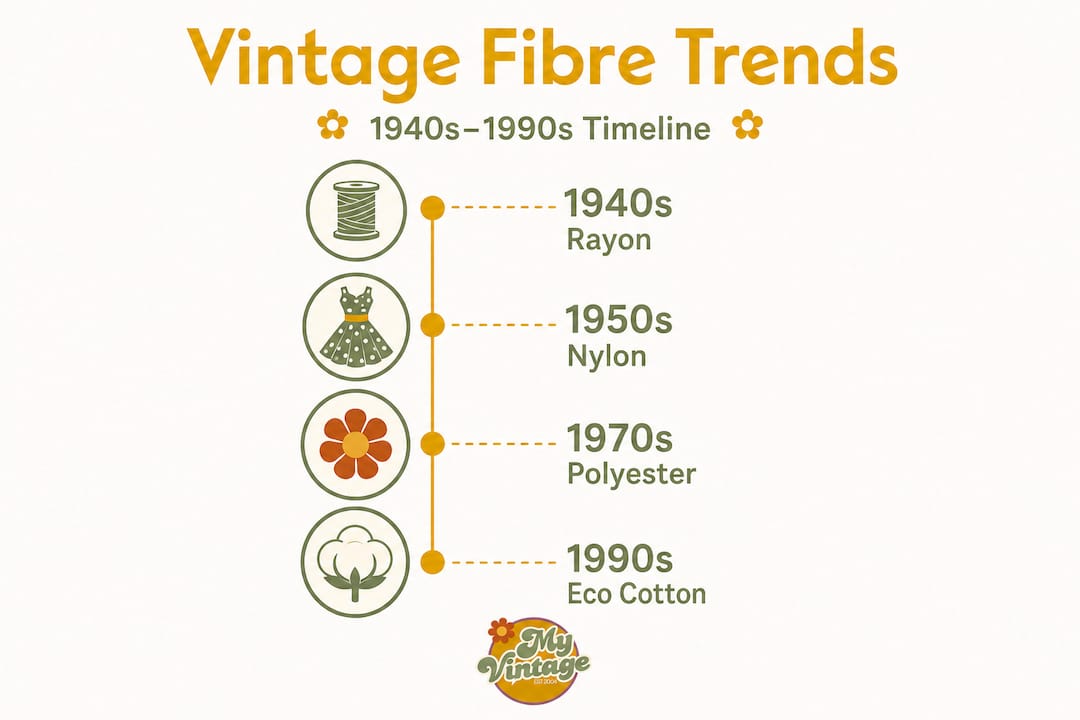
Lyocell and Tencel arrived in the 1990s as sustainable alternatives to traditional rayon, particularly used in sportswear and casual garments. Produced from wood pulp in a closed-loop process that recycled its own solvents, lyocell offered a genuinely reduced environmental footprint compared with conventional viscose rayon. Finding a 1990s garment labelled Tencel is a genuine discovery for collectors who care about both authenticity and sustainability.
Other less commonly discussed fibres worth knowing about include:
Modal, a type of rayon made from beechwood, which appeared in underwear and loungewear from the late 1980s onwards. It has a silky softness and drapes beautifully.
Microfibre polyester, introduced in the late 1980s, which created an ultra-fine, lightweight fabric used in activewear and lightweight blousons.
Cupro, a regenerated cellulose fibre derived from cotton waste, used as a high-quality lining material. Finding cupro in a vintage lining indicates a quality garment from a manufacturer who invested in premium materials.
These unusual fibres matter because knowledge of them helps collectors date pieces more accurately and make informed decisions about wearability, care, and sustainability. The sustainable vintage fabrics that emerged in the late vintage era are a fascinating bridge between the fashion history we cherish and the environmental values many of us hold today.
What most vintage collectors miss about fabric authenticity

Here is the honest truth that most guides will not tell you: the obsession with natural fibres in vintage collecting is, in many cases, a relatively modern and somewhat romanticised idea. It did not reflect reality for most people buying and wearing clothes in the 1950s, 1960s, or 1970s. Those consumers were often excited about synthetics. A nylon blouse was modern. A Dacron suit was aspirational. To reject those pieces today on the grounds of fibre snobbery is, in a way, to misunderstand the era entirely.
The best collectors we have worked with over the years look beyond fibre content alone. They examine branded fibre names, study the lining, analyse the construction, and think about the cultural context of the piece. A 1970s polyester leisure suit is not inferior to a 1950s cotton day dress. They are both authentic records of their moment in fashion history, and both are worth understanding in full.
As collectors reject valid polyester vintage based on fibre myths, genuinely wonderful pieces go unappreciated and occasionally, underpriced on the market. That is an opportunity for the informed collector. Learning to see the value in era-appropriate synthetics does not lower your standards. It raises your game.
The garment’s full story, expressed through its material, its construction, its label, and its context, matters far more than a simple checklist of natural versus synthetic. When you hold a 1960s Terylene shift dress, you are holding a piece of optimism about modernity, technology, and a future that seemed entirely bright. That story is worth every bit as much as the finest silk.
Discover authentic vintage pieces with unique fabrics
Inspired by the remarkable range of fabrics woven through vintage fashion history? At My Vintage, we have been curating and selling authentic vintage clothing since 2004, and every piece in our collection is described and dated by people who genuinely love this world.
Whether you are searching for a 1950s nylon slip, a 1970s polyester print dress, or a beautifully lined 1940s wool coat, our collections cover the full spectrum of vintage fabric history. We also have gorgeous original 1950s vintage homeware if you want to bring the whole era home. Browse with confidence, knowing that every piece has been thoughtfully selected and honestly described, with fabric and era details you can trust.
Frequently Asked Questions
How can I tell if a vintage garment’s fabric is from its authentic era?
Check for fibre tags carrying branded names like Dacron or Orlon and match the construction and lining style to the decade’s known conventions for the most accurate dating.
Was polyester used in 1940s vintage clothing?
Polyester was commercially introduced in 1941 but appeared in clothing from the 1950s onwards, becoming widespread through the 1960s and 1970s under trade names like Dacron and Terylene.
Are natural fabrics always better for collecting vintage pieces?
Not at all. Some synthetics such as early nylon, Dacron, and Orlon are highly collectable because myths lead collectors to overlook these genuinely era-authentic and often well-preserved pieces.
Why do 1960s and 1970s garments often have polyester linings?
Polyester linings became standard for many garments during these decades as polyester replaced acetate, offering greater durability and easier care for the wearer.
What sustainable fabrics might I find in late 1980s and 1990s vintage?
You may well find lyocell or Tencel, both of which were developed as sustainable rayon alternatives and used in sportswear and casual garments during this forward-thinking period.
Recommended


Comments