


Novelty Handbags: Fashion’s Fun Side
- 4 hours ago
- 5 min read

Handbags may be practical by nature, but fashion has never been particularly good at leaving practical things alone. Over the decades, designers and manufacturers have transformed the humble handbag into dogs, clocks, baskets, boxes, fruit and all manner of wonderfully unexpected objects.
These are novelty handbags: bags where the design itself is part of the fun. Rather than simply complementing an outfit, they demand attention, start conversations and often reveal something about the fashion, technology and popular culture of the era in which they were made.
From whimsical early designs to the fabulous plastics of the 1950s and Space Age experimentation of the 1960s, vintage novelty handbags prove that accessories have always had a playful side.
How Did Novelty Handbags Begin?
The idea of turning a bag into something unexpected is older than many people realise. During the early decades of the 20th century, handbags were already becoming more varied as women's lifestyles changed and the contents they carried evolved.
By the 1920s and 1930s, novelty designs could transform an everyday bag into an amusing object. Surviving examples include bags resembling clocks, while later designs took the form of animals and other recognisable objects. Rather than hiding their eccentricity, these bags made it the whole point.

The trend continued through the 1940s and into the post-war years. Novelty bags might be witty, glamorous or deliberately surreal, offering their owners an easy way to inject personality into an otherwise conventional outfit.
As new materials and manufacturing techniques became available, designers could become increasingly adventurous. By the 1950s, the novelty handbag was ready to have a particularly fabulous moment.
The Fabulous Novelty Bags of the 1950s and 1960s
If there is a golden age for the vintage novelty handbag, the 1950s and 1960s make a very strong case.
One of the most distinctive developments was the rise of the rigid plastic handbag. Acrylic plastics could be moulded, carved and decorated in ways that traditional leather could not, giving designers enormous freedom. Transparent and translucent bags appeared alongside versions filled with glitter or confetti, embellished with rhinestones or formed into striking sculptural shapes.
Lucite is now closely associated with glamorous 1950s handbags, although not every vintage clear plastic bag should automatically be described as Lucite. Genuine period examples were made in a variety of acrylic and other plastic materials.
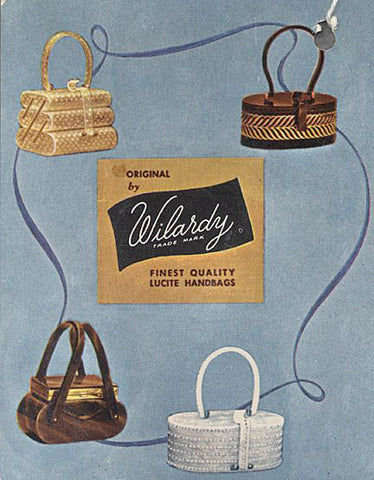
The shapes could be wonderfully extravagant. Hatboxes, drums, beehives and other unusual forms turned the handbag into something closer to a miniature piece of design. Some were expensive statement accessories, while more affordable versions allowed the look to reach a much wider audience.
Wicker and woven handbags provided another opportunity for experimentation. Basket bags could be transformed into animals, unusual containers and playful sculptural shapes. One surviving 1950s example takes the form of a wicker dog, complete with a strap resembling a lead and a head that opens to reveal the bag inside.
Then came the 1960s, when fashion's appetite for new materials and futuristic design became even stronger.
PVC, Perspex and other synthetics fitted perfectly with the youthful, forward-looking mood of the decade. Metallic surfaces, exaggerated handles and geometric shapes helped handbags become part of the bold new language of Mod and Space Age fashion.
A handbag no longer had to be a sensible leather accessory chosen to last for years. It could be colourful, inexpensive, quirky and completely different from anything your mother would have carried.
When Handbags Became Wearable Art
Once designers had demonstrated that a handbag could look like almost anything, there was really no going back.
Later decades continued the joke. Bags have been inspired by telephones, food, animals, household objects, vehicles and countless other unlikely subjects. Designers increasingly played with the boundary between fashion accessory and sculpture.

This is where the term wearable art begins to feel particularly appropriate.
Some novelty bags were deliberately humorous and kitsch. Others used exceptional craftsmanship to turn an eccentric idea into a luxury object. A handbag shaped like a tomato, for example, sounds inherently silly — cover that tomato in thousands of glittering crystals and suddenly it occupies a rather different fashion universe.
That contrast is part of the enduring appeal. Novelty handbags can be cheap and cheerful, beautifully handcrafted, high fashion or gloriously ridiculous. Sometimes they manage to be several of those things at once.
They also offer a fascinating snapshot of their era. The materials, colours and subjects chosen by designers can reflect contemporary technology, popular culture and changing attitudes towards fashion itself.
For collectors today, that makes an unusual vintage handbag much more than a quirky accessory. It can be a tiny piece of design history.
How Can You Identify a Vintage Novelty Handbag?
The more desirable vintage novelty handbags become, the more important it is to distinguish genuinely older pieces from modern retro designs.
Start with the construction. Examine the clasp, hinges, frame, handle attachments, stitching and interior as closely as possible. Older hardware may show appropriate wear and oxidation, although age alone is never proof of authenticity.
Labels and maker's marks can provide valuable clues. Search any names, stamps or patent numbers you find, but don't dismiss an unlabelled bag automatically. Plenty of genuine vintage accessories were produced without famous designer names attached to them.
Materials are particularly important with novelty bags. Vintage plastics can develop scratches, cloudiness, crazing or discolouration, while wicker may become brittle or suffer broken strands. Beaded and embellished bags should be checked for missing decoration, loose threads and previous repairs.
The lining can be revealing too. Look at the fabric, seams, pockets and fastenings rather than concentrating solely on the spectacular exterior.
Most importantly, consider the whole object. Does the construction make sense for the claimed period? Do the materials, hardware and signs of age tell the same story?
And remember: a bag can look wonderfully 1950s without actually having been made in the 1950s. Vintage-style and vintage are not interchangeable.
Collecting Vintage Novelty Handbags

For anyone tempted to start a collection, novelty handbags offer almost endless possibilities.
You could concentrate on a particular era, material or subject: 1950s plastics, wicker animals, unusual box bags or anything shaped like food. Alternatively, you could adopt the considerably less disciplined collecting philosophy of simply buying whichever bag makes you grin first.
Condition matters, but what is acceptable will depend on the bag. A rare and unusual piece may still be desirable with some age-related wear, whereas serious cracks to a rigid plastic body or extensive damage to a woven structure can dramatically affect both appearance and value.
Original components are worth looking for too. Handles, clasps, mirrors and decorative fittings can be difficult to replace sympathetically, particularly when they were made specifically for an unusual design.
Maker, rarity, craftsmanship and provenance can all influence value, but novelty does not automatically mean valuable. An eccentric shape alone does not transform an inexpensive mass-produced bag into a collector's treasure.
Then again, monetary value isn't the only reason to love them.
Vintage novelty handbags capture something particularly joyful about fashion. They remind us that getting dressed has never been purely about practicality or good taste. Sometimes fashion exists simply because somebody looked at an ordinary handbag and thought: yes, but what if it looked like a dog?
And frankly, we're very glad they did.


Comments