


Role of Vintage Shops Today – Impact on Fashion Choices

Shopping at a vintage shop is not just about finding a one-of-a-kind treasure. It is a conscious choice that helps reduce fashion waste, as over 26 million tonnes of textiles end up in European landfills every year. For eco-conscious fashionistas in the United Kingdom, vintage shops offer the thrill of historical discovery alongside a more mindful approach to style and home decor. This guide reveals how authenticity, sustainability, and uniqueness set these retailers apart. What is the role of vintage shops today...
Table of Contents
Role of Vintage Shops Today - Key Takeaways
Point | Details |
Vintage Shops as Cultural Archives | Vintage shops preserve fashion history, offering unique pieces that represent specific eras and craftsmanship. They provide alternative fashion choices outside mainstream retail. |
Focus on Sustainability | Vintage retailers promote the reuse of clothing, encouraging consumers to adopt more sustainable fashion practices and reduce dependence on fast fashion. |
Diverse Shopping Experiences | The UK hosts various types of vintage shops, from high street boutiques to online platforms, each catering to different consumer preferences and shopping experiences. |
Economic Challenges | Traditional vintage shops face competitive pressures from online platforms and must adapt to shifting consumer demands to remain viable in the market. |
Defining Vintage Shops and Their Purpose
Vintage shops represent far more than traditional retail spaces. These specialised outlets serve as curated repositories of fashion history, offering consumers a unique opportunity to explore clothing and accessories from past decades. Unlike mainstream fashion retailers, vintage shops focus on preserving and celebrating distinctive styles from specific historical periods.
The core purpose of vintage shops extends beyond simple clothing sales. Academic research indicates these spaces are crucial in providing alternative fashion choices outside the conventional retail ecosystem. They act as cultural archives, allowing fashion enthusiasts to connect with authentic pieces that represent specific eras, craftsmanship techniques, and design philosophies. These shops carefully curate collections that showcase the evolution of style, offering garments that tell rich stories about social and aesthetic trends.
Moreover, vintage shops play a significant role in sustainable fashion. By promoting the reuse and appreciation of pre-existing clothing, these retailers encourage consumers to move away from fast fashion’s disposable culture. Their collections typically feature high-quality, durable pieces that have already demonstrated remarkable longevity, encouraging a more mindful approach to personal style and wardrobe development.
Pro tip: When exploring vintage shops, focus on understanding the provenance and historical context of pieces rather than just their aesthetic appeal.
Types of Vintage Shops in the UK
The United Kingdom hosts a diverse ecosystem of vintage retail spaces that cater to different consumer preferences and fashion enthusiasts. These vintage shops can be broadly categorised into several distinct types, each offering a unique shopping experience and approach to curating historical fashion pieces.

One prominent category includes high street vintage boutiques, which are carefully curated retail spaces specialising in meticulously selected clothing from specific decades. These shops often focus on premium, collector-quality pieces and provide extensive background information about each garment’s historical context. Alongside these boutiques, charity shops and flea market traders represent another significant segment of the UK’s vintage retail landscape, offering more affordable and eclectic selections that appeal to budget-conscious shoppers seeking unique finds.
The contemporary vintage market also encompasses online platforms and hybrid retail models that blend physical and digital shopping experiences. These innovative retailers leverage technology to provide comprehensive vintage shopping opportunities, allowing consumers to browse extensive collections, verify authenticity, and purchase rare pieces from the comfort of their homes. Some specialist vintage shops even focus on particular eras or fashion subcultures, creating niche marketplaces for dedicated collectors and fashion historians.
Pro tip: Research the specialisation of different vintage shops before visiting, as each tends to focus on unique historical periods or specific fashion styles.
Here is a comparison of distinct types of vintage shops found across the UK:
Shop Type | Core Focus | Typical Price Range | Shopping Experience |
High Street Boutique | Era-specific premium pieces | Higher | Curated, informative, premium |
Charity Shop/Flea Trader | Mixed eras, eclectic finds | Lower | Affordable, diverse, casual |
Online Platform | Wide range, global selection | Variable | Convenient, extensive, remote |
Specialist Niche Shop | Specific eras/subcultures | Moderate to high | Expert-led, targeted, unique |
Key Features: Authenticity, Sustainability, Uniqueness
Vintage shops distinguish themselves through three fundamental characteristics that set them apart from mainstream retail: authenticity, sustainability, and uniqueness. These features represent more than mere marketing strategies—they embody a profound approach to fashion consumption that challenges contemporary retail paradigms.
The concept of authenticity lies at the heart of vintage retail, with shops meticulously sourcing genuine historical pieces that tell compelling stories. Specialist retailers leverage owner expertise and carefully curated environments to communicate the historical significance of each garment. This commitment to authenticity means each piece undergoes rigorous verification, ensuring customers receive genuinely historic items with provable origins and historical context.
Sustainability emerges as another critical feature, with vintage shops positioned as ethical alternatives to fast fashion. By promoting clothing reuse, repair, and long-term preservation, these retailers encourage consumers to move beyond disposable fashion cycles. The environmental impact is significant: each vintage piece represents a form of textile recycling that reduces waste, conserves resources, and challenges the linear consumption model prevalent in contemporary fashion industries. Moreover, the unique aesthetic of vintage clothing allows individuals to express personal style while making environmentally conscious choices.
Pro tip: Always ask vintage shop owners about a garment’s provenance and original era to understand its true historical and cultural significance.
This summary outlines the key business impacts of authenticity, sustainability, and uniqueness in vintage shops:
Key Feature | Consumer Benefit | Business Impact |
Authenticity | Assured provenance, cultural value | Builds trust, brands expertise |
Sustainability | Reduces fashion waste, ethical | Enhances reputation, loyal base |
Uniqueness | Distinct personal style, rarity | Differentiates from competitors |
Vintage Shops’ Cultural and Social Influence
Vintage shops transcend traditional retail spaces, emerging as powerful cultural institutions that shape societal narratives and personal identity. These unique retail environments serve as more than mere commercial spaces, functioning as dynamic platforms for cultural expression, historical preservation, and social connection.
The social influence of vintage shops extends deeply into community dynamics, particularly among younger generations. UK vintage fashion has become a significant vehicle for multicultural expression and intergenerational style transmission, reflecting broader social changes and individual creativity. These shops provide spaces where personal narratives intersect with historical fashion, allowing individuals to construct identities that blend nostalgia, individual expression, and cultural heritage.
Moreover, vintage shops act as critical repositories of cultural memory, preserving and recontextualising fashion as a living, evolving form of social communication. By presenting clothing not just as commodities but as artefacts with rich historical significance, these spaces encourage consumers to engage more critically with fashion’s social and aesthetic dimensions. They challenge mainstream retail’s disposable culture, promoting a more thoughtful, sustainable approach to personal style that values craftsmanship, individual expression, and historical continuity.
Pro tip: Explore vintage shops as cultural museums, paying attention to the stories behind each piece and how they reflect broader social narratives.
Economic Challenges in Today’s Market
Vintage retail shops face increasingly complex economic challenges that threaten their traditional business models, navigating a landscape of rapid digital transformation and shifting consumer preferences. The emergence of online resale platforms has fundamentally disrupted the vintage retail ecosystem, creating unprecedented competitive pressures for small, independent retailers who historically relied on physical storefront experiences.
The economic pressures manifest through multiple interconnected challenges. Rising operational costs, reduced foot traffic, and the growing sophistication of digital marketplaces have compressed profit margins for traditional vintage shops. Many small retailers find themselves struggling to balance their commitment to sustainability and ethical consumption with the financial realities of maintaining a viable business. The need to invest in digital infrastructure, online marketing, and e-commerce capabilities has become increasingly critical for survival.
Moreover, the volatility of consumer demand presents another significant economic hurdle. Vintage shops must continually adapt their sourcing strategies, pricing models, and inventory management to remain competitive. The unpredictability of secondhand fashion trends, combined with changing generational preferences, requires exceptional agility and strategic foresight. Successful vintage retailers are those who can effectively blend traditional curatorship with modern business technologies, creating hybrid models that appeal to both nostalgic collectors and digitally savvy younger consumers.
Pro tip: Diversify your revenue streams by combining physical retail, online platforms, and specialist consultation services to mitigate economic uncertainties.
Comparing Vintage Shops with Online Resale
Consumer preferences are dramatically reshaping the vintage fashion marketplace, creating nuanced distinctions between traditional brick-and-mortar vintage shops and emerging online resale platforms. While both channels serve the secondhand fashion ecosystem, they offer fundamentally different consumer experiences and value propositions.
Traditional vintage shops excel in creating immersive, curated experiences that online platforms cannot easily replicate. These physical spaces provide tactile interactions, expert curation, and immediate authentication that digital marketplaces struggle to match. Online resale channels, by contrast, are rapidly transforming fashion purchasing through unprecedented convenience and broader product accessibility, enabling consumers to browse extensive inventories from multiple sellers without geographical limitations.
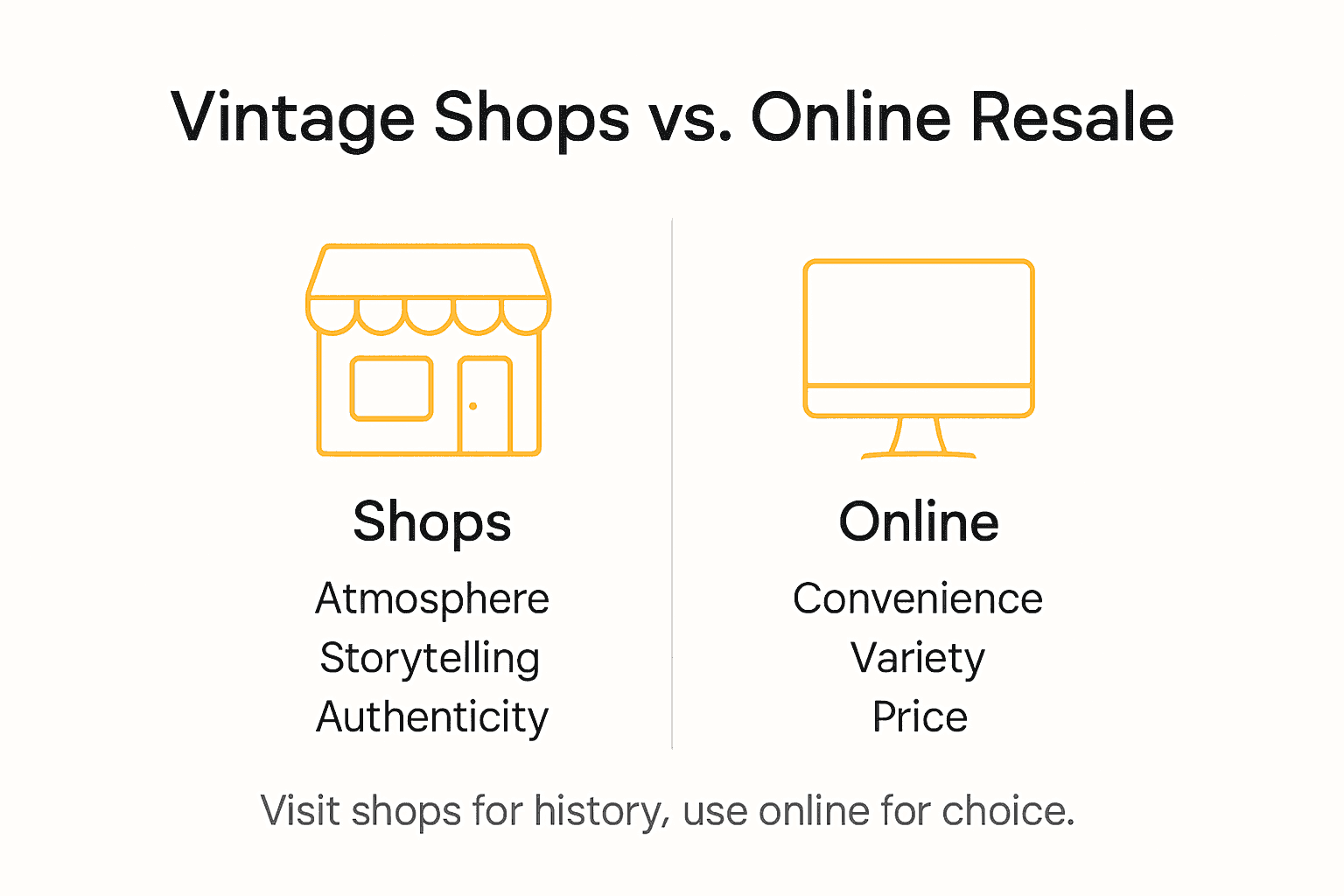
The primary differentiators between vintage shops and online resale platforms lie in their approach to storytelling, authenticity, and consumer engagement. Physical vintage shops emphasise historical context, craftsmanship, and personal narrative, whereas online platforms prioritise transactional efficiency, price competitiveness, and algorithmic recommendation systems. This fundamental distinction reflects broader shifts in consumer behaviour, where younger generations increasingly value both digital convenience and authentic, meaningful purchasing experiences.
Pro tip: Consider using online platforms for initial research and price comparison, but visit physical vintage shops for truly unique, historically significant pieces.
Discover Authentic Vintage Style That Makes a Difference
Vintage shops highlight the importance of authenticity, sustainability, and uniqueness for fashion choices today. If you are seeking timeless pieces with rich histories that reflect your personal style and values, it can be challenging to find reliable sources that balance quality and ethical practices. Many shoppers face uncertainty about provenance and struggle to navigate the blend of physical and digital vintage shopping options.
My Vintage offers a trusted solution as a carefully curated online emporium specialising in authentic vintage clothing and retro homeware from the 1940s to the 1990s. Our platform brings you distinctive, high-quality fashion that supports sustainable consumption while connecting you to the cultural stories behind each piece.
Experience the convenience of exploring a wide selection of vintage apparel and accessories in one place tailored for fashion-conscious and eco-minded consumers.

Explore our unique collections now and embrace a style choice that honours history and sustainability. Visit My Vintage today and start your journey towards a thoughtfully curated vintage wardrobe. Don’t miss the chance to express yourself with timeless authenticity and make a positive impact on fashion’s future.
Frequently Asked Questions
What defines the authenticity of vintage clothing?
Authenticity in vintage clothing is determined by rigorous sourcing and verification processes that ensure each piece is a genuine artefact from a specific era, complete with its historical context and craftsmanship.
How do vintage shops contribute to sustainable fashion?
Vintage shops support sustainable fashion by promoting the reuse and appreciation of pre-existing clothing, reducing waste, and encouraging consumers to choose quality garments over disposable fast fashion items.
What are the key differences between traditional vintage shops and online resale platforms?
Traditional vintage shops offer an immersive, curated experience focused on storytelling and authenticity, while online resale platforms provide convenience and broader access to a wide range of products with a more transactional approach.
How can I appreciate the uniqueness of vintage pieces when shopping?
To appreciate the uniqueness of vintage pieces, focus on understanding their provenance and the historical significance of each item, as well as how they reflect individual style and cultural narratives.
Recommended


Comments