


Space Age Fashion: The 60s Movement that Changed Fashion
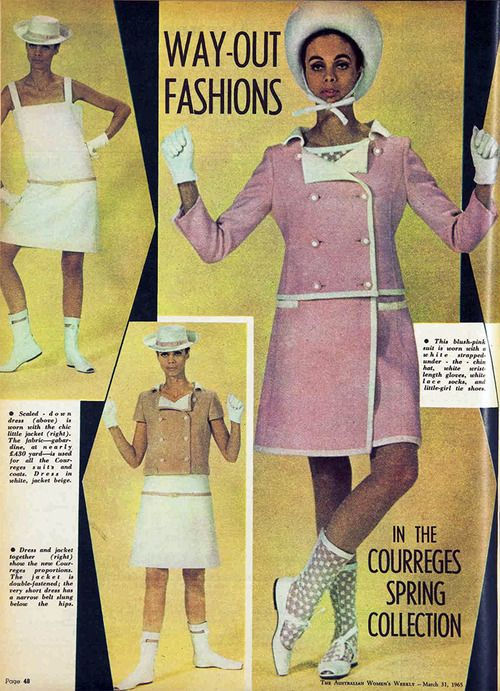
Space age fashion is the design movement that translated the Space Race directly into clothing, producing metallic fabrics, geometric silhouettes, and a new vocabulary of synthetic materials that broke decisively with 1950s tailoring. Rooted in the early-to-mid 1960s, it was shaped by four designers above all others: André Courrèges, Paco Rabanne, Pierre Cardin and Mary Quant. The Victoria and Albert Museum holds key examples and remains the principal UK reference point for researchers. At My Vintage, we work with these pieces regularly, and the authentication questions they raise are genuinely fascinating.
Its signature traits are worth scanning quickly before we go deeper:
Geometric silhouettes: A-line shifts, drop-waist miniskirts and peg-leg trousers with clean, mathematical lines
Metallic and white palettes: silver, chrome and stark white dominating, with occasional bold primaries
Synthetic and industrial materials: PVC, vinyl, aluminium, plastic discs and chain mail
Mobility and youth: shorter hemlines, trouser suits and unstructured cuts designed for movement
Futurist accessories: go-go boots, opaque visor sunglasses and helmet-style headwear
The rest of this guide covers the historical origins, key designers, materials, iconic works, lasting legacy and, crucially, where you can see originals in the UK and how to assess authenticity when you encounter a candidate piece.
How did space age fashion begin?
The answer is almost embarrassingly direct: rockets went up, and hemlines went with them. When the Soviet Union launched Sputnik in 1957 and NASA followed with its own programme, public imagination became saturated with images of gleaming capsules, white jumpsuits and the promise of a technological future. By the early 1960s that imagery had migrated from newspaper front pages into the couture salons of Paris and the boutiques of Carnaby Street.
The political framing mattered too. Fashion historians link the era’s modernising rhetoric directly to the aesthetic choices designers made, and the phrase “white heat of technology” captures that mood precisely. Harold Wilson used it in 1963 to describe Britain’s relationship with industrial progress, but it could just as easily have been a Courrèges press release. Designers were not simply responding to a trend; they were visualising a national and international commitment to futurity.
Youth culture accelerated everything. The postwar generation had money, confidence and no interest in their mothers’ corseted silhouettes. The Women’s Movement was gathering pace, and with it came a demand for clothes that allowed genuine physical freedom. Short hemlines and trouser suits were not just aesthetic choices; they were statements about how women intended to move through the world. The BBC’s cultural analysis of Mary Quant places her squarely at the intersection of these forces, democratising modernist style for younger consumers who could not afford Paris couture.
The designers who defined the movement
Four names appear in virtually every curatorial account of this era, and each brought a distinct sensibility to the shared project of dressing the future.
André Courrèges
Courrèges trained as a civil engineer before working under Balenciaga, and that background shows in every seam. His 1964 “Moon Girl” collection introduced helmets, opaque white sunglasses and the white go-go boot as a coherent visual system. The silhouettes were mathematically precise: angular mini-dresses and trouser suits cut with a rigour that owed more to architecture than to traditional couture. His 1964 collection defined the era’s stark, streamlined look and influenced virtually every designer who followed. The V&A holds examples of his work, and the construction quality repays close study.
Paco Rabanne
Where Courrèges worked in white and geometry, Rabanne worked in metal. His 1966 collection, officially titled 12 Unwearable Dresses in Contemporary Materials, used aluminium discs, chain mail and plastic linked together with metal rings. The Met Museum’s account of this collection describes it as pushing fashion toward wearable sculpture. Rabanne then costumed Jane Fonda for Barbarella in 1968, cementing the collection’s cultural status. These pieces were genuinely difficult to wear, heavy and unyielding, but that was almost the point: they were objects as much as garments.
Pierre Cardin
Cardin’s contribution was partly aesthetic and partly commercial. He embraced helmets, tunics and vinyl with the same enthusiasm as his contemporaries, but he also understood licensing in a way that Courrèges and Rabanne did not. His use of synthetics and large-scale licensing meant that futurist motifs spread from couture salons to high-street shops across Europe and beyond. For researchers, this creates an interesting challenge: Cardin’s name appears on a vast range of pieces, and distinguishing couture from licensed ready-to-wear requires careful attention to construction and labelling.
Mary Quant
Quant’s role was democratisation. Working from her Chelsea boutique Bazaar and later through mass-market channels, she brought jersey, plastics and short hemlines to consumers who had never set foot in a Paris atelier. Her use of accessible materials and her instinct for what young women actually wanted to wear made modernist style genuinely available. She is sometimes treated as a secondary figure in academic accounts that focus on Paris couture, but her cultural impact in Britain was arguably greater than any of the French designers.
Designer summary
Designer | Hallmark collection | Signature materials | Where to view examples |
André Courrèges | Moon Girl, 1964 | White PVC, opaque vinyl, go-go boots | V&A, London; Met Museum, New York |
Paco Rabanne | 12 Unwearable Dresses, 1966 | Aluminium, chain mail, plastic discs | Met Museum; Musée des Arts Décoratifs, Paris |
Pierre Cardin | Cosmos collection | Vinyl, synthetics, structured tunics | V&A; Cardin archive, Paris |
Mary Quant | Ginger Group range, 1963 onwards | Jersey, PVC, plastics | V&A; Fashion Museum, Bath |
What materials and techniques defined the look?
The materials list reads like an industrial catalogue, and that was entirely deliberate. Designers wanted to signal a break with natural fibres and traditional craft, and the V&A’s notes on 1960s fashion confirm that synthetic and industrial materials were central to the movement’s identity.
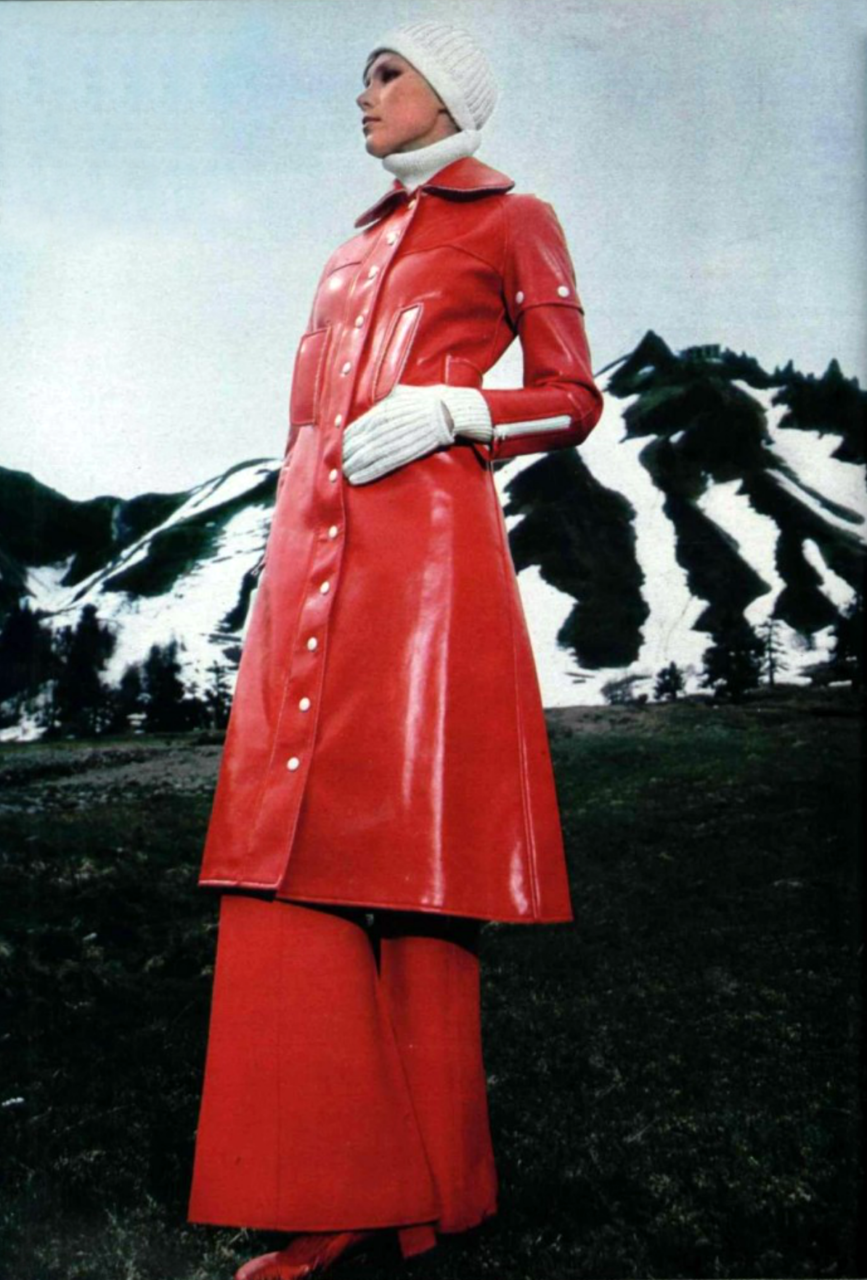
Core materials included:
Rigid PVC and vinyl: used for shift dresses, coats and accessories; visually glossy and impermeable, but stiff and non-breathable
Aluminium and metal discs: linked by rings or chain mail to create flexible metallic surfaces; heavy in wear
Plastic discs and rods: lighter than metal, used for similar linking effects; prone to brittleness with age
Velcro fastenings: adopted partly because NASA used the same material, giving garments a technological credibility; a useful dating cue for researchers
Jersey and bonded fabrics: used particularly by Quant for wearable everyday pieces; more forgiving than rigid synthetics
White and silver coatings: applied to boots, helmets and accessories to complete the lunar aesthetic
Construction methods were equally distinctive. Rabanne’s chain-mail technique involved linking individual discs or rods by hand, producing garments that were essentially assembled rather than sewn. Rigid PVC shifts were often bonded rather than stitched, with minimal seam allowances. Many pieces used no lining at all, since the synthetic outer fabric was itself the structure.
Pro Tip: When examining a candidate Space Age garment, check the fastenings first. Velcro closures, large plastic press-studs and metal ring fastenings are period-consistent cues. A conventional zip with a woven label citing a Paris or London address narrows the date range considerably.
The V&A’s materials notes are candid about wearability: many of these pieces were uncomfortable, non-breathable and effectively exhibition objects from the moment they were made. That context is worth holding onto when you encounter a piece in apparently unworn condition.
The collections and cultural moments that made history
A handful of works crystallised the movement so completely that they remain the primary references in curatorial writing and academic research.
Courrèges’ 1964 Moon Girl collection was the opening statement. The helmets, white boots and angular mini-dresses appeared at a moment when the public was primed to receive them, and the press response was immediate. Fashion photography amplified the effect: Richard Avedon’s astronaut-helmet photograph of Jean Shrimpton for Harper’s Bazaar is one of the defining images of the decade, and William Klein’s 1966 film Qui êtes-vous Polly Maggoo? used the aesthetic as both subject and satire. These images are primary sources, not just illustrations, and researchers should treat them accordingly.
Rabanne’s 1966 collection arrived two years later and pushed the logic further. If Courrèges had made clothes that looked like they belonged on the moon, Rabanne made clothes that looked like they had been assembled in a spacecraft. The Barbarella commission in 1968 gave the collection a second life in popular culture: Jane Fonda’s costumes, designed by Rabanne, reached an audience that had never attended a Paris runway show. For researchers, the film is a useful cross-reference when verifying silhouettes and material finishes.

When consulting archives, prioritise original magazine plates from Harper’s Bazaar, Vogue and Elle from 1964 to 1968. These are the period documents curators use to verify provenance, and the British Vogue archive at Condé Nast is accessible to researchers by appointment.
How does the space age aesthetic live on today?
Academic reviews confirm that the movement is cyclical: designers return to space-age tropes whenever cultural attention turns toward futurity or technological spectacle. The pattern has repeated several times since the 1960s, and it shows no sign of stopping.
Contemporary revivals tend to borrow selectively from the original vocabulary:
Silver and metallic surfaces: appearing in ready-to-wear and accessories whenever a collection wants to signal modernity
Helmet silhouettes: revisited in millinery and headwear, most visibly in Chanel’s rocket-themed runway staging, which placed models in a full-scale spacecraft set
Vinyl and PVC: recurring in both high fashion and high-street collections, particularly in outerwear
Geometric minimalism: the clean A-line and shift silhouette reappears regularly as a counterpoint to maximalist trends
Visor sunglasses and opaque lenses: a shorthand for futurist styling that never entirely disappears
The ScienceDirect review of space exploration’s influence on fashion identifies specific runway homages and notes that the revivals tend to cluster around moments of renewed public interest in space exploration. The current period, with commercial spaceflight generating significant press coverage, has produced another wave of space-inspired apparel in both high fashion and street style. For comparative analysis, recent collections from Balenciaga and Iris van Herpen offer the most direct contemporary parallels to the 1960s originals.
If you are looking for a wearable piece that captures the spirit of the era, a vintage garden mini dress in a period-consistent silhouette is a good starting point for understanding how the proportions actually feel in wear.

Where can you see and study originals in the UK?
The V&A is the natural first stop. Its costume and fashion collection includes pieces by Courrèges, Cardin and Quant, and the online catalogue is searchable by designer, date and material. Not everything is on permanent display, but study room access is available by appointment through the Clothworkers’ Centre at Blythe House.
Institution | Holdings relevant to Space Age fashion | Access |
Victoria and Albert Museum, London | Courrèges, Cardin, Quant; accessories and footwear | Online catalogue; study room by appointment |
Fashion Museum, Bath | British ready-to-wear including Quant; 1960s accessories | Online catalogue; gallery displays |
Museum of London | London street fashion and retail history, 1960s | Online collections; gallery access |
British Vogue Archive (Condé Nast) | Original editorial photography and magazine plates, 1964–1968 | Researcher access by appointment |
Royal College of Art Research Archive | Academic papers on fear, fashion and Cold War culture | Online via RCA Research Online |
When searching museum catalogues, use the fields “designer,” “date made” and “materials” in combination. Searching “PVC 1960s” or “Courrèges 1964” in the V&A’s online system returns usable results. For photographic sources, the Getty Images archive and the National Portrait Gallery’s online collection both hold period editorial images that can be used for silhouette verification.
How to identify and care for authentic 1960s Space Age pieces
Authenticating a candidate garment is a sequential process, and starting with materials saves time. Here is the checklist we use at My Vintage:
Assess the material first. Rigid or semi-rigid PVC, vinyl, aluminium linking, plastic discs or bonded synthetic fabrics are all period-consistent. Natural fibres alone suggest the piece is not Space Age, though some Quant pieces used jersey.
Examine stitching and fastenings. Velcro closures, large plastic press-studs and metal ring fastenings are strong period indicators. Machine stitching should be even but not computerised-precise; hand-linking of metal discs is a Rabanne signature.
Check labels carefully. Paris couture labels from this period follow specific formats: the designer’s name, the address and a numbered couture tag. London labels should cite the retailer or designer with a British address. Reproductions often get the font or layout wrong.
Compare against primary visual sources. Period magazine plates, film stills and original runway photographs are the most reliable comparators when a label is absent. Curators routinely cross-check period magazine plates for provenance verification.
Consult an expert or museum. For high-value pieces, a curatorial opinion from the V&A or a specialist dealer is worth seeking before purchase.
Conservation is where many collectors go wrong. Early PVC and coated fabrics suffer plasticiser migration, producing sticky or discoloured surfaces that are very difficult to reverse. Metal elements can corrode or leave marks on adjacent fabrics.
Pro Tip: Store PVC and vinyl pieces flat, wrapped in acid-free tissue, in a climate-controlled environment away from direct light and heat. Never use standard plastic bags, which accelerate plasticiser loss. Metal-linked pieces should be stored separately to prevent scratching and corrosion transfer.
My Vintage’s sourcing process involves exactly these checks. When we acquire 1960s pieces, we assess materials, fastenings, labels and provenance before listing, and we are always happy to discuss authentication questions with researchers and collectors directly.
Useful sources
The V&A and the Met Museum are the strongest starting points for any serious research into this movement. Both hold primary objects and publish curatorial essays that are far more reliable than general fashion histories.
V&A: An introduction to 1960s fashion — the museum’s own overview, covering silhouettes, materials and key designers; freely accessible online, with links to catalogue records for specific objects.
Met Museum: Paco Rabanne and contemporary materials — curatorial account of the 1966 collection and its material innovations; includes catalogue photography useful for comparison.
Encyclopedia.com: Space Age styles — covers Courrèges’ 1964 collection and the role of media imagery in disseminating the aesthetic; useful for visual culture research.
BBC Culture: Mary Quant and 1960s fashion — accessible account of Quant’s democratising role and her use of plastics and jersey; good secondary source for the British retail context.
The Guardian: cultural and political framing — fashion historians on the political dimension of the movement and the “white heat of technology” context.
Nature / conservation article on early plastics degradation — archival conservation guidance on PVC and coated fabrics; essential reading before handling or storing period synthetics.
RCA Research Online: Fear and fashion — academic paper on Cold War culture and its influence on fashion design; freely downloadable and well-cited in curatorial literature.
ScienceDirect: space exploration and fashion — peer-reviewed reviews of the movement’s cyclical revivals and contemporary homages; useful for comparative analysis of modern references.
For archive access in the UK, contact the V&A’s Clothworkers’ Centre directly for study room appointments, and approach the British Vogue Archive at Condé Nast by email for researcher access to original magazine plates. Image permissions for publication require separate licensing agreements with each institution.
My Vintage’s own blog covers 1960s vintage clothing in detail, and our product archive includes authenticated pieces that illustrate the period’s silhouettes and materials at first hand. If you are researching a specific garment or need sourcing guidance, we are genuinely glad to help.
Authentic 1960s pieces, sourced and verified by My Vintage
My Vintage has been sourcing and authenticating vintage clothing since 2004, and the 1960s is one of our most-loved decades. For researchers and collectors who want to handle real examples rather than catalogue photographs, our 1960s vintage collection offers authenticated pieces with full provenance notes, covering everything from Mod shift dresses to space-inspired accessories. We also supply costume pieces to television, film and theatre productions, so our authentication process is rigorous by necessity.
If you are building a research collection or simply want to own a piece of this extraordinary moment in design history, browse our 1960s party outfits and Space Age style guide for styling context, or head straight to our vintage clothing shop to see what is currently available. Every piece we list has been assessed for materials, construction and provenance, and we are always happy to answer questions from researchers and enthusiasts alike.
Recommended


Comments