


Step by Step Vintage Shopping Guide 2026

Vintage shopping is the practice of sourcing clothing and home decor that is at least 20 years old, selected for its quality, character, and authenticity. A step by step vintage shopping guide matters because the market is flooded with reproductions, vintage-inspired replicas, and poorly stored pieces that look the part but fall short on quality. The Vintage Fashion Guild defines true vintage as items produced in a specific era with construction and materials consistent with that period. My Vintage, founded in 2004, has spent over two decades curating exactly these kinds of pieces, and the approach we share here reflects that experience. Follow this process and you will shop with confidence, avoid costly mistakes, and build a collection worth keeping.
What do you need before starting your vintage shopping journey?
Preparation separates a rewarding vintage shopping trip from a frustrating one. Before you step into a shop or open a browser, gather a few physical tools: a soft measuring tape, a magnifying glass for examining labels and stitching, a fabric swatch guide, and your smartphone for quick research. These cost very little but save you from expensive errors.
Understanding how vintage is classified is equally important. An item must be at least 20 years old to qualify as genuinely vintage. Fabric science provides a reliable timeline for dating vintage clothing, making it a skill every serious shopper needs. For example, polyester did not enter mainstream fashion until the late 1960s, so a garment containing polyester cannot be from the 1950s, regardless of what the seller claims.
Label knowledge is your next foundation. Union tags, care labels, and hardware types all serve as forensic dating markers. Care labels were not legally required in the United States until 1971, so a garment without one is likely pre-1971. Metal zippers were standard pre-1970s, and union tags indicate pre-1995 American manufacture. Learning these markers takes an afternoon and pays dividends for years.
Setting a realistic budget before you shop is the final preparation step. Factor in not just the purchase price but also the cost of tailoring or restoration. When buying vintage jewellery, budgeting for styling and alterations is just as relevant as the item price itself.

Tool or knowledge area | Why it matters |
Measuring tape | Compares flat garment measurements to your own body |
Magnifying glass | Reveals label text, stitching quality, and hardware detail |
Fabric swatch guide | Helps identify fabric type and era |
Label and union tag knowledge | Confirms manufacture date and authenticity |
Tailoring budget | Accounts for fit adjustments on non-standard vintage sizing |
Pro Tip: Before any shopping trip, measure a garment you already own that fits you perfectly. Write down the chest, waist, hip, and sleeve measurements. Use these as your personal sizing benchmark when evaluating vintage pieces.
How to find vintage clothing in physical stores and markets
Shopping in person gives you the advantage of touch, smell, and immediate inspection. The process works best when you approach it methodically rather than browsing at random.
Allocate your time properly. Spend about 90 minutes per thrift store visit to filter through racks effectively. Rushing leads to missed gems; lingering too long leads to decision fatigue.
Prioritise estate sales. Estate sales provide access to well-preserved vintage wardrobes spanning 30 to 50 years, with prices typically ranging from £5 to £20 per item. EstateSales.net is a useful resource for locating sales locally, and similar directories exist for the UK market.
Work the rails systematically. Start at one end and move steadily. Pull anything that catches your eye and evaluate it away from the rail, in good light.
Check the label first. Before examining the rest of the garment, read the label. This tells you the era, fabric content, and country of manufacture in seconds.
Inspect construction. Turn the garment inside out. Quality vintage pieces show French seams, hand-stitched hems, and tightly woven fabric. Fast fashion replicas show raw edges and loose threads.
Apply the nose test. The ‘nose test’ detects mildew and improper storage that is invisible to the eye. Persistent mildew indicates fibre damage that no amount of washing will fully reverse. If a piece smells musty, walk away.

When it comes to sizing, vintage labels are not reliable guides to fit. Vintage sizes differ widely from modern standards, so always compare the flat measurements of the garment against your personal benchmark rather than trusting the label number.
Check for moth holes along seams and under arms, where fabric is thinnest.
Look at buttons closely. Bakelite and glass buttons indicate pre-1960s pieces.
Feel the weight of the fabric. Genuine vintage wool and silk have a density that modern reproductions rarely match.
Examine zips. A metal zip with “Talon” or “Conmar” branding points to American manufacture from the 1940s to 1960s.
Pro Tip: Visit thrift stores mid-week rather than at weekends. Stock is restocked throughout the week, and weekend crowds pick over the best pieces quickly. Tuesday and Wednesday mornings are often the quietest and most rewarding times.
How to shop for vintage clothing and home decor online
Online vintage shopping rewards specificity. Generic search terms return thousands of irrelevant results. Using specific search terms like “70s silk blouse” rather than “vintage top” cuts through the noise immediately and helps you verify market prices using completed listings filters.
Filter by decade, fabric, and style. Platforms like My Vintage, Etsy and eBay allow you to filter by era and size. Use these filters from the start rather than scrolling through pages of mixed results.
Read condition notes carefully. Sellers use terms like “excellent vintage condition,” “good condition with flaws,” and “as-is.” Excellent means minimal wear. “As-is” means the seller is not responsible for undisclosed faults. Ask for additional photos if the listing does not show the label, lining, or any mentioned flaws.
Check seller reputation. Look at feedback scores, response times, and whether the seller specialises in vintage. A seller with hundreds of positive reviews for vintage clothing is a safer choice than a general reseller with mixed stock.
Budget for tailoring. Online vintage pieces generally cost more than thrift store finds, with tailoring often adding a further cost on top. Factor this into your total spend before committing.
Use reverse image search. Upload a listing photo to Google Images or TinEye to check whether the same image appears on multiple listings or on a manufacturer’s website. This is one of the fastest ways to spot a reproduction being sold as genuine vintage.
Interpret photos actively. Ask yourself whether the seller has photographed the label, the lining, and any wear. A listing with only styled shots and no detail photos is a red flag.
For buying vintage online with confidence, always request the flat measurements of the garment rather than relying on the stated size. A 1970s size 14 is not the same as a modern size 14. Knowing your own measurements and comparing them directly to the garment removes the guesswork entirely.
Pro Tip: Save completed eBay listings for items you are interested in. This shows you what pieces actually sold for, not just what sellers are asking. It is the most accurate way to calibrate your budget for any specific era or garment type.
What to look for when evaluating vintage quality and authenticity
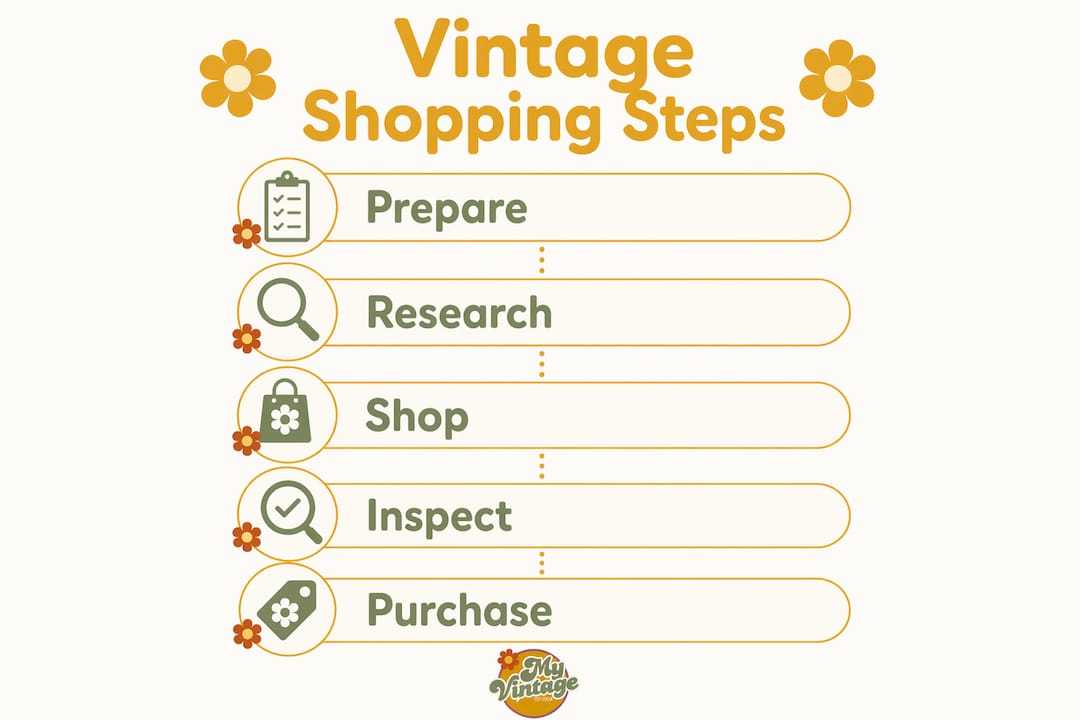
Authenticating a vintage piece is a skill built from several overlapping methods. No single marker tells the whole story, but together they paint a clear picture.
The most reliable forensic dating methods combine label analysis, hardware inspection, and fabric identification. A garment with no care label, a metal zip, and a woven union tag is almost certainly pre-1971 American manufacture. A garment with a polyester content label and a plastic zip cannot be from the 1950s, regardless of its styling.
Labels: Look for the country of origin, fabric content, and any union or guild markings. Pre-1971 garments often have no care instructions at all.
Hardware: Metal zips, hook-and-eye closures, and press studs made from brass or steel indicate older manufacture. Plastic components became standard from the 1970s onwards.
Fabric: Wool crepe, silk charmeuse, and cotton lawn were the dominant fabrics of the 1940s and 1950s. Polyester did not enter mainstream fashion until the late 1960s, so its presence in a supposedly earlier piece is a clear red flag.
Construction: Hand-finished seams, bound buttonholes, and padded shoulders with internal structure all indicate quality vintage tailoring. Machine-overlock seams suggest post-1970s or reproduction manufacture.
Condition red flags to avoid include extensive fading, loose beading, worn elastic, and ripped chiffon. Minor moth holes or faint stains may be acceptable if the piece is genuinely exceptional and the damage is repairable. The key question is always whether the flaw is fixable and whether the cost of repair fits your budget.
Prioritise the feel and personal connection to a garment over brand prestige. A beautifully constructed 1960s shift dress from an unknown label will outlast and outperform a poorly stored designer piece. Focus on fabric density, drape, and the way the garment moves. These qualities are harder to fake than a label.
The Vintage Fashion Guild offers free online resources for verifying label dates and identifying specific garment types by era. Cross-referencing their label resource with what you find on a garment takes minutes and can confirm or rule out authenticity quickly.
Pro Tip: Hold fabric up to natural light. Genuine vintage silk and wool show a depth and sheen that synthetic reproductions cannot replicate. This single test takes seconds and is remarkably reliable.
Marker | What it tells you> |
No care label | Likely pre-1971 manufacture |
Metal zip with brand name | Pre-1970s American or European origin |
Polyester content | Post-late 1960s at the earliest |
Hand-finished seams | Quality tailoring, likely pre-1980s |
Plastic hardware throughout | Post-1970s or reproduction |

Common vintage shopping challenges and how to avoid them
Every vintage shopper encounters obstacles. Knowing them in advance means you handle them calmly rather than making rushed decisions.
Mixed and unsorted racks. Many thrift stores mix eras, sizes, and conditions without organisation. Work methodically from one end of the rail to the other, and never skip a section because it looks unpromising at first glance.
Reproductions and vintage-inspired replicas. These are the biggest risk in online shopping. Apply your label, hardware, and fabric knowledge every time. A reproduction will almost always fail at least one of these checks.
Fit issues. Vintage sizing is inconsistent across decades and countries. Always use flat measurements rather than label sizes, and budget for tailoring from the outset.
Non-returnable purchases. Many vintage sellers, particularly at markets and estate sales, do not accept returns. Inspect thoroughly before buying, and if you are unsure, walk away. There will always be another piece.
Pacing yourself. Vintage shopping is absorbing, and it is easy to spend three hours in one shop and leave exhausted. Set a time limit per venue and stick to it.
Pro Tip: Keep a simple vintage shopping checklist on your phone: label checked, hardware inspected, flat measurements taken, nose test done, condition assessed. Running through it takes under two minutes and prevents the most common buying mistakes.
For a deeper look at identifying authentic pieces before you commit to a purchase, the process becomes second nature with practice.
My Vintage: Curated Vintage Shopping
My Vintage has been sourcing and curating authentic vintage pieces since 2004, and every piece is selected for genuine provenance, condition, and character. My Vintage authenticates every item before listing, so you shop with the confidence that what you see is exactly what you receive. Whether you are building a vintage wardrobe or furnishing a retro-inspired home, the My Vintage collection is a reliable starting point for pieces that are worth owning for decades.
Frequently Asked Questions
What does “vintage” actually mean?
Vintage refers to items that are at least 20 years old and reflect the style and construction of their era. Items less than 20 years old are generally described as retro or vintage-inspired rather than true vintage.
How do I avoid buying a reproduction?
Check the label for care instructions (absent pre-1971), inspect the zip and hardware material, and verify the fabric content against known textile timelines. Polyester before the late 1960s is a reliable sign of a reproduction.
Why do vintage sizes not match modern sizes?
Sizing standards changed significantly across decades and varied by country. A 1950s size 12 is typically smaller than a modern size 12. Always compare flat garment measurements to your own body measurements rather than relying on the label.
Are estate sales better than thrift stores for vintage finds?
Estate sales generally offer better-preserved pieces because wardrobes are sold intact rather than sorted and handled repeatedly. Prices are often higher than thrift stores but still well below retail for comparable quality.
How do I know if a vintage garment is worth repairing?
Assess whether the damage is structurally repairable and whether the repair cost fits your budget. Ripped chiffon and shredded lining are rarely worth the expense. Minor moth holes, faint stains, and loose seams on otherwise exceptional pieces are usually worth addressing.
Key Takeaways
Successful vintage shopping requires preparation, forensic knowledge, and disciplined evaluation at every stage of the process.
Point | Details |
Prepare before you shop | Gather a measuring tape, magnifying glass, and label knowledge before visiting any store or browsing online. |
Use forensic dating methods | Check union tags, care labels, hardware, and fabric content to confirm a garment’s era and authenticity. |
Always measure flat | Compare garment flat measurements to your own body rather than trusting vintage label sizes. |
Apply the nose test | Smell every garment in person; persistent mildew indicates fibre damage that cannot be reversed. |
Budget for tailoring | Factor alteration costs into your total spend, particularly when buying online where fit cannot be assessed in person. |
Recommended


Comments