


The Trouser Suit: From Rebellion to Wardrobe Classic

There are few garments that tell the story of women’s changing relationship with fashion quite as clearly as the trouser suit. What now feels like an ordinary wardrobe option once carried far more weight, because trousers themselves were not always considered acceptable clothing for women outside very specific settings. To wear them could be practical, modern, provocative or quietly rebellious depending on the decade, and when trousers were paired with a matching jacket, the result became something even more powerful: tailoring borrowed from menswear, reshaped for women and gradually transformed into a fashion statement in its own right.
That journey is what makes vintage trouser suits so fascinating. They can be sharply cut or softly fluid, formal or flamboyant, businesslike or glamorous, and each era left its own mark on the silhouette. The neat, experimental suits of the 1960s feel very different from the wide-legged tailoring of the 1970s, just as an oversized 1980s power suit has an entirely different attitude from the pared-back styles of the 1990s. What links them all is the idea that women’s tailoring could be more than an imitation of menswear; it could become its own language.
Before the Trouser Suit Became Mainstream
Women had worn trousers in practical contexts long before the trouser suit became fashionable. They appeared in sportswear, workwear and informal clothing, particularly during periods when practicality took priority over convention. During the Second World War, for example, trousers became far more visible in women’s everyday lives because they made sense for factory work, transport and other jobs that demanded freedom of movement.
Even so, trousers were still not universally accepted as ordinary public dress for women, especially in smarter or more formal settings. That is what made the trouser suit so significant when it began to enter fashion more visibly. It was not simply a new outfit shape; it challenged the assumption that a woman had to wear a skirt or dress to look polished, elegant or appropriately dressed.
By the middle of the twentieth century, fashion was beginning to explore that idea more confidently, and the growing influence of youth culture, modern tailoring and changing social attitudes would push the trouser suit into a much more prominent role.
The 1960s: Tailoring Starts to Break the Rules
The 1960s were a natural moment for the trouser suit to gain ground because fashion itself was becoming more experimental. Younger women were increasingly willing to reject older dress codes, and designers were playing with cleaner lines, sharper shapes and clothing that felt more modern than the highly structured femininity of the previous decade.
Women’s trouser suits during this period often had a neat, streamlined quality. Jackets could be cropped or sharply tailored, while trousers were usually straight or gently flared. Some suits borrowed obvious menswear details such as lapels and structured shoulders, but the overall proportions remained lighter and more fitted than the power suits that would appear later.
The appeal was not purely practical. Wearing a trouser suit could feel sophisticated and slightly daring, particularly for evening wear or smarter occasions where a dress might once have been the expected choice. It offered a different kind of glamour, one based on confidence, line and attitude rather than softness or decoration.
This was also the decade when the idea of women wearing tuxedo-inspired tailoring became increasingly influential. The contrast between traditionally masculine tailoring and a distinctly feminine wearer created a tension that fashion found endlessly interesting, and that idea would continue to evolve through the decades that followed.
The 1970s: The Trouser Suit Finds Its Groove
If the 1960s introduced the trouser suit as something modern and slightly rebellious, the 1970s turned it into a full fashion language. Tailoring became broader, softer and more expressive, and trouser suits could move easily between workwear, evening glamour and the more flamboyant side of the decade.
Wide-leg trousers were particularly important, creating a long, fluid line that worked beautifully with fitted jackets, waistcoats and blouses. Some suits had a relaxed, almost languid feel, especially in softer fabrics, while others embraced the sharper side of 1970s fashion with strong lapels, high waists and bold colour.
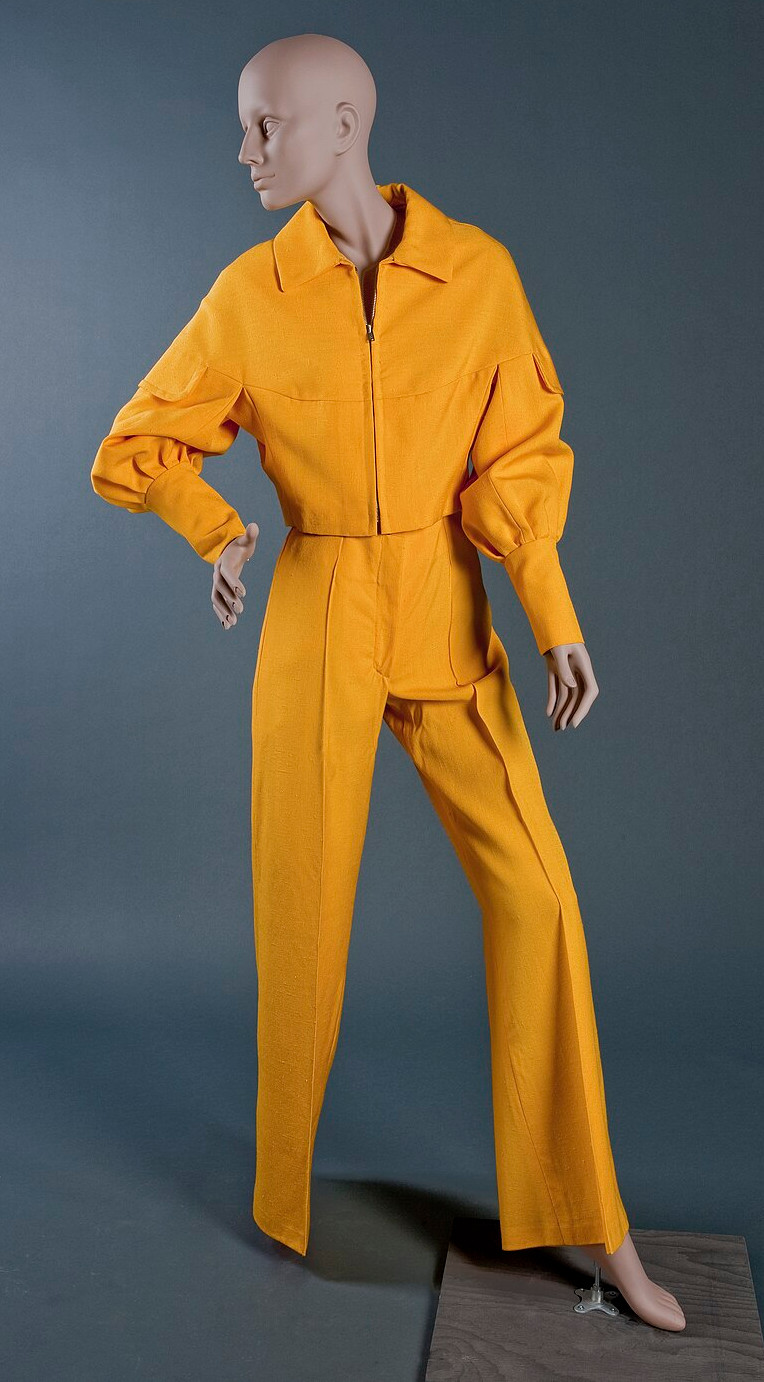
The decade also had fun with three-piece suits. Waistcoats became a fashionable addition, often worn with matching trousers and jackets or used to create a more relaxed layered look. This borrowing from traditional menswear felt less like disguise and more like reinvention, especially when suits appeared in velvet, corduroy, bright checks or richly coloured synthetics.
Evening trouser suits flourished too. Satin, metallic fabrics and dramatic cuts allowed tailoring to move far beyond the office, while plunging necklines and flared trousers gave the silhouette a glamorous confidence that felt entirely at home in the disco era. A trouser suit no longer had to prove it could be feminine; it simply was.

The 1980s: Power Dressing Changes Everything
The 1980s gave the trouser suit one of its most recognisable transformations. As women became increasingly visible in professional and corporate environments, fashion responded with a silhouette that projected authority. Shoulders grew broader, jackets became longer and more structured, and tailoring took on a deliberately powerful presence.
The so-called power suit became one of the defining images of the decade. Strong shoulders, double-breasted fronts, defined waists and matching trousers created a silhouette that was impossible to ignore. Some versions were sober and businesslike, while others embraced colour, pattern and bold accessories with typical 1980s enthusiasm.
There was an interesting contradiction at the heart of the power suit. On one hand, it borrowed heavily from traditional menswear in order to communicate seriousness and authority. On the other, designers often exaggerated the proportions so much that the result became something distinctly its own. The wide shoulders, cinched waist and dramatic scale created a look that was not simply masculine or feminine, but deliberately commanding.
That is one reason original 1980s trouser suits can be so striking now. Even relatively simple examples often have a confidence built into the cut, and when the decade went further with bright colour, oversized buttons or glossy fabrics, the suit became every bit as expressive as an evening dress.
The 1990s: Tailoring Gets Cleaner
After the scale and drama of the 1980s, 1990s tailoring gradually became calmer. Jackets could still be oversized, particularly early in the decade, but the overall mood shifted towards cleaner lines, simpler fabrics and less obvious decoration.
Minimalism had a strong influence, and trouser suits often appeared in black, grey, navy and neutral shades. The silhouette could be long and lean, with straighter trousers and more relaxed jackets creating a pared-back effect that felt very different from the exaggerated structure of the previous decade.
The way women wore suits changed too. Rather than always pairing them with formal blouses, they might be worn over a simple vest, camisole or even a bare neckline for evening. This styling softened the business associations of the suit and made it feel more versatile, allowing the same basic tailoring to move between work, dinner and nightlife.
By this point, the trouser suit had largely lost the shock value it once carried. It no longer needed to justify itself as unusual women’s clothing. Instead, it had become an established part of fashion, which gave designers freedom to experiment with proportion and styling without the garment itself feeling controversial.
Why the Trouser Suit Became So Important
The trouser suit matters in fashion history because it represents much more than a shift in silhouette. It reflects changing expectations around how women could dress, work and present themselves in public, particularly in spaces where authority and formality had traditionally been expressed through menswear.
What makes the story especially interesting is that women did not simply adopt the male suit unchanged. Fashion repeatedly reshaped it, changing the waist, shoulder, trouser width, fabric and styling until the garment developed many different identities of its own. A 1970s velvet suit, an 1980s power suit and a minimalist 1990s two-piece all belong to the same broad category, yet they communicate completely different things.

That ability to adapt is what allowed the trouser suit to become a wardrobe classic rather than a passing trend. It could represent rebellion in one decade, professional confidence in another and understated elegance in the next, without ever losing the essential appeal of a matching tailored set.
The Appeal of Vintage Trouser Suits
Vintage trouser suits are particularly satisfying because the proportions often differ so much from contemporary tailoring. Jacket lengths, lapel widths, trouser rises and shoulder shapes can place a suit very clearly within its era, even before you look at labels or construction details.
Fabrics also tell part of the story. Wool and wool blends create a more traditional tailored feel, while polyester and other synthetics became increasingly common in later decades and allowed for stronger colour and easier-care finishes. Velvet, corduroy and textured fabrics can make 1970s suits feel especially distinctive, while lighter, smoother materials suit the cleaner styles of the 1990s.
Finding a complete vintage suit can be more difficult than finding individual jackets or trousers, simply because the pieces were often separated over time. When the original pair does survive together, it offers a wonderful glimpse of the silhouette exactly as it was intended to be worn.
How to Wear a Vintage Trouser Suit Today
The easiest way to wear one now is to let the tailoring provide the vintage character while keeping everything else relatively simple. A 1970s suit with wide-leg trousers can look beautifully current with a plain knit or camisole, while an 1980s jacket can be softened with a simple top and understated accessories.

There is no rule saying the pieces have to remain together either. A vintage blazer can work with modern jeans, while the matching trousers might be worn with a completely different jacket or blouse. Separating the suit can make more distinctive vintage tailoring feel much easier to incorporate into everyday wardrobes.
Fit is especially important because vintage suit proportions can vary dramatically. Shoulder width, jacket length and trouser rise all affect how the outfit sits, so actual measurements are far more useful than relying on the original size label. A suit that fits well through the shoulders and waist is likely to look far more intentional than one chosen simply because the label appears familiar.
What Should You Look for in a Vintage Trouser Suit?
Condition around the cuffs, trouser hems and waistband deserves particular attention, as these areas tend to show wear first. Linings should also be checked carefully because they can weaken or split even when the outer fabric still looks excellent.
With older tailoring, construction details can be especially interesting. Look at the shape of the lapels, buttons, pockets and shoulder structure, as these often reveal a great deal about the era. Matching belts, waistcoats or original spare buttons are lovely bonuses when they survive, although their absence does not necessarily detract from a strong suit.
As with all vintage clothing, it is worth thinking about how the piece will actually work in your wardrobe. A beautifully cut suit is far more useful when you can imagine wearing the jacket and trousers both together and separately, because that flexibility is exactly what has kept the trouser suit relevant for so long.
From Rule-Breaker to Wardrobe Staple
The trouser suit began its journey carrying far more social weight than most modern wearers would ever need to think about. What once challenged ideas about how women were expected to dress gradually became a symbol of modernity, confidence and eventually everyday style.

Its different incarnations tell the story beautifully. The neat experimentation of the 1960s, the fluid glamour of the 1970s, the commanding power suits of the 1980s and the minimalism of the 1990s all reflect the priorities of their era, yet each remains recognisably part of the same tradition.
That is perhaps the trouser suit’s greatest achievement. It moved from rebellion to wardrobe classic without becoming dull, proving that tailoring could evolve alongside women’s lives rather than simply dictate how they were supposed to look.

Comments