


The Vintage Dressing Table: A Short History

There is something wonderfully personal about a vintage dressing table. Unlike a dining table or sideboard, it was never really intended for an audience. It belonged to that quieter part of the day spent getting ready or getting unready, surrounded by the small possessions that gradually became part of somebody’s routine: a bottle of scent, a hairbrush with a few stubborn strands still caught between the bristles, powder, hairpins, jewellery, perhaps a photograph tucked into the edge of the mirror. Even an empty dressing table seems to invite you to imagine the person who once sat in front of it.
For anyone who loves vintage, that is a large part of its charm. Over the years at My Vintage, we have handled so many of the objects that once populated these little corners of people's bedrooms, from perfume bottles and vanity sets to jewellery boxes, brushes, mirrors and powder pots. Seen individually, they can be beautiful collectables; put them back into the context of a dressing table and they become part of a much bigger story about beauty, privacy, fashion and the changing ritual of getting ready.
Before There Was a Dressing Table
The idea of keeping special possessions for grooming is considerably older than the piece of furniture we now recognise as a dressing table. Cosmetic containers, mirrors, combs and perfume vessels have existed in numerous cultures for thousands of years, and ornate boxes were used to keep these precious objects together long before anyone thought they required a dedicated table. The Metropolitan Museum of Art traces the beginnings of the vanity's story through these early cosmetic boxes and carriers, while dating the development of the recognisable European dressing table to the late seventeenth century.

It was among wealthy households in England and France that specialised furniture began to appear for the business of dressing and grooming. The word toilette, incidentally, had rather more elegant associations than its modern English usage might suggest. It referred to the process of dressing and preparing oneself, and in fashionable society this could become quite an elaborate affair. At the great European courts, dressing was not necessarily the private activity we would expect today. The V&A notes that the elaborate daily toilette of fashionable women encouraged the creation of dressing sets containing mirrors, brushes, pots and vessels, sometimes made in silver.
By the eighteenth century, the dressing table could therefore be both practical furniture and an unmistakable advertisement of wealth. Beautiful woods, marquetry and ingenious mechanisms concealed mirrors and compartments, while drawers accommodated everything from brushes and bottles to personal papers. One French example in the V&A, made by Pierre Migeon around 1760–70, even combines compartments for toilette articles with a pull-out writing desk and ink pots. These tables were private workstations as much as places devoted purely to beauty.
A Private Corner of One's Own
As the dressing table became established in the bedroom, one of its most interesting qualities was the little territory it created around its owner. By the early nineteenth century, furniture makers were deliberately partitioning drawers to accommodate such things as combs, powders, scents and pincushions. It is easy to look at an elaborate antique dressing table now and see only a beautiful piece of furniture, but originally it was designed around the clutter of real life.
That has never really changed. The contents changed enormously, of course, but the dressing table remained somewhere personal possessions could accumulate without needing to be displayed formally elsewhere in the home. Jewellery taken off at night, letters, photographs, hair accessories, cosmetics, keepsakes and all those inexplicable little things that somehow acquire permanent residence in a drawer could happily coexist there.
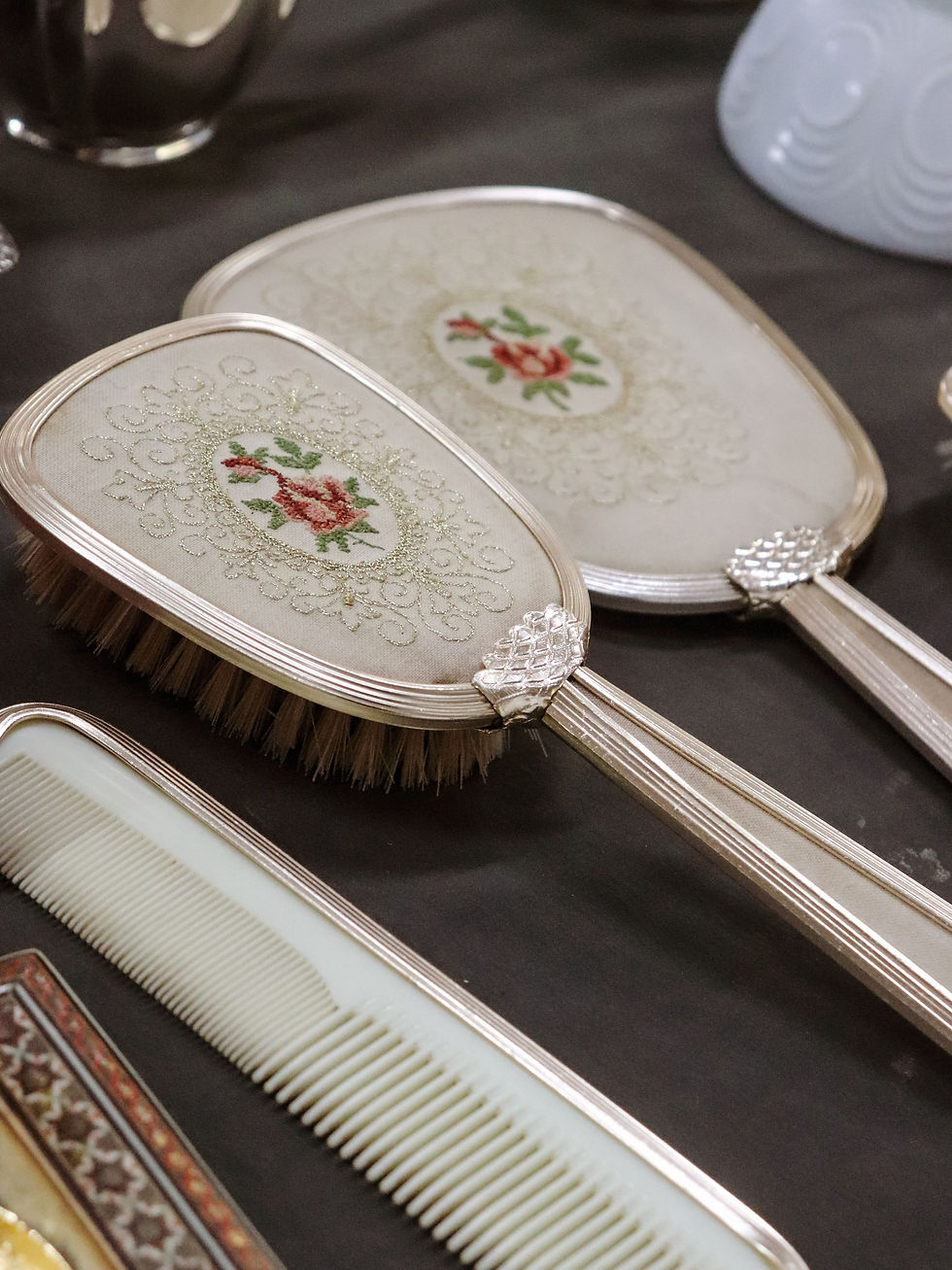
This is also why surviving dressing-table accessories can be so evocative. A matching brush, mirror and comb set tells us something about the ideal of an orderly, beautifully arranged bedroom, but the individual pieces that survive tell another story too. Sets became separated, brushes wore out, bottles were refilled or kept simply because they were pretty, and containers acquired uses their manufacturers probably never imagined. Anyone who regularly handles vintage knows that real lives have a habit of interfering with perfectly coordinated sets.
When Getting Ready Became Glamorous
The late nineteenth and early twentieth centuries brought huge changes to bedrooms, beauty culture and the products available to women, but it was during the early decades of the twentieth century that the dressing table acquired much of the glamorous image we associate with it today. Furniture design changed alongside fashion, and the dressing table proved particularly well suited to the new decorative styles.

Art Deco gave it some of its most spectacular incarnations. The V&A's collection includes Émile-Jacques Ruhlmann's extraordinary dressing table of 1919–23, while the wider Art Deco vocabulary brought geometry, luxurious surfaces and a sense of sophisticated modernity to furniture and personal accessories alike. Vanity cases, cigarette cases, perfume bottles and cosmetic packaging all participated in the same fashionable visual world.
By the 1930s, the image of a woman seated at her dressing table had also become deeply entwined with the glamour of cinema. Mirrors, flattering lamps, perfume atomisers, carefully arranged bottles and polished surfaces looked wonderful on screen, and the bedroom dressing table offered the perfect setting for the transformation from private woman to public appearance. Hollywood did not invent the ritual, but it certainly knew how to make it look fabulous.
This glamorous ideal should not be mistaken for the way every woman actually lived.
A spectacular mirrored dressing table with matching accessories belonged to a very different budget from a simple wooden table with a freestanding mirror perched on top. As with fashion itself, however, expensive ideals could be translated. A pretty tray, a treasured perfume bottle or a smart brush set could bring a little of the same glamour to a far more ordinary bedroom.
The Dressing Table Comes Into Its Own
For many of us, the quintessential vintage dressing table belongs somewhere between the 1930s and the 1960s. There are the wonderfully curvaceous Art Deco and 1930s examples, often with large circular or triptych mirrors, followed by the softer shapes of the 1940s and 1950s and the cleaner lines that arrived with mid-century furniture. Designs varied enormously, but the combination of drawers, mirror and somewhere to sit became instantly recognisable.

The things sitting on top changed too. Face powder, cold cream, lipstick, nail polish and perfume joined brushes, combs and hairpins. Decorative atomisers and scent bottles could be kept long after their original contents disappeared, while embroidered dressing-table mats and trays protected the surface underneath. Jewellery might live in a box or simply collect in a little dish beside the mirror. Some dressing tables were immaculate; plenty, we can safely assume, were not.
There is a tendency when looking back at vintage interiors to imagine everyone living in perfectly coordinated rooms resembling furniture catalogues. Real bedrooms were rarely so obliging. Furniture was handed down, bought second-hand, received as wedding presents and kept for years. A 1930s dressing table could quite happily still be serving its purpose in a 1960s bedroom, now surrounded by completely different cosmetics and hairstyles from those it had originally witnessed. That mixture is important because it is much closer to how people actually lived than the neatly divided decades we create retrospectively.
Perfume, Powder and the Things We Kept
Perhaps the most fascinating part of the dressing table is not the furniture at all, but what people chose to put on it. Beauty products are inherently temporary, yet their containers often weren't. An attractive perfume bottle could survive for decades after the fragrance had gone, while powder compacts, vanity jars and decorative pots were frequently too appealing to throw away.
That helps explain why dressing-table objects remain such a rich area for vintage collectors. They sit somewhere between fashion, beauty and social history. A perfume bottle can tell us about changing packaging and advertising; a brush set about fashions in hair and personal grooming; a jewellery box about the accessories its owner valued. Even the materials chart changing tastes, from silver and cut glass to enamel, early plastics and the colourful synthetic materials of the post-war years.
After more than twenty years working with vintage, these are often the objects that make the past feel surprisingly close. A dress can show us how somebody presented themselves once they left the house, but the things from a dressing table belonged to the moments before that presentation was complete. They are quieter objects, and perhaps more intimate ones.
From Boudoir to Teenage Bedroom
The dressing table did not disappear when the great age of matching bedroom suites began to fade. Instead, its role became less formal. During the later twentieth century, beauty culture increasingly belonged to teenagers as well as adult women, cosmetics became more accessible and bedrooms themselves became important spaces for expressing personal identity.
The contents of a dressing table in the 1960s or 1970s could look very different from those of thirty years earlier, and by the 1980s and 1990s the ritual of getting ready might take place amid cans of hairspray, brightly coloured make-up, costume jewellery and an ever-expanding collection of beauty products. Some bedrooms still had a traditional dressing table; elsewhere, a chest of drawers, desk or shelf with a mirror performed exactly the same job.
For anyone who grew up with one, however, the dressing table often became far more than somewhere to put make-up. It was where you experimented with a new look before daring to show anyone else, where jewellery and birthday presents accumulated, and where photographs, ticket stubs, notes and tiny treasures ended up wedged around the mirror. In that sense, the dressing table had returned to something it had been centuries earlier: a place where grooming and personal possessions mingled together.
Why Vintage Dressing Tables Still Fascinate Us
Our routines have changed enormously, but the appeal of having a little space devoted to getting ready has never entirely vanished. Modern beauty storage may involve acrylic organisers, bathroom cabinets and drawers full of products that would astonish an eighteenth-century owner, yet the basic desire is remarkably familiar. We still gather the things we use to construct our appearance and, given half a chance, surround them with objects that mean something to us.
Vintage dressing tables preserve that history particularly well because they were never just furniture. Their drawers, mirrors, scratches, faded surfaces and occasional mysterious stains are evidence of use. The same is true of the accessories that once sat upon them. A worn silver-backed brush or an almost-empty scent bottle may not possess the pristine perfection of a museum piece, but its wear is part of what makes it interesting.
Perhaps that is why a vintage dressing table can inspire such immediate nostalgia even when it predates us. It represents a familiar ritual in an older form: sitting in front of a mirror, choosing what to wear, fastening jewellery, doing your hair, applying lipstick or reaching for a favourite perfume before heading out into the world. Fashion has changed, bedrooms have changed and beauty routines have changed beyond recognition, but that quiet moment of getting ready has survived them all.
And, rather wonderfully, so have many of the tables that witnessed it.


Comments