


Thea Porter: The Queen of Bohemian Fashion

Thea Porter was the British designer who defined 1960s–70s bohemian chic, and whose kaftans, embroidered gowns and brocade-panel dresses are now among the most sought-after vintage collectibles in the world. This guide covers everything you need to know: a compact biography, her signature design vocabulary, where to view originals in UK collections, how to find and buy authentic pieces, what to check when authenticating, and how to care for a Porter garment once you have one.
This guide covers:
A brief biography and career timeline
Signature silhouettes, fabrics and techniques
UK museum holdings and catalogue records
Where to look for authentic pieces in the UK
Authentication and care advice
Cultural legacy and modern styling ideas
Who was Thea Porter?
Born Dorothea Noelle Naomi Porter on 24 December 1927, she grew up in Jerusalem and Damascus, the daughter of a British clergyman. That upbringing gave her a direct, lived relationship with Middle Eastern textiles, colour and craft that would later define every garment she made. She spent years in Beirut before eventually settling in London, and it was that accumulated experience of souks, silk merchants and hand-embroidered cloth that set her apart from every other designer working in the capital.
Her move into fashion was wonderfully unplanned. She opened Thea Porter Decorations Ltd at 8 Greek Street, Soho, on 27 July 1966, initially selling cushions and wall hangings made from imported Middle Eastern fabrics. Clients kept asking whether the same fabrics could be made into clothing, and so garments followed, almost by accident. It was a bespoke and small-run process from the start, worlds away from industrial ready-to-wear.
By the late 1960s she was dressing Elizabeth Taylor, Faye Dunaway and a constellation of musicians and socialites. International boutiques stocked her work, and her Greek Street shop became a destination for anyone who wanted something genuinely different from the mod minimalism dominating the high street. Her company went into receivership in the early 1980s, a consequence of financial instability she was famously disengaged from managing. She died in 2000, leaving a body of work that took decades to receive the serious critical attention it deserved.
What made a Thea Porter design unmistakable?
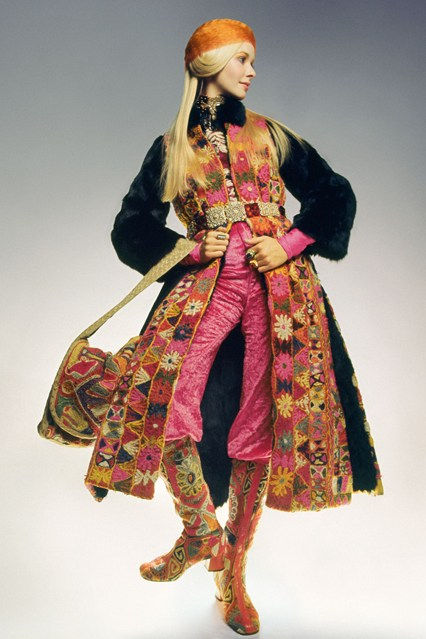
The Fashion & Textile Museum identifies seven signature styles that define her output, and knowing them is the starting point for any collector:
Abaya and kaftan: flowing, full-length robes in silk chiffon or brocade, often with wide sleeves and minimal seaming. The silhouette is generous and unstructured.
Gipsy dress: layered, tiered skirts with mixed-fabric panels, frequently combining printed cotton with embroidered or woven trims.
Faye dress: named after Faye Dunaway, typically a bias-cut or draped silk piece with a fluid, body-skimming line.
Brocade-panel dress: structured bodice panels in gold or jewel-toned brocade set against chiffon skirts, creating a rich contrast of texture and weight.
Wrap-over dress: cross-front closure in lightweight silk, often printed with botanical or geometric patterns drawn from Middle Eastern sources.
Chazara jacket: a short, embellished jacket with tribal-influenced trims, worn over dresses or wide-leg trousers.
Sirwal skirt: wide, gathered trousers or skirt-trousers in soft silk, echoing traditional Middle Eastern dress.
Across all of these, Porter favoured silk chiffon, gold brocade, antique trims sourced from markets in the Middle East and North Africa, and hand embroidery. Mixed-fabric panels are a recurring construction detail: a single garment might combine three or four different textiles, each with its own weight and drape. That layering of materials is one of the most reliable physical signs of an authentic piece.
Pro Tip: When examining a suspected Porter garment, look at the seams and trims first. Hand-stitched finishes, antique metallic braiding and carefully matched mixed-fabric panels are strong indicators of authenticity. Machine-overlocked seams and synthetic trims are immediate red flags.
Where can you see Thea Porter’s work in the UK?

The Victoria and Albert Museum holds the most significant publicly accessible collection of Porter garments in the UK. You can search the V&A’s online catalogue to browse accession records, view catalogue images and identify specific pieces by date, fabric and construction. For high-resolution images or to arrange a study-room appointment to view pieces in person, contact the V&A’s textile and fashion department directly.
Institution | What they hold | How to access |
Victoria and Albert Museum, London | Multiple garments including dresses, kaftans and separates; full catalogue records online | Search V&A Explore the Collections; book study-room appointments via the museum |
Fashion & Textile Museum, London | Held a major retrospective exhibition; exhibition archive and catalogue available | Contact the museum for archive enquiries and exhibition records |
ASU FIDM Museum (USA) | Documented pieces including a butterfly print dress with full provenance notes | Online catalogue; useful for cross-referencing construction details |
The Fashion & Textile Museum’s retrospective was a landmark moment in Porter’s critical reappraisal, and their exhibition archive is worth consulting if you are researching provenance or trying to establish whether a specific piece was shown publicly. Exhibition history is one of the strongest provenance signals a collector can find.
How do you find authentic pieces to buy in the UK?
Porter originals circulate through specialist channels rather than general vintage marketplaces, and knowing where to look saves a great deal of time. Dealer commentary consistently points to curated specialist auctions and vetted dealers as the primary routes, rather than mass-market resale platforms where provenance is rarely documented.
Primary acquisition channels:
Specialist vintage fashion dealers in London (particularly those focusing on 1960s–70s couture and designer pieces)
Major auction houses with dedicated fashion and textiles sales (Kerry Taylor Auctions is the best-known UK specialist in this area)
Specialist vintage fairs, including those held at venues such as Olympia and Alexandra Palace
Curated online platforms with editorial curation and provenance policies
Private sales through collector networks and fashion history societies
Questions to ask any seller before buying:
Can you provide the full ownership history of this piece?
Has it been repaired, altered or re-lined?
What is the fabric composition, and has it been tested?
Does it have an original label, and is the label intact?
Has the piece appeared in any exhibition, publication or auction record?
Pro Tip: Search the V&A’s online catalogue before approaching a seller. If a piece matches a catalogued garment in fabric, construction and date, that catalogue record can support your provenance research. It is not proof of authenticity on its own, but it is a useful reference point.
When buying online, the difference between a curated dealer and a general marketplace matters enormously. Curated dealers vet pieces before listing them and can usually provide more detailed condition notes. For buyers uncertain about fit when purchasing vintage online, resources on vintage sizing and fit can help you understand the limitations of standard size guides with pre-metric garments.
How do you authenticate a Porter piece and care for it?

Authentication comes down to three things: label evidence, construction quality and provenance trail. Original Porter labels changed over the years, and the Vintage Fashion Guild’s label resource is a useful community reference for cross-checking label styles against known dated examples.
Authentication checklist:
Label present and consistent with known Porter label styles for the claimed period
Hand-stitched or carefully finished seams, not machine-overlocked edges
Mixed-fabric panels with antique or hand-sourced trims
Silk chiffon, gold brocade or hand-embroidered fabric (not polyester substitutes)
Provenance documentation: receipts, exhibition records, auction catalogue entries, or previous ownership history
Reproduction red flags: modern synthetic trims, uniform machine stitching throughout, vague or absent provenance, labels that look freshly printed, and sellers who cannot name a previous owner or source.
Once you have a piece, care is everything. Silk chiffon and brocade are fragile, and the antique trims on many Porter garments are irreplaceable.
Do not:
Machine wash or tumble dry any Porter garment
Store in direct sunlight or in plastic bags (both degrade silk fibres)
Use wire hangers, which distort shoulder seams on heavy brocade pieces
Apply perfume or hairspray near the fabric
Attempt to remove stains at home without specialist advice
Store pieces flat or on padded hangers, wrapped in acid-free tissue, in a cool, dark, dry space. For any significant cleaning or repair, consult a professional textile conservator. The Textile Society and the Institute for Conservation both maintain directories of accredited conservators in the UK.
Why does Thea Porter matter now?

Porter’s work was reappraised as historically significant rather than merely exotic novelty, and that shift in critical perspective has driven both collector interest and curatorial attention. She was designing at a moment when bohemian culture, second-wave feminism and a new appetite for international travel were reshaping how British women thought about dress. Her garments offered an alternative to both the rigid formality of couture and the throwaway energy of mod fashion.
“Porter designed to change how a wearer felt. The clothes have an emotional and experiential quality that goes beyond aesthetics — they are mood-transformative in a way that very few designers achieve.” — Curator Laura McLaws Helms, as cited in The Cut
That mood-transformative quality is precisely why collectors remain so attached to Porter pieces decades after they were made. Wearing one is a different experience from wearing most vintage garments. The weight of the brocade, the movement of the chiffon, the detail of the hand embroidery: all of it communicates a level of intention and craft that contemporary fashion rarely matches. Her 1970s bohemian aesthetic has also fed directly into recent runway revivals, with designers repeatedly returning to the kaftan silhouette and mixed-textile layering she pioneered.
How to wear Porter pieces or Porter-inspired looks today
The joy of a Porter garment is its versatility. A silk kaftan that was worn to a 1970s Mayfair party works equally well at a summer wedding, a festival, or a relaxed evening dinner. The key is to let the garment do the work and keep everything else simple.
For daywear, a wrap-over dress or gipsy-style tiered skirt pairs beautifully with a plain white cotton blouse and flat sandals. The layered fabric does enough visually without additional embellishment. For UK weather, a fine wool or cashmere wrap in a neutral tone sits over the top without competing with the print.
Evening is where brocade-panel dresses and kaftans come into their own. Wear them with minimal jewellery, letting the antique trims and fabric speak. A single gold cuff or a pair of simple drop earrings is all you need.
For a festival or relaxed party setting, the Chazara jacket over wide-leg trousers echoes the original styling Porter’s clients favoured. You can find 1960s and 1970s partywear that pairs well with Porter-inspired pieces if you want to build a full look from the era.
Porter’s abaya and kaftan shapes also translate naturally into modest dressing, offering full coverage with extraordinary elegance. The silhouettes work across body types and ages, which is part of why they have never really dated.
Key Takeaways
Thea Porter’s significance lies in her direct translation of Middle Eastern textile traditions into wearable, emotionally resonant fashion that defined an era and continues to captivate collectors today.
Point | Details |
Who she was | British designer born 1927, raised in Jerusalem and Damascus; opened her Soho shop in 1966 and dressed celebrity clients throughout the 1970s. |
Signature signs | Look for mixed-fabric panels, silk chiffon or gold brocade, hand embroidery, antique trims and hand-finished seams. |
Where to view originals | The V&A holds the most significant UK collection; search their online catalogue or book a study-room appointment. |
Authentication priority | Check the label against known dated examples, examine seam finishing, and ask for full provenance documentation before buying. |
My Vintage | Browse My Vintage for curated 1960s and 1970s vintage pieces that sit alongside or complement a Porter-inspired wardrobe. |
Find Porter-era vintage at My Vintage
If you are building a collection inspired by Thea Porter’s world, My Vintage is a good place to start. As a UK-based specialist in authentic vintage clothing from the 1940s through to the 1990s, My Vintage offers carefully curated pieces with detailed condition notes, so you know exactly what you are buying. The team also supplies vintage costume for television, film and theatre, which means the eye for quality and period accuracy runs through everything on the site.
Whether you are after a 1970s silk evening piece, a brocade-trimmed jacket, or simply want to explore what genuine vintage from Porter’s era looks and feels like, browsing the My Vintage collection is a natural next step. Head to myvintage.uk to see current listings, or get in touch with Emma directly for sourcing advice.
Useful sources and further reading
A curated list of the most authoritative sources used in this guide. For provenance research, always start with institutional catalogue records and contact museum curators directly for high-resolution images or exhibition history queries.
V&A Explore the Collections: Thea Porter search — the primary UK catalogue for viewing accession records and garment images
Fashion & Textile Museum: Thea Porter — 70s bohemian chic — exhibition archive and signature style documentation
Wikipedia: Thea Porter — baseline biography with key dates and career chronology
The Guardian: Thea Porter reappraisal — critical re-evaluation and cultural context
The Cut: The designer who brought the caftan to Britain — curator perspectives and emotional legacy
AnOther: Thea Porter — Spirit of the 70s — silhouette details, celebrity clientele and styling notes
ASU FIDM Museum: Thea Porter butterfly print dress — detailed provenance and construction notes on a documented piece
Vintage Fashion Guild Forums: dating a Thea Porter dress — community label resource and dating discussion
Recommended


Comments