


Vintage Jewellery Clasps: Identification & Dating Clues

Turn over a piece of vintage jewellery and you will often find that its fastening is almost as interesting as the decorative side. Tiny hooks, rings, catches, screws and boxes can reveal fascinating details about how a piece was made and worn, and they are certainly worth examining when trying to understand its history.
There is, however, an important warning before we begin: you cannot reliably date a piece of jewellery from its clasp alone. This is one of the most persistent misconceptions in vintage jewellery identification, encouraged by wonderfully neat online charts that assign a particular fastening to a particular decade. Real vintage jewellery is rarely so obliging.
At My Vintage, after more than 20 years of handling vintage pieces, we have encountered older necklaces with apparently later-style clasps, vintage jewellery that has clearly been repaired or restrung, and fastening styles that simply refuse to fit into tidy timelines. A clasp is evidence, but it is only one part of the story.
So, rather than promising an impossible shortcut, this guide explores some of the clasps and catches you may encounter, how they work and how their construction can contribute to a much broader assessment of vintage jewellery.
Why Jewellery Clasps Can Help With Identification
A fastening is a functional part of a piece of jewellery, and functional details are always worth examining. Jewellery-making techniques have evolved, manufacturing has become increasingly mechanised and certain fastening mechanisms have become more or less fashionable over time. Looking closely at a clasp can therefore provide useful clues.
The mistake is assuming that the date when a particular mechanism was invented, patented or became popular gives us the date of every piece carrying one. Jewellery designs overlap enormously. Older fastening methods did not suddenly disappear when newer ones arrived, and familiar mechanisms have continued to be manufactured in different forms for generations.

There is another complication: jewellery lives a life. A necklace might be restrung several times during decades of wear. A broken clasp may be replaced by a jeweller or by its owner. A brooch catch can be repaired. Vintage beads may be reassembled into a new necklace, while an older clasp might occasionally be reused on a later piece. All of this means that the fastening you see today may not necessarily be the fastening with which the jewellery began its life.
The C-Clasp
The C-clasp, or C-catch, is most commonly encountered on brooches rather than necklaces. Its name comes from its simple curved shape. The pin is pushed beneath the open curve of the catch, where tension helps keep it in position.

C-catches are strongly associated with antique brooch construction and can certainly be an encouraging clue when examining an apparently older piece. What they are not is an automatic certificate of Victorian age. Variations of simple open catches continued to be used, while later jewellery can deliberately imitate earlier construction. The hinge at the opposite end of the pin, the length and shape of the pin itself, the way the fittings are attached and the construction of the brooch all deserve equal attention.
If you find an open C-shaped catch, therefore, note it as one piece of evidence. Then keep looking.
Safety Catches and Rollover Clasps
The obvious weakness of an open C-catch is that there is no separate mechanism locking the pin into position. More secure brooch catches were developed in numerous forms, eventually giving us the familiar safety catches found on huge quantities of 20th-century jewellery.
One type frequently encountered on vintage brooches is the rollover or locking safety catch. Once the pin is positioned, a small rotating element closes over it, reducing the chance of the brooch accidentally coming undone. There are variations in design and construction, which is another reason that simply seeing a rotating catch shouldn't be used to assign an exact decade.
When examining one, look beyond the moving part itself. Is the catch soldered directly to the brooch? Does its metal and finish correspond with the rest of the piece? Does it appear noticeably cleaner or less worn? Is there evidence that an earlier fitting has been removed? These observations can sometimes be more revealing than the clasp category.
The Trombone Clasp
Trombone clasps are particularly interesting because their mechanism looks quite different from the more familiar rotating safety catch. Usually found on brooches, they secure the pin with a small sliding or pulling mechanism, its action somewhat reminiscent of the slide of a trombone – hence the name.
They are encountered on antique and vintage European jewellery and are a useful fastening to recognise, particularly because somebody unfamiliar with the mechanism may initially wonder how on earth the brooch is supposed to open.
As with the C-clasp, however, recognition is not the same as precise dating. Country of manufacture, construction and the rest of the jewellery should all be considered before drawing conclusions about age.
Spring Ring Clasps
The spring ring is one of those wonderfully ordinary findings that can cause trouble for anyone hoping for a simple vintage timeline. It is generally circular, with a small lever that retracts a spring-loaded section of the ring so that it can be attached to another loop.

Spring mechanisms of this general type have a long history, and spring rings have remained useful enough to continue in jewellery manufacture through changing fashions. The presence of one therefore tells us far less about age than some simplified dating guides suggest.
There can still be useful details to examine. Size, construction, metal, the form of the operating tab, the attachment loops and the way the clasp connects to the necklace or bracelet may all contribute to the overall picture. The important thing is not to see a spring ring and immediately reach for a particular decade.
Bolt Ring Clasps
In Britain, you will also commonly hear the term bolt ring used for the familiar circular spring-loaded fastening found on necklaces and bracelets. Terminology can vary between sellers, manufacturers and countries, and “spring ring” and “bolt ring” are sometimes used for closely related or essentially equivalent circular mechanisms.
That variation in terminology is worth remembering when researching vintage jewellery online. Two sellers may describe similar findings using different names, while historical manufacturers may have used their own terminology. Identification should therefore be based primarily on how a mechanism is constructed and operates rather than on the label attached to it in a modern listing.
Barrel and Screw Clasps
A barrel clasp consists of two sections that meet to form a small barrel-like shape. Some examples screw together, while other cylindrical fastenings use different internal mechanisms. Screw-type versions are particularly easy to recognise once opened because one half carries a threaded component that turns into the other.
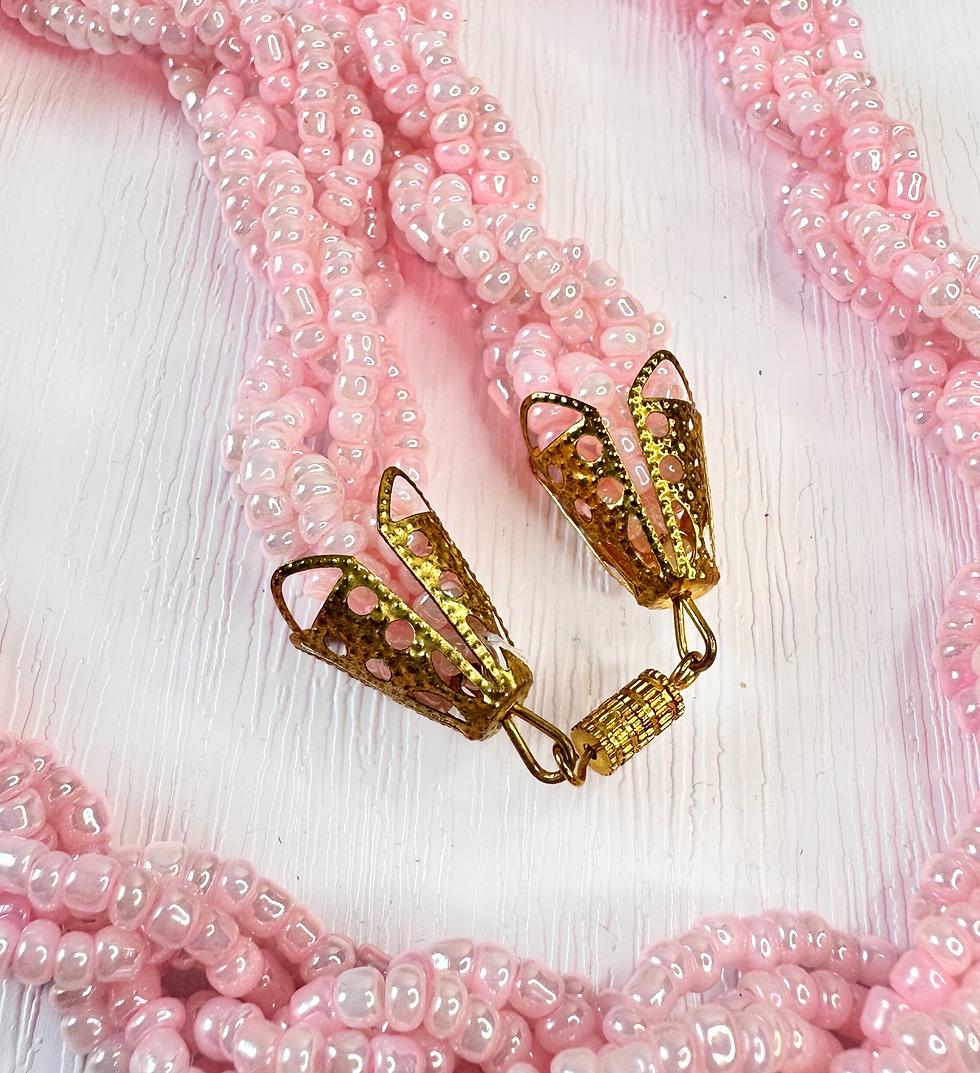
These fastenings can be found on necklaces of many different styles and ages, including strings of beads and pearls. Again, their presence alone cannot establish a date. Necklaces are especially prone to restringing, and replacing a worn fastening during that process is entirely understandable.
If the necklace itself appears considerably older than its clasp, that isn't necessarily evidence that the whole piece is a reproduction. Look at how the beads are strung, the thread or wire, knots, end fittings and any signs of previous repair before deciding what has happened.
Box Clasps
Box clasps are both practical and decorative. A projecting tongue or tab slides into a box-shaped housing and locks into place, sometimes with an additional safety feature. On some jewellery the box is deliberately hidden within the design; on other pieces it becomes an elaborate decorative feature in its own right.
You'll encounter variations on box mechanisms across necklaces and bracelets, from delicate fine jewellery to costume pieces. Because the basic idea is so adaptable, “box clasp” describes a broad family rather than one narrowly dateable finding.
This is a good example of why examining quality and construction matters. A beautifully integrated decorative box clasp that forms part of a bracelet's design tells us much more than simply ticking “box clasp” on an identification checklist.
Fold-Over Clasps
Fold-over clasps are especially familiar on bracelets and some necklaces. The fastening uses a hinged section that folds over another component and snaps or locks into place. They can be compact, secure and relatively easy to operate, which helps explain their continued usefulness.
They are commonly encountered on 20th-century jewellery, but once again the category encompasses numerous variations and a long period of manufacture. The style of the jewellery, materials, construction and any maker's information should carry far more weight than an attempt to date the piece from the fold-over mechanism alone.
Lobster Clasps and the Vintage Jewellery Problem
The lobster or lobster-claw clasp is perhaps one of the best examples of why we need to be cautious. Its familiar spring-loaded shape opens with a small lever and closes automatically when released. Today it is so commonplace that seeing one on a necklace can make the entire piece feel comparatively modern.
But should a lobster clasp make you dismiss an otherwise convincing vintage necklace? No.
During years of dealing in vintage jewellery, we have encountered older necklaces fitted with lobster clasps. There are several possible explanations for a seemingly later fastening on an older piece, including replacement after breakage and restringing during the necklace's lifetime. Depending on the piece in question, the clasp may also simply be less useful as a dating clue than expected.

Rather than asking “What decade does a lobster clasp mean?”, ask whether the fastening makes sense in the context of the entire necklace. Examine its attachment, the end findings, the stringing material, the beads or chain, construction, wear, marks and overall style. If several other pieces of evidence point towards an older date, one familiar-looking clasp should not automatically overrule them all.
Why Clasp Dating Charts Can Be Misleading
A chart that says one clasp equals one era is wonderfully appealing because it turns a complicated identification problem into a quick answer. Unfortunately, vintage jewellery doesn't work that way.
There are several reasons. Fastening designs overlap across periods; mechanisms can remain in production long after their introduction; jewellery may be repaired or altered; necklaces can be restrung; replacement components can be added decades later; and revival jewellery can deliberately borrow features from earlier periods. There can also be differences between countries and manufacturers.
Patent dates need careful handling too. Finding a patent for a particular mechanism can establish that a documented version existed by a certain point, but it does not necessarily tell us when every variation first appeared, when the mechanism became widely used or how long related designs remained in production.
This doesn't make clasps useless for dating. Far from it. It simply means that good identification involves accumulating evidence rather than searching for one decisive feature.
Look at the Whole Piece
When we assess vintage jewellery, the most convincing conclusions usually come from features that agree with one another. Start with the clasp, but then move outwards.
Consider the way the fastening is attached. Look for solder, connecting rings and end caps.
Examine the pin, hinge and catch on a brooch rather than concentrating on the catch alone. Look at the construction of chains and settings, the backs of stones, surface wear and finishing. Check for maker's marks, metal marks, patent information or country-of-origin marks where present. Materials, decorative style and manufacturing quality can all contribute further clues.

Consistency is particularly useful. If the clasp, construction, materials, wear and style all make sense together, your proposed date becomes more convincing. If one element looks dramatically different from everything around it, that doesn't necessarily make the piece wrong – but it gives you a reason to investigate further.
Can You Tell If a Clasp Has Been Replaced?
Sometimes the evidence is obvious. You may see fresh-looking solder, mismatched metal, an unusually bright connecting ring or a fastening whose wear seems inconsistent with the rest of the jewellery. At other times, a skilled historic repair can be extremely difficult to distinguish from the original construction.
Necklaces present an additional challenge because restringing can be part of perfectly normal maintenance. Pearls and beads do not have to remain on their original thread for the beads themselves to be old, and a replacement clasp doesn't erase their history.
This is also why condition and originality are separate questions. A genuinely vintage piece can contain a later repair. Whether that repair affects desirability or value depends on the jewellery, its rarity, maker, materials, quality of the work and what exactly has been changed.
Clasp, Catch or Fastening?
Jewellery terminology can become confusing because these words are sometimes used interchangeably. Broadly speaking, a clasp is a mechanism that joins two ends of something such as a necklace or bracelet, while the catch on a brooch receives and secures its pin. In everyday vintage selling, however, you'll frequently encounter “brooch clasp” used for the complete pin fastening.
Don't become too hung up on terminology when identifying an unknown piece. Understanding what the mechanism does and how it is constructed is ultimately more useful than winning an argument over whether somebody should have called it a clasp or a catch.
A Clue, Not a Date Stamp
Vintage jewellery identification is often described as though every feature provides a secret code: find the clasp, consult the chart and discover the decade. In practice, it is much closer to detective work. One clue supports another until a convincing picture begins to emerge.
That may sound less satisfying than being told that a particular clasp guarantees a particular date, but it is considerably more reliable. It also makes examining vintage jewellery much more interesting. Repairs, alterations and replaced findings are part of the lives these pieces have led, and sometimes the unexpected feature is itself part of the story.
So by all means turn over that necklace or brooch and inspect the fastening. It may tell you something useful. Just don't expect one tiny clasp to tell you everything.
Can you date vintage jewellery by the clasp?
A clasp can contribute useful evidence when dating vintage jewellery, but it should never be used alone to assign an exact age. Fastening styles overlap across periods and jewellery can be repaired, restrung or fitted with replacement components. For a more reliable assessment, examine the clasp alongside construction, materials, marks, style, wear and the way the findings are attached.
Does a C-clasp mean a brooch is Victorian?
Not necessarily. C-shaped catches are associated with older brooch construction and may support an antique date when other features agree, but the presence of a C-clasp alone does not prove that a brooch is Victorian. Examine the hinge, pin, attachment method, materials and overall construction as well.
Does a lobster clasp mean a necklace isn't vintage?
No. An older necklace can have a lobster clasp, and the fastening may have been replaced during repair or restringing. The clasp should be considered alongside the necklace's other features rather than being used to dismiss an otherwise convincing vintage piece.
Can an old necklace have a replacement clasp?
Absolutely. Clasps are working components and can wear out or break, while bead and pearl necklaces may be restrung during their lifetime. A later replacement clasp therefore doesn't automatically mean that the necklace itself is modern.
What should I check when dating vintage jewellery?
Look for a combination of evidence. Examine the fastening and how it is attached, construction methods, materials, stones or beads, settings, hinges and pins where relevant, maker's and metal marks, surface wear and overall style. The strongest dating assessment comes from several compatible clues rather than a single feature.


Comments