


Vintage Pearl Necklaces: A Style Guide

Most vintage pearl buyers have no idea whether what they’re holding is genuine or a clever imitation. It’s one of the most common dilemmas in vintage jewellery collecting, and honestly, it’s completely understandable. Pearls have been faked, replicated, and reimagined for over a century, making the hunt for authentic pieces both thrilling and tricky. Whether you’re a seasoned collector or just falling in love with the elegance of a 1950s strand, this guide will walk you through how to identify real vintage pearls, place them within their correct era, style them beautifully, and keep them in perfect condition for years to come.
Table of Contents
Key Takeaways
Point | Details |
Check authenticity | Use touch and teeth tests to verify if pearls are genuine for both value and style. |
Recognise era features | Clasp, stringing, colour and design cues reveal which decade a vintage pearl necklace is from. |
Style creatively | Vintage pearl necklaces add unique flair to modern outfits, whether layered or worn solo. |
Care preserves value | Regular restringing and gentle cleaning keep vintage pearls beautiful for years to come. |
Why Vintage Pearl Necklaces Remain Timeless
Pearls have graced the necks of some of history’s most iconic women. From Audrey Hepburn’s elegant strands in the 1950s to Princess Diana’s layered looks in the 1980s, pearl necklaces have never truly gone out of fashion. They carry a sense of quiet confidence and refined beauty that few other accessories can match. And unlike mass-produced modern jewellery, each vintage piece tells its own story.

The appeal of vintage pearl necklaces goes well beyond nostalgia. They represent a form of sustainable fashion, giving beautiful objects a second life rather than contributing to the cycle of fast fashion. They’re also wonderfully versatile. A single strand from the 1960s can look just as striking with a linen blazer today as it did with a shift dress back then. Keeping an eye on vintage jewellery trends shows just how regularly these pieces cycle back into the spotlight.
Here’s why collectors and fashion lovers keep returning to vintage pearls:
Individuality: No two vintage necklaces are identical, making each piece genuinely one of a kind.
Historical value: Pieces from specific eras carry cultural and fashion significance that modern replicas simply cannot replicate.
Craftsmanship: Pre-1990s jewellery was often hand-knotted and made with far greater attention to detail.
Versatility: Pearls complement casual, formal, and creative outfits with equal ease.
Sustainability: Choosing vintage reduces demand for newly mined or farmed materials.
Exploring iconic jewellery eras reveals just how dramatically styles shifted across the decades, and how those shifts are reflected in the necklaces we find today. If you’re curious about wearing statement jewellery with confidence, the principles apply beautifully to vintage pearls too.
How to Identify Genuine Vintage Pearls
Understanding why vintage pearls are so appealing naturally leads to the practical skills for verifying their authenticity. And this is where many buyers feel uncertain. The good news is that a few simple tests can tell you a great deal.
Real pearls have a distinctive texture. Real pearls feel cooler to the touch and gritty when rubbed gently against your teeth, while imitation pearls feel smooth and glassy. This is the quickest test you can do anywhere, and it’s surprisingly reliable.
Here are the key steps for checking authenticity:
The tooth test: Rub the pearl lightly against your front teeth. A real pearl will feel slightly rough or sandy. A fake will feel perfectly smooth.
Check the lustre: Genuine pearls have a deep, layered glow called orient. Imitations tend to look shiny but flat, almost like painted glass.
Examine the drill holes: On real pearls, the nacre (the iridescent coating) is visible around the drill hole. Fakes often show a clear coating or paint peeling away.
Feel the weight: Real pearls are denser and heavier than most plastic or glass imitations of the same size.
Look for slight imperfections: Natural and cultured pearls are rarely perfectly uniform. Suspicious uniformity is a red flag.
“Real pearls feel cooler to the touch, gritty when rubbed against teeth” — a simple but highly effective test that costs nothing and takes seconds.
For vintage pieces specifically, the clasp is a brilliant clue. Box clasps were popular in the 1940s and 1950s, while barrel clasps became common from the 1960s onwards. Hand-knotting between each pearl is a sign of quality and age. Our guide to collecting vintage jewellery tips covers this in more detail, and you’ll find examples of collectable jewellery to help train your eye.

Pro Tip: Always examine a vintage pearl necklace under natural light. Artificial lighting can mask poor lustre and hide the subtle imperfections that confirm a pearl’s authenticity.
Era Guide: Pearl Necklaces from the 1940s to the 1990s
Knowing how to spot authentic pearls is key, but recognising which decade your necklace comes from enriches your appreciation and supports collecting. Each era left its own unmistakable mark on pearl jewellery design.
Decade | Style characteristics | Typical clasp | Pearl type |
1940s | Short single strands, wartime simplicity | Box clasp | Natural or early cultured |
1950s | Layered, dramatic, Hollywood glamour | Ornate box clasp | Cultured, often larger |
1960s–70s | Mod and bohemian, colourful accents | Barrel or toggle | Cultured, dyed varieties |
1980s–90s | Bold multi-strands, power dressing | Magnetic or barrel | Freshwater, faux blends |
The 1940s brought wartime restraint to jewellery design. Single strands were elegant but understated, reflecting the era’s practical sensibility. By the 1950s, Hollywood had transformed pearls into symbols of glamour and aspiration. Think Grace Kelly and Marilyn Monroe, both photographed regularly in lustrous pearl strands.

The 1960s and 1970s saw pearls take on a more playful character. Mod fashion embraced geometric shapes and bold colour, and pearl necklaces began appearing alongside colourful beads and innovative clasps. Bohemian styling in the 1970s brought longer ropes and layered looks. You can see a beautiful surviving example in this 1960s multi-strand necklace from our collection.
The 1980s and 1990s were all about impact. Power dressing demanded bold accessories, and pearl necklaces grew larger, bolder, and more theatrical. Multi-strand designs and oversized pearls became status symbols. Browse our favourite vintage necklace styles for a visual tour through these decades, and explore further vintage jewellery examples to sharpen your eye.
How to Style Vintage Pearl Necklaces for Today
Once you understand the eras and uniqueness of vintage pearls, it’s time to use them with style and confidence in any wardrobe. The beauty of pearls is that they genuinely work across almost every aesthetic.

For everyday wear, a single strand from the 1950s or 1960s pairs brilliantly with a crisp white shirt, a fine-knit jumper, or even a simple T-shirt. The contrast between casual fabric and classic pearl creates an effortlessly chic look. For formal occasions, layering two or three strands of different lengths adds drama without overwhelming your outfit.
Here are some practical styling ideas to get you started:
Layer boldly: Mix a short choker-length strand with a longer rope for a modern, editorial feel.
Mix eras: Pair a 1980s bold multi-strand with contemporary minimalist clothing for striking contrast.
Consider your neckline: V-necks suit longer strands, while round or boat necks work beautifully with shorter, closer-fitting pieces.
Seasonal styling: In summer, pearls look stunning against bare skin or with linen. In winter, they add warmth and elegance over knitwear.
Event dressing: For weddings or evening events, a single dramatic strand or a layered 1950s set elevates any outfit instantly.
For more inspiration on styling vintage jewellery across different looks, we’ve put together plenty of ideas. And if you’re preparing for a special occasion, this guide to accessorising for special occasions offers brilliant practical advice.
Pro Tip: Don’t be afraid to wear pearls with denim. A vintage pearl necklace against a classic denim jacket is one of those combinations that always looks intentional and stylish, never overdone.
Buying and Caring for Your Vintage Pearl Necklace
To truly enjoy and preserve your vintage pearl necklace, follow these buying and care guidelines. Getting this right from the start protects both your investment and the piece’s beauty.

When buying vintage pearls, work through this checklist:
Verify authenticity using the tooth test and lustre check before committing.
Choose a reputable retailer who specialises in vintage jewellery and can provide provenance or dating information.
Inspect the condition carefully, checking for loose knots, damaged clasps, or discoloured pearls.
Ask about returns so you have recourse if the piece turns out to be misrepresented.
Check the stringing as old silk thread can weaken over time, making restringing necessary before wear.
Our vintage buying tips are a great starting point for building confidence as a buyer. For a beautiful example of what to look for, take a look at this 1950s pearl necklace from our curated collection.
Care task | How often | Method |
Cleaning | After each wear | Soft damp cloth only |
Restringing | Every one to two years | Professional jeweller |
Storage | Always | Soft pouch, away from other jewellery |
Chemical exposure | Never | Keep away from perfume, hairspray, acids |
Pearls are organic gems and genuinely sensitive to their environment. Experts recommend you restring every one to two years and avoid chemicals entirely, as even everyday products like perfume and hairspray can dull the nacre over time. Always put your pearls on last when getting dressed, and take them off first.
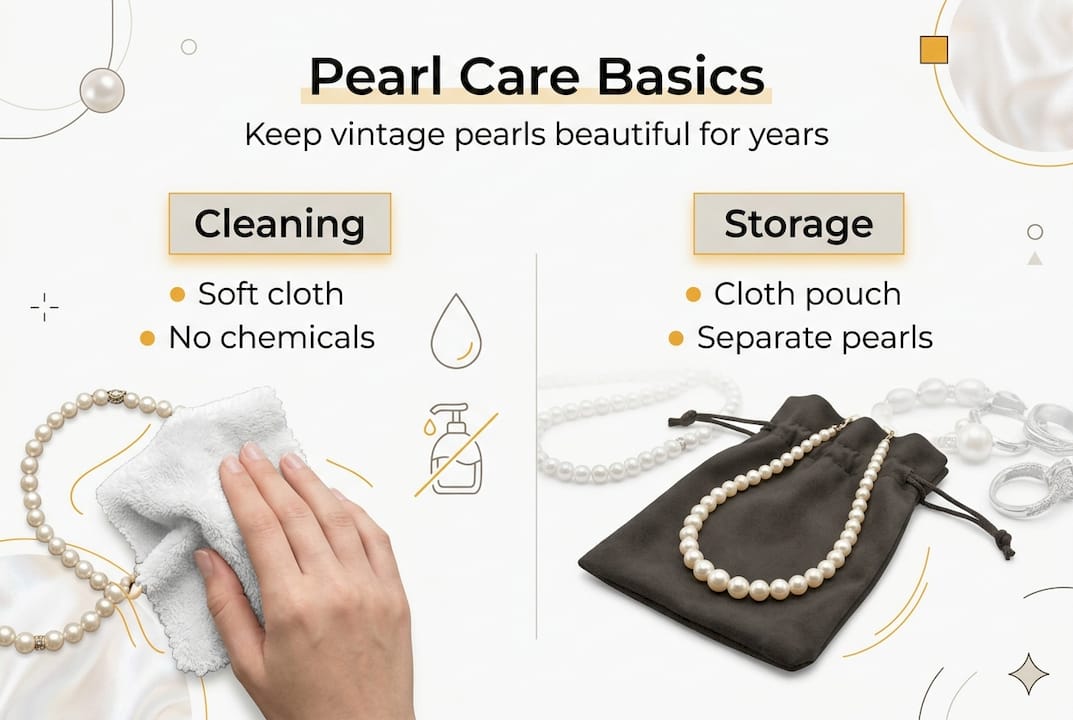
Storage matters too. Keep pearls in a soft cloth pouch rather than a hard jewellery box, and never store them alongside metal pieces that could scratch the surface. If you love the look of pearl-adjacent pieces, our mother of pearl brooch is a wonderful companion piece to any pearl necklace.
Pro Tip: Wearing your pearls regularly actually helps keep them in good condition. The natural oils from your skin maintain the nacre’s moisture and lustre. Just remember to wipe them gently with a soft cloth afterwards.
Find Your Next Vintage Treasure
Equipped with knowledge and style inspiration, you’re ready to treasure hunt or add another unique piece to your collection. At My Vintage, we’ve been curating authentic vintage pieces since 2004, and our jewellery selection reflects the same passion for quality and individuality that runs through everything we do.
Whether you’re searching for a delicate 1950s single strand or a bold 1980s multi-layer statement piece, our collection is carefully selected to offer genuine vintage finds you won’t discover on the high street. And if jewellery is just the beginning, you’ll find equally beautiful mid-century homeware and so much more waiting for you. Come and shop vintage treasures and find the piece that speaks to you.
Frequently Asked Questions
Are vintage pearl necklaces a good investment?
Well-maintained, authentic vintage pearl necklaces often hold or increase in value over time due to their rarity and the quality of their craftsmanship. Pieces from notable eras or with documented provenance tend to be particularly sought after.
How do I clean a vintage pearl necklace safely?
Wipe gently with a soft, damp cloth after each wear and avoid chemicals entirely, as pearls are highly sensitive to acids, detergents, and even common beauty products like perfume.
How do I know which decade my necklace is from?
Examine the clasp style, pearl size, and stringing method, as these vary significantly across decades. Any maker’s marks, original packaging, or accompanying paperwork can also help confirm the era.
Are imitation pearls ever collectable?
Some costume jewellery pieces from prestigious designers such as Chanel or Miriam Haskell are genuinely collectable and can command strong prices, but natural and cultured pearls generally hold greater long-term value.
Recommended


Comments