


Why Buy Vintage Decor for Your Home?

There is a common assumption that vintage decor is simply old furniture you could not afford to replace. That view misses the point entirely. The real reasons to why buy vintage decor go far deeper than budget or nostalgia. Vintage pieces carry authentic history, genuine craftsmanship, and a character that no flatpack shelf will ever replicate. They also carry an environmental conscience, connecting your home to a more thoughtful way of living. In this article, we will explore the emotional, practical, and sustainable arguments for choosing vintage, along with honest advice on how to do it well.
Table of Contents
Why Buy Vintage Decor: The Emotional Case
Ask yourself what makes a room feel genuinely lived in rather than staged. The answer, more often than not, comes down to objects with a past. Psychologist Krause’s research, covered by House Beautiful, introduces the concept of “place authenticity.” The idea is that meaningful connections to history and culture give a home its emotional weight. Vintage decor is one of the most direct ways to build that authenticity.
“Authenticity in home decor arises from meaningful connections to history, culture, and people, not just aesthetic trend adherence.”
Think about the difference between a mass-produced ceramic bowl bought online this morning and a hand-thrown stoneware piece from a 1960s British pottery. Both hold flowers. Only one holds a story. That story is felt the moment someone walks into your room, even if they cannot quite name why.

This emotional resonance is one of the most compelling benefits of vintage decor, and it extends across many object types:
Heirlooms and inherited pieces that carry family history and a sense of continuity across generations
Folk art and handcrafted textiles that connect your home to a specific cultural tradition or region
Vintage ceramics and glassware that reflect the design values and craft of their era
Mid-century lighting that speaks to a period of genuine optimism in design
You can transform your space with vintage home decor in ways that feel rooted and personal rather than assembled from a catalogue. And there is real psychological value in that. A home filled with objects that mean something to you, or that carry meaning from the people who made them, simply feels warmer. It feels like yours.
Quality and Craftsmanship that Lasts
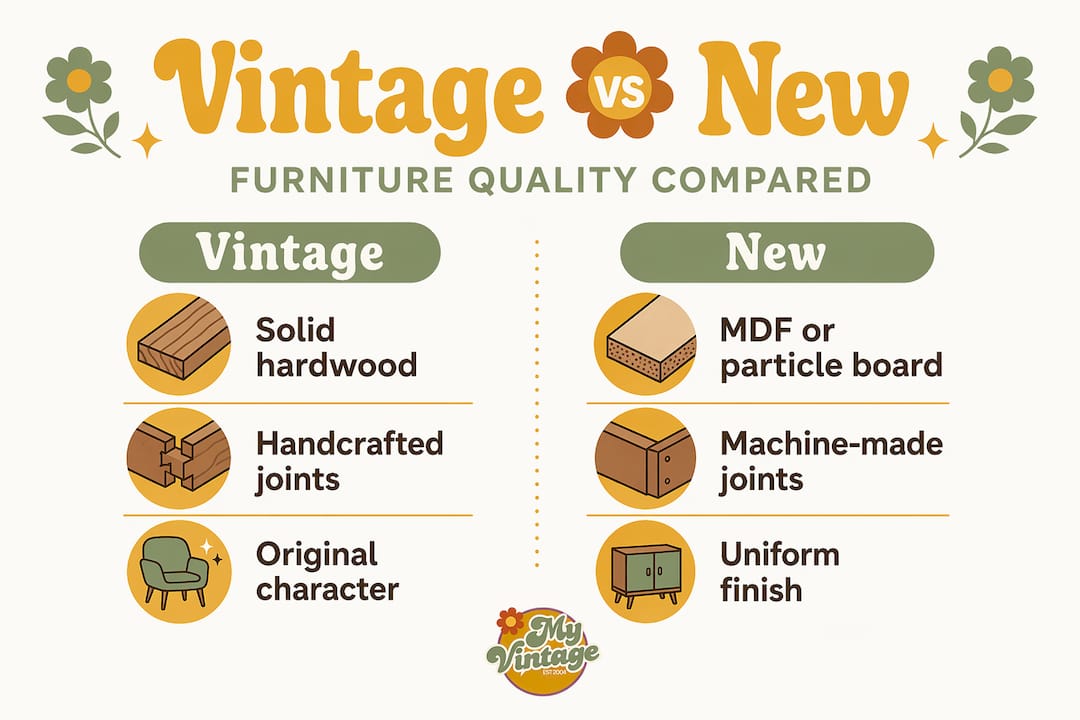
One of the most under-appreciated vintage decor advantages is the quality of construction. Many pieces made before the era of mass manufacturing were built to last decades, not seasons. Solid hardwoods, hand-cut dovetail joints, and hand-laid veneer were standard practice rather than premium options. You are unlikely to find those things in most high-street furniture today.
House Beautiful’s advice on evaluating vintage construction is worth knowing: look for dovetail joints in drawers and solid wood frames rather than MDF cores. These are reliable signals of long-term durability. A piece built this way can be stripped, repainted, or reupholstered and still outlast several rounds of modern replacements.
Vintage rugs are a particularly good example. According to Veranda’s expert guidance, handwoven vintage rugs are typically vegetable-dyed and far more tightly constructed than their machine-made equivalents. That density makes them better suited to high-traffic areas where a cheaper rug would pill or thin within a few years.

Pro Tip: When examining vintage furniture, pull out a drawer and look at the underside of the joints. Dovetail joints cut by hand are slightly irregular, whereas machine-cut ones are perfectly uniform. Hand-cut almost always signals an older, better-quality piece.
Here is a quick comparison to put the quality argument in context:
Feature | Vintage piece | Mass-produced new piece |
Frame material | Solid hardwood | MDF or particle board |
Joints | Dovetail or mortise-and-tenon | Staples or dowels |
Upholstery potential | Fully reupholsterable | Often not worth restoring |
Resale value | Holds or appreciates | Depreciates quickly |
Lifespan | Decades with care | Often 5 to 10 years |
When you think about why vintage furniture makes sense as an investment, this table tells the story clearly. Restoring a vintage piece with solid bones is almost always cheaper than replacing a mass-produced item that has worn out. The craftsmanship is already there. You are simply giving it a new chapter.
The Sustainability Argument for Vintage
The environmental case for buying vintage is not a minor footnote. It is one of the most powerful reasons to choose vintage over new, particularly as awareness of furniture waste grows. The furniture waste crisis is significant: Americans alone generate over 12 million tonnes of furniture waste annually, a 450% increase since 1960. The UK tells a similar story, with fast furniture following the same disposable logic as fast fashion.
Every vintage piece you bring into your home is one fewer item manufactured, shipped, and destined for landfill. As design expert Alec Broughton notes, buying vintage limits carbon emissions and reduces landfill contributions in measurable ways. You are participating in a circular economy rather than a linear one.

The broader philosophy is sometimes called slow decorating, and it sits neatly alongside other mindful consumer habits:
Choosing fewer, better objects rather than filling space quickly
Prioritising longevity over trend cycles
Reducing the demand for newly manufactured goods
Supporting local markets, dealers, and charity shops rather than global supply chains
If you want to understand more about how this connects to the broader picture, our guide on the environmental impact of vintage goes into useful detail. The core idea is simple though. Buying vintage is one of the most accessible ways a homeowner can make a genuinely sustainable choice without sacrificing style or beauty. In fact, style tends to improve.
How to Shop for Vintage Decor that Works in Your Home
Knowing you want vintage decor is one thing. Knowing how to pull it off without your home looking like a car boot sale is another. The good news is that the approach is straightforward once you understand a few guiding principles.
Start with a hero piece. Choose one significant vintage item as the anchor of a room. A sculptural lamp, a mid-century sideboard, or a Kilim rug can carry a space. Build around it rather than filling a room with equal-sized vintage finds that compete for attention.
Echo colours across eras. Mixing vintage with modern works best when you use colour as a connective thread. If your vintage ceramic has a particular ochre tone, pick up that colour in a modern cushion or a throw. This stops the room feeling like a period reconstruction and makes it feel curated instead.
Assess condition honestly. Look past surface grime or dated upholstery. Structural integrity is what matters. Wobbly frames, signs of woodworm, or damaged veneer that cannot be repaired are genuine concerns. A dirty but solid piece is almost always worth it.
Think practically as well as aesthetically. Younger buyers are leading the way here. Gen Z and millennial buyers are gravitating towards vintage patterned ceramics, compact antique desks, and decorative storage that solves real problems in smaller homes.
Add smaller vintage details for impact without commitment. You do not need a full room overhaul to feel the benefits. Small vintage details like cast-iron hardware, period door pulls, or a vintage mirror can add soul to a modern space without disrupting what is already working.
When it comes to sourcing, explore car boot sales, estate sales, online platforms, charity shops, and specialist dealers. Each source has its strengths. Estate sales and dealers often yield the best quality. Charity shops and markets offer more affordable entry points and the thrill of the unexpected find.
Pro Tip: When mixing eras, keep your largest pieces (sofa, bed frame, dining table) in one design language and let vintage pieces play supporting or statement roles. This prevents visual chaos and gives each vintage piece room to breathe.
The key is to treat vintage shopping as an ongoing pleasure rather than a one-time project. Vintage decor style examples can help you discover which eras and aesthetics resonate with your existing home before you commit to any purchase.

My Honest Take on Why Vintage is Worth It
I have been sourcing and styling vintage pieces for a long time, and my view has only strengthened: vintage decor is not a trend. It is a genuinely better way to furnish a home.
What I have learned is that the biggest mistake people make is waiting for the perfect piece rather than recognising potential. I once passed on a scuffed 1950s oak sideboard because it looked unloved. Someone else bought it, oiled it, replaced the handles, and it became the focal point of a beautiful room. I still think about that sideboard.
The other thing I know from experience is that mixing vintage with modern is less difficult than people imagine. You do not need to be a trained interior designer. You need one confident choice, a willingness to live with things for a little while, and some curiosity about what worked in the past and why. The visible age and texture of a genuinely old piece, placed thoughtfully against clean modern lines, tells a room story that no showroom set-up can replicate.
Vintage decor is also simply more interesting to own. There is a difference between buying something and discovering something. That feeling matters. It makes you more connected to your home, more proud of it, and honestly more likely to care for it.
Discover Authentic Vintage Homeware at My Vintage
If this article has sparked the urge to start your own vintage decor collection, My Vintage is a wonderful place to begin. Since 2004, the team has been carefully curating authentic vintage and retro homeware, selecting pieces for their character, quality, and originality.
Whether you are searching for a sculptural lighting piece, a characterful ceramic, or something truly original, the My Vintage collection offers genuine finds rather than reproduction approximations. One particularly special piece is this original 1950s atomic magazine rack, a perfect example of mid-century design confidence that adds instant personality to any room. Every piece on the site has been chosen with the same care you would bring to your own home. Browse, discover, and find something worth keeping.
Frequently Asked Questions
Why is vintage decor better than buying new?
Vintage decor offers superior craftsmanship, genuine character, and a lower environmental impact than most new mass-produced alternatives. Pieces made with solid wood and handwoven textiles typically outlast modern equivalents by decades.
Is vintage decor worth the investment?
Yes. Well-chosen vintage pieces hold their value far better than flat-pack or fast furniture, and many appreciate over time. Restoring a structurally sound vintage item is almost always more cost-effective than repeated replacement of cheaper new goods.
How does vintage decor enhance a space?
Vintage decor adds emotional authenticity and visual depth that modern pieces rarely replicate. Research on place authenticity shows that objects connected to history and culture make a home feel more rooted and personally meaningful.
Where can I find vintage decor in the UK?
Good sources include estate sales, local markets, charity shops, specialist antique dealers, and curated online retailers like Myvintage, which has been selecting quality vintage homeware since 2004.
Can you mix vintage decor with a modern interior?
Absolutely. The most effective approach is to choose one or two strong vintage statement pieces and use colour and texture to connect them to modern furnishings, creating a cohesive look that feels current rather than dated.
Recommended


Comments