


1940s Clothes: Classic Vintage Style
- May 10
- 10 min read

Few decades in fashion history carry as much undeserved baggage as the 1940s. Many people assume wartime rationing meant drab, shapeless clothing with little flair. The reality is quite the opposite. Utility clothing regulations and fabric restrictions forced designers, dressmakers, and everyday women to become remarkably inventive, producing silhouettes and techniques so well-considered that they continue to inspire vintage lovers today. If you are building an authentic vintage wardrobe or seeking truly distinctive pieces, 1940s fashion offers far more creativity, quality, and lasting style than most people expect.
Table of Contents
Key Takeaways
Point | Details |
Signature 1940s style | Strong shoulders, nipped waists, and sleek suits define authentic 1940s clothing. |
Rationing’s creative impact | Wartime constraints led to ingenious garment construction and everyday innovation. |
Quality and durability | Robust seams and smart textile use make 1940s garments exceptional survivors. |
Styling and collecting tips | Mix 1940s clothes with modern basics for a unique look and preserve originals with care. |
What Defines Authentic 1940s Clothes?

To set the stage for understanding 1940s fashion, let’s clarify the hallmarks that distinguish truly authentic pieces. Knowing what to look for is the difference between spotting a genuine wartime gem and walking past it entirely.
For women, the 1940s silhouette was immediately recognisable. Padded shoulders, nipped waists and straight or A-line skirts sitting at the knee defined the look. Utility dresses made from rayon, wool, or jersey were the everyday staple, kept deliberately simple with minimal buttons, pleats, and pockets to conserve fabric. Trousers for women also entered the mainstream as women took on factory and land-army roles, a genuinely revolutionary shift in dress that had lasting consequences.
Men’s tailoring tells an equally interesting story. Wartime regulations led to narrower lapels and single-breasted jackets with no turn-ups on trousers, cutting fabric use wherever possible. Despite these restrictions, suits remained well-constructed and carried a quiet dignity. Accessories such as fedora hats and trench coats added character and practicality in equal measure.
Key features to look for in authentic 1940s garments:
Padded or structured shoulders on women’s jackets, blouses, and dresses
Straight or gently flared knee-length skirts
Minimal decorative details: few buttons, no elaborate trims
Fabrics including rayon, wool crepe, and utility jersey
Single-breasted jackets on men’s suits with narrow lapels
Sturdy, practical footwear such as platform shoes or lace-up brogues
Accessories including pillbox and wide-brimmed hats, gloves, and brooches
The distinction between 1940s pieces and those from neighbouring decades is often subtle but meaningful. A 1940s dress will typically sit squarely on the knee rather than below it as in the 1930s, and it will lack the full, petticoat-supported skirts of the 1950s. Details matter enormously here.
Pro Tip: When evaluating a potential vintage find, check the shoulder seam position. In authentic 1940s women’s garments, the shoulder seam often sits slightly off the natural shoulder, creating that characteristic square, structured silhouette you simply cannot replicate with a modern cut alone.
Feature | 1930s style | 1940s style | 1950s style |
Skirt length | Below knee, bias cut | At the knee, straight | Below knee, full circle |
Shoulders | Natural, soft | Padded, squared | Soft, rounded |
Waist | Relaxed or belted | Nipped in sharply | Exaggerated hourglass |
Fabric | Satin, silk, chiffon | Utility wool, rayon, jersey | Cotton, taffeta, nylon |
Silhouette | Fluid, elongated | Angular, practical | Feminine, full |
How Wartime Rationing Shaped 1940s Wardrobes
Having covered the key characteristics of 1940s style, it is vital to understand why these traits exist. The era was shaped as much by necessity as by choice, and the mechanics of rationing tell a fascinating story.
In the UK, clothes rationing began in June 1941 and initially allocated 66 coupons per person per year. A dress cost 11 coupons, a coat cost 18, and even a pair of stockings required 2. By 1945, the annual allowance had been cut to just 36 coupons, forcing people to make genuinely difficult choices about how they dressed. This was not a minor inconvenience. It was a fundamental restructuring of how ordinary people related to clothing.
“Wartime rationing, for all its hardships, democratised access to well-made clothing in a way that fast fashion has entirely reversed. The CC41 Utility Clothing scheme meant working-class women wore the same quality as their wealthier neighbours.”

The American L-85 regulations operated somewhat differently. While both systems aimed to reduce fabric consumption, WWII fashion rationing in Britain was more stringent, with firmer limits on styles and embellishments. This explains why some American garments from the same period appear slightly more decorative or varied in silhouette.
How rationing changed the way people dressed:
Women repurposed men’s suits, curtains, and pre-war fabrics into new garments.
Patching and piecing became widely practised skills rather than signs of poverty.
Knitting patterns became enormously popular as wool remained more accessible than coupon-dependent fabric.
Dyeing faded garments extended their lifespan significantly.
Community “make do and mend” groups shared techniques and patterns.
Understanding this context makes wartime style change far more than a historical footnote. It is the key to appreciating why these garments feel so considered, even when their designs appear modest at first glance.
Expert Secrets to Vintage 1940s Construction
These constraints forced inventiveness, not only in style but in garment-making craft itself. Here is how the makers of the 1940s turned challenges into remarkable assets.
One of the most striking features of authentic 1940s garments is their construction quality. With fabric strictly limited, every centimetre counted. Makers used single-layer cutting techniques to minimise waste, pattern pieces were nested tightly together, and linings were often omitted entirely to save material. What remained was finished meticulously because there was simply no fabric to spare for corrections.
Seams were sewn with durability in mind. You will often find flat-felled seams (a technique where one seam allowance wraps around the other to create a neat, double-stitched finish) in workaday utility garments, providing exceptional strength. Stress points at underarms and pockets were reinforced with additional stitching or small stay-stitches that modern mass production rarely bothers with.
What to assess when examining a 1940s garment for authenticity and condition:
Look for hand-stitching at hems and facings, a sign of skilled construction
Check for metal rather than plastic zip fastenings, as nylon zips came later
Examine seam allowances, which tend to be generous in 1940s pieces, allowing for alteration
Feel the fabric weight. Authentic utility wool has a satisfying density rarely matched by modern reproductions
Look for internal belt carriers, shaped waist seams, and shoulder pads sewn directly into the garment rather than removable
Statistic to note: Fabric consumption per garment in the UK dropped by an estimated 25% during the wartime period due to utility regulations, yet customer complaints about garment quality actually fell during the same years, suggesting that focused craftsmanship compensated effectively for reduced materials.
Pro Tip: If you are restoring an authentic 1940s piece, source wool crepe or utility-weight wool from specialist fabric suppliers rather than modern lightweight alternatives. The weight and drape of the original fabric is what gives 1940s garments their characteristic structure, and a lightweight replacement will change the silhouette noticeably.
From Austerity to Glamour: Evening and Post-War Looks
Understanding construction leads naturally into the era’s range, from strictly functional to unexpectedly glamorous. Let us decode how these styles emerged and diverged across the decade.
Not all 1940s clothing was uniform and utilitarian. Evening wear occupied a different world entirely. With evening fabrics partially exempted from the harshest restrictions, skilled dressmakers created remarkable gowns from salvaged fabrics, pre-war remnants, and cleverly pieced together scraps. Beading and embroidery were applied by hand to elevate simple silhouettes into genuine occasion pieces.

The divide between Hollywood glamour and UK restraint is particularly vivid when comparing evening looks. American studios dressed stars such as Rita Hayworth and Lauren Bacall in sweeping gowns with more embellishment than UK regulations permitted. British evening wear was generally more restrained, but this austerity produced its own elegance, an understated sophistication that still feels modern today.
“The post-war ‘New Look’ by Christian Dior in 1947 was a direct rejection of wartime austerity, introducing full skirts and nipped waists that used enormous amounts of fabric deliberately. For many British women, it felt both thrilling and slightly obscene given the continued rationing.”
Style category | Wartime utility | Post-war new look |
Skirt volume | Straight, minimal fabric | Full, padded, extravagant |
Waist | Nipped but practical | Dramatically corseted |
Fabric | Wool, rayon, jersey | Silk, taffeta, heavyweight cotton |
Mood | Purposeful, democratic | Opulent, aspirational |
Construction | Minimal lining, flat seams | Structured boning and petticoats |
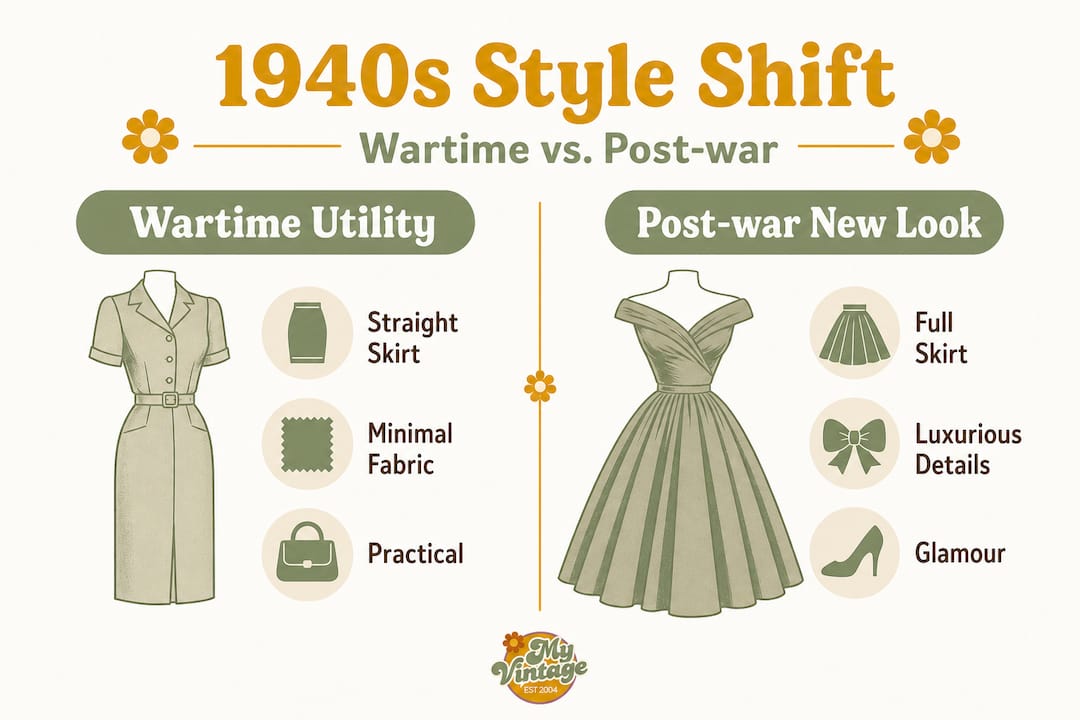
The post-war New Look was not universally welcomed. Many women who had spent years mastering the art of making do felt that Dior’s extravagance was almost disrespectful. Yet it also represented genuine relief and joy after years of restriction. Both perspectives are valid, and both inform how we understand 1940s fashion as a whole. You can find a rich selection to browse when you explore the vintage spring dress guide at My Vintage, where both wartime and post-war silhouettes are represented.
How to Wear and Collect 1940s Clothes Today
Now that you recognise the full spectrum of 1940s clothing, here is how you can confidently adopt and enjoy these vintage treasures in your daily style.
Finding genuine pieces requires patience and knowledge in equal measure. Charity shops, specialist vintage fairs, and trusted online vintage retailers are your best starting points. When sourcing, always prioritise condition over price. A slightly more expensive piece in excellent original condition is far better value than a damaged bargain that requires costly restoration.
Steps to building a wearable 1940s-inspired wardrobe:
Start with a versatile utility dress in a neutral colour such as navy, forest green, or burgundy. These pair naturally with modern wardrobe staples.
Add a structured blazer or box jacket with padded shoulders. This single piece transforms modern outfits instantly and works across seasons.
Invest in authentic accessories: a wide-brimmed or pillbox hat, leather gloves, and a brooch or two go an enormously long way.
Source wide-legged trousers in a heavy fabric for a practical 1940s working-woman look that feels entirely contemporary.
Choose footwear carefully. Platform shoes, Mary Janes, and lace-up brogues all read as authentically 1940s and remain comfortable for daily wear.
Mixing 1940s pieces with modern items is entirely encouraged. A utility-style dress paired with modern ankle boots and a contemporary tote bag creates a wearable, stylish look without feeling like a costume. The key is balance. You want the 1940s piece to lead the outfit rather than compete with other statement items.
For preservation, store authentic vintage garments in breathable fabric bags rather than plastic. Keep them away from direct light to prevent fading, particularly with rayon and wool. If you are dressing in 1940s style for an event or photoshoot, air the garments beforehand and steam rather than iron to avoid damaging fragile vintage fabric.
Pro Tip: When mixing vintage and modern pieces, use the “one era at a time” rule. Let your 1940s garment be the anchor, then build around it with neutral modern basics rather than mixing multiple vintage decades at once. This creates a cohesive look that feels styled rather than eclectic.
The Overlooked Power of 1940s Fashion Ingenuity
In stepping back from the how-to, I want to share something we have genuinely come to believe through years of sourcing and studying vintage clothing: the 1940s represents a kind of making philosophy that modern fashion has almost entirely abandoned.
We talk often about sustainability in fashion today, and rightly so. But there is a certain irony in the fact that the most sustainable fashion decade by necessity produced garments so well-made that they still exist and function eighty years later. A wartime utility dress outlasted countless wardrobes of fast-fashion pieces that did not survive their second season.
The wartime creativity we see encoded in 1940s garments was not born from trend or aspiration. It was born from genuine constraint. And yet constraint produced mastery. Dressmakers who learned their craft under rationing became extraordinary problem-solvers, understanding fabric behaviour, garment structure, and longevity in ways that formal training rarely produces.
What this means for modern vintage enthusiasts is genuinely encouraging. When you wear a 1940s garment, you are wearing the product of someone’s complete skill and attention. There was no cutting corners, no cheap interfacing, no throwaway mentality. That quality is irreplaceable, and it is why authentic 1940s pieces feel different on the body. They have intention stitched into them.
The lesson for contemporary dressers is clear: learning to identify, care for, and celebrate these garments is not just about style. It is about valuing the kind of thoughtful making that took an entire generation’s ingenuity to perfect.
Bring 1940s Style into Your Wardrobe
Ready to dress the part yourself? Finding authentic and stylish 1940s clothing is closer than ever.
At My Vintage, we have been sourcing and curating genuine vintage pieces since 2004, and the 1940s collection remains one of our most beloved. Whether you are searching for a CC41-labelled utility dress, a structured box jacket, or the perfect wartime accessories to complete a look, we update our stock regularly to ensure there is always something new to discover.
Browse our collections across women’s, men’s, and accessories categories to find pieces that tell a real story. We also supply vintage costume clothing for film, television, and theatre productions, so every item is authenticated and accurately described. Start or expand your 1940s wardrobe today at My Vintage and wear something that was built to last.
Frequently Asked Questions
What fabrics were most common in 1940s clothing?
Rayon, wool, and jersey were the most widely used fabrics, with cotton and utility blends also appearing due to wartime fabric restrictions and coupon rationing.
How did people accessorise 1940s outfits?
Accessories were both practical and stylish, typically including hats, gloves, belts, and brooches, with men favouring fedoras and trench coats as everyday staples.
Did the 1940s have different fashion rules in the UK compared to the US?
Yes. The UK’s CC41 Utility Clothing scheme was stricter than the American L-85 order, which allowed more styling flexibility and some Hollywood-influenced glamour in women’s and men’s dress.
Why are 1940s clothes considered durable?
Wartime necessity meant garments were built with reinforced seams and flat-felled construction techniques, resulting in exceptional longevity that mass-produced modern clothing rarely matches.
Recommended


Comments