


Chelsea Boots: From Everyday Victorian to Sixties Cool
There are certain pieces of fashion that seem to belong to just about every generation, and the Chelsea boot is a particularly good example. Equally at home beneath a sharply tailored 1960s suit, a pair of well-worn jeans or a modern winter coat, this wonderfully uncomplicated ankle boot has managed to remain stylish for the best part of two centuries. Its distinctive elastic sides, neat silhouette and easy slip-on design are instantly recognisable, even if most of us probably give very little thought to where it all began.

What makes the Chelsea boot especially interesting is the rather unlikely journey it has taken through fashion history. Long before the Beatles made it famous, its ancestors were being worn in Victorian Britain, and what began as a practical improvement to everyday footwear eventually found itself at the heart of London's swinging sixties. Along the way, the Chelsea boot has been embraced by musicians, fashion-conscious youngsters, country dwellers and just about everyone in between. For something so apparently simple, it has accumulated quite a colourful past.
A Victorian Invention with a Very Modern Idea
The origins of the Chelsea boot take us all the way back to the early Victorian period, when footwear was generally a much more complicated business than it is today. Boots were commonly secured with laces or rows of tiny buttons, which might look wonderfully elegant but were hardly the most convenient things to deal with when getting dressed. The introduction of elastic-sided boots offered a clever solution, allowing the wearer to pull them on without fiddling with fastenings.
The design is closely associated with Joseph Sparkes Hall, a London bootmaker who supplied footwear to Queen Victoria. In 1837, Hall patented an elastic-sided ankle boot developed through experiments with India rubber cloth. Its flexible side panels allowed the boot to fit closely around the ankle while remaining easy to put on and remove, often with the help of a small fabric loop at the back. It was an ingenious piece of practical design, particularly for an age when even the simplest everyday garments could involve an astonishing number of buttons.
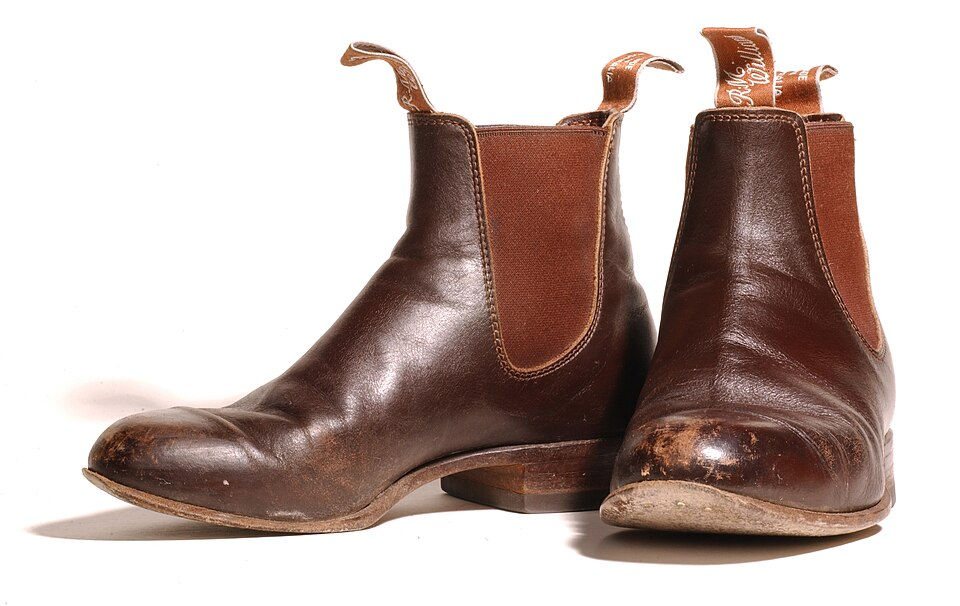
The boots soon found favour as comfortable footwear for walking and riding, eventually becoming associated with the countryside and equestrian life. By the later nineteenth century, elastic-sided ankle boots were often known as paddock boots, a name reflecting their practical uses. Although the materials and construction would continue to improve, the essential idea had already been established: a close-fitting ankle boot that combined comfort, convenience and a pleasingly tidy appearance. More than 180 years later, that original principle remains remarkably familiar.
How the Chelsea Boot Found Its Name
Despite its Victorian beginnings, the Chelsea boot didn't acquire its strongest fashion identity until the middle of the twentieth century. By then, the elastic-sided ankle boot was an established style, but it was hardly considered the height of youthful sophistication. That was about to change as a new generation began experimenting with clothing that challenged the more conservative tastes of post-war Britain.
During the late 1950s and early 1960s, London's King's Road became increasingly associated with fashionable young people, artists, designers and musicians. Chelsea was developing a reputation as somewhere exciting, where new ideas about clothes, music and modern living were beginning to flourish. The fashionable social circle sometimes referred to as the Chelsea Set helped give the area its distinctive image, and the revived elastic-sided boot became closely associated with this new world of youthful style.
The name Chelsea boot became established around this period, linking a much older piece of practical footwear with one of London's most fashionable neighbourhoods. It was a rather extraordinary transformation when you think about it. A design that had once been associated with Victorian walking and riding was now becoming part of a new urban wardrobe, worn by people who were far more interested in looking stylish on the King's Road than wandering around a country paddock.
The Beatles, the Mods and the Making of a Fashion Icon
If Chelsea gave the boot its fashionable identity, the Beatles helped introduce its possibilities to an international audience. During the early 1960s, the group became closely associated with slim-fitting suits, narrow trousers and distinctive ankle boots, creating a look that was smart, modern and just rebellious enough to appeal to a generation eager to dress differently from its parents.
London theatrical shoemakers Anello & Davide played an important part in developing the look. In 1961, John Lennon and Paul McCartney commissioned modifications to Chelsea boots, introducing the higher Cuban heels that would become a characteristic feature of the famous Beatle boot. With its slimmer profile, pointed or tapered toe and more pronounced heel, this variation gave the traditional ankle boot a theatrical edge. The result worked beautifully with the narrow trousers and tailored suits that became such an important part of the group's early image.

The style also appealed to the Mods, whose carefully considered appearance helped define British youth fashion during the decade. Sharp tailoring, narrow trousers and beautifully polished footwear were all part of the look, and Chelsea boots offered exactly the sort of clean, streamlined shape that worked with it. Their lack of laces kept the line of the shoe wonderfully uncluttered, while the more exaggerated Cuban-heeled versions added a little swagger. Other musicians, including members of the Rolling Stones, also embraced the style, strengthening its association with the rapidly changing world of popular music.
It's difficult to imagine quite how exciting this must have seemed at the time. Fashion, music and youth culture were becoming increasingly intertwined, and something as ordinary as a pair of boots could signal that you belonged to a very different generation. Chelsea boots were no longer simply practical footwear. They had become part of the visual language of the swinging sixties, instantly associated with an era when British fashion seemed to be making headlines around the world.
A Style That Crossed Fashion's Boundaries
Although the Chelsea boot is frequently associated with men's fashion, particularly the Beatles and the Mod movement, women were equally important to its developing popularity. The clean ankle-high shape worked beautifully with the changing silhouettes of the 1960s, complementing everything from tailored trousers to the shorter skirts and dresses that were transforming fashionable wardrobes.
One of the most appealing things about the design was that it didn't need to be dramatically altered for different wearers. The same basic combination of elastic side panels, a neat upper and a close-fitting ankle could look equally effective with masculine tailoring or a more feminine outfit. It was part of a broader shift towards fashion that felt younger, less formal and increasingly willing to borrow ideas across traditional boundaries. By the middle of the decade, fashionable elastic-sided boots could be found in remarkably similar styles for men and women.

The Chelsea boot also demonstrated how readily a familiar design could take on different personalities. In polished black leather it looked sleek and sophisticated, particularly with a narrow trouser leg. Brown leather offered a softer, more relaxed appearance, while suede brought an altogether different texture and character. The shape itself remained recognisable, but small changes in the toe, heel, material or finish could completely alter the impression it gave.
From Sixties Cool to a Modern Wardrobe Favourite
Unlike some of the more extravagant footwear fashions of the twentieth century, the Chelsea boot never depended on a particularly outrageous silhouette to make its mark. Its appeal lay in its simplicity, which made it wonderfully adaptable as fashions changed. While the narrow, Cuban-heeled styles of the 1960s remained closely associated with rock music and Mod culture, more traditional versions continued to serve as dependable everyday footwear.
Over the following decades, Chelsea boots appeared in everything from smart leather styles to sturdier designs intended for more practical wear. The combination of an enclosed upper, elastic sides and an easy pull-on fit proved equally suited to country footwear and city wardrobes. Fashion has repeatedly revisited the shape, sometimes favouring elegant, slim-fitting versions and at other times experimenting with heavier soles, rounded toes and more substantial proportions.

More recently, chunky Chelsea boots have introduced yet another interpretation of this familiar design. Thick, ridged soles and contrasting colours can give the boot a bold contemporary appearance, while traditional brown suede or polished black leather versions retain much of their understated charm. It's quite a testament to the original design that a Victorian-inspired ankle boot can accommodate such different looks without losing its identity.
Why Chelsea Boots Never Really Go Out of Fashion
Having spent more than twenty years surrounded by vintage clothing and accessories, I've developed a particular appreciation for designs that manage to remain relevant without constantly reinventing themselves. Chelsea boots fall comfortably into that category. Their proportions are generally flattering, they work with an enormous range of clothes, and their straightforward construction means they rarely feel out of place, even when the rest of fashion has gone off on one of its more adventurous tangents.
For vintage lovers, they're especially useful because they can complement clothes from several different decades without making an outfit feel like a costume. A slim black pair looks wonderful with 1960s-inspired tailoring, while brown suede Chelsea boots can soften the appearance of 1970s-style flared trousers or a relaxed denim outfit. More substantial versions can work just as well with later vintage looks, particularly when worn with oversized knitwear, loose-fitting trousers or a favourite old coat. The trick is often in the proportions: slimmer boots naturally complement neater silhouettes, while chunkier designs can balance fuller or more relaxed clothing.

There is also something particularly satisfying about a well-made pair of leather boots that develops character with age. Leather softens, the finish acquires a little patina, and a favourite pair gradually becomes part of its owner's everyday wardrobe. When buying genuine vintage Chelsea boots, it's worth paying particular attention to the condition of the elastic panels, which can lose their stretch over time, as well as checking the soles, stitching and overall structure. Elastic gussets can sometimes be replaced by a skilled repairer, giving an otherwise beautiful pair a new lease of life.
Perhaps that is why the Chelsea boot has enjoyed such extraordinary longevity. Its history encompasses Victorian ingenuity, fashionable London society, the Beatles, Mod culture and countless later interpretations, yet the design remains reassuringly recognisable. Few pieces of footwear can claim such a varied history while still looking entirely at home in a modern wardrobe. Whether you prefer the sharp elegance of a classic black leather pair or the slightly more rugged charm of a well-worn brown boot, the Chelsea boot continues to prove that good design doesn't need to make a great deal of fuss to leave a lasting impression.


Comments