


Window Shopping: When the High Street Was Theatre

There was a time when going into town meant more than simply buying what you needed. The high street itself was part of the outing: polished windows, carefully dressed mannequins, department stores glowing after dark and whole displays designed to make you stop in your tracks before you had even reached the door. You might have gone out for stockings, a birthday present or nothing in particular, yet still found yourself lingering in front of a window that had somehow transformed a few dresses, handbags and lamps into a tiny world of aspiration. Long before online wish lists and endless scrolling, this was where many people first encountered the season’s new fashions.
Shop windows were advertising, of course, but the best of them were also entertainment. They could be witty, glamorous, surreal or wonderfully over-the-top, using props, painted backdrops, theatrical lighting and mannequins posed as though they had lives of their own. A good display did not simply say, “Here is a coat.” It suggested where you might wear it, who you might become in it and what sort of life might be waiting just beyond the glass. In many ways, window shopping was the original version of browsing: pleasurable even when you had absolutely no intention of buying anything.
That is perhaps why old photographs of department-store windows remain so captivating. The clothes matter, but so does everything around them. You notice the flooring, the lettering, the carefully placed handbag, the painted scenery, the slightly eerie mannequin expression and the confidence with which an entire fantasy has been built around a product that might otherwise have looked quite ordinary on a rail. Retail understood very early that people were not only buying objects. They were buying ideas.
When the Window Was the Advertisement
Before television advertising became part of everyday life and decades before social media could put a new collection in front of millions of people in seconds, the shopfront was one of a retailer’s most valuable pieces of advertising space. It was visible all day, every day, to anyone passing on foot, on a bus or from the back seat of a car, and a successful display could tempt somebody into a shop they had not planned to visit at all.
The great department stores understood this particularly well. Their windows often had the scale and budget to become miniature stage sets, with professional display teams creating scenes that changed with the seasons. Fashion might be placed in an elegant drawing room one month and surrounded by spring flowers the next, while Christmas gave window dressers permission to abandon restraint almost entirely. Mechanical figures, artificial snow, toy scenes, lights and fantasy landscapes could turn a shopping street into something children and adults went specifically to see.
What made these displays so clever was that they rarely felt like shelves of merchandise placed behind glass. The products were edited. A few carefully chosen pieces were given space and context, which made them appear more desirable than they might have done among dozens of similar items inside the shop. The window taught the customer where to look, which colours belonged together and which object was supposed to feel new or special.
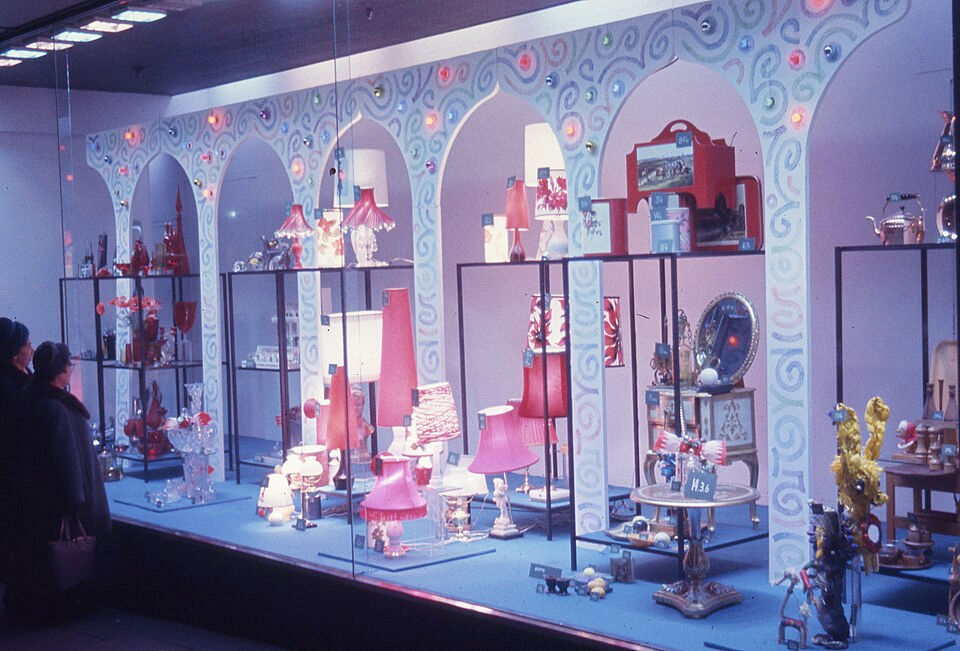
Fashion windows were especially powerful because clothing is so easily transformed by styling. A dress on a hanger is simply a dress; put it on a mannequin with gloves, a hat, shoes and the right handbag and suddenly it becomes an occasion. The customer no longer has to imagine quite so hard.
The Mannequin as Fashion Editor
Mannequins deserve far more credit than they usually receive in fashion history. They have been silent stylists, salespeople and occasionally rather unsettling residents of shop windows for generations, showing customers not just individual garments but complete looks. Their changing shapes, poses, hairstyles and faces have also reflected the fashionable ideals of different periods remarkably clearly.
Mid-century mannequins could be extraordinarily glamorous, with sculpted hair, arched brows and expressions that suggested they had somewhere far more exciting to be later that evening. Their poses often gave even practical daywear an air of elegance. By the 1960s, mannequins could look younger and sharper, perfectly suited to shorter hemlines and cleaner silhouettes, while later decades brought more abstract bodies, dramatic poses and increasingly stylised faces.
They also allowed retailers to do something editorial magazines were doing at the same time: show customers how to put a look together. A coat might be displayed with matching gloves and shoes; an evening dress with jewellery and a small bag; a simple skirt transformed by the right blouse, scarf and hat. Long before the phrase “shop the look” appeared online, the shop window had already mastered the idea.

There is something lovely about looking at an old window photograph and studying those combinations now. Some styling feels wonderfully elegant, some instantly dates the image, and occasionally there is a pairing so unexpected that you find yourself wondering why on earth we ever stopped doing it.
Dressing the Window Was a Skill
Window dressing was once a recognised creative profession with its own techniques, fashions and tricks of the trade. A display had to work from the pavement rather than from a few inches away, which meant thinking carefully about height, balance, colour and sightlines. Objects needed to be visible through reflections on the glass, lighting had to remain effective after dark and the arrangement had to attract attention without becoming so cluttered that nobody knew what was actually being sold.
The best window dressers understood theatre. They created focal points, repeated shapes and colours and used empty space deliberately. Fabrics might be draped to guide the eye, platforms used to vary height and props introduced simply because they created mood. A mannequin standing against a blank wall could show you a dress; the same mannequin surrounded by a carefully built scene could make you want the entire imaginary life that went with it.
This is why some vintage displays now look almost like art installations. Retailers could be remarkably adventurous, particularly when there was prestige attached to producing the most talked-about window on a fashionable shopping street. Surreal props, oversized objects and humorous scenes were not necessarily distractions from the products. They were what made people stop.
And stopping was the whole point. A passer-by who paused for thirty seconds was already more engaged than one who walked straight past.
The High Street as a Social Space
Window shopping also belonged to a different way of using town centres. For much of the twentieth century, the high street was not simply somewhere you went when you needed to make a purchase. It was a meeting place, a routine and often part of a Saturday afternoon or lunch-hour wander, particularly before large out-of-town shopping centres and online retail changed the geography of shopping.
People looked at windows together. Friends discussed dresses they could not afford, teenagers checked what had arrived in the fashionable boutiques and children pressed their noses against toy-shop glass while adults attempted to move them along. You could keep track of changing fashions without buying anything at all simply by noticing what appeared in the windows from week to week.
There was also an element of anticipation that is difficult to recreate now. New stock was not visible to you before it arrived. You had not already seen twenty photographs, three videos and an influencer wearing it on your phone. A changed window could genuinely reveal something new, and the display itself might be your first introduction to a silhouette, colour or styling idea that would soon be everywhere.
That slower discovery gave the high street its own rhythm. Windows changed for spring, summer holidays, autumn, party season and Christmas, creating little visual markers through the year. Retail and the calendar were closely intertwined, and even people who were not shopping could sense the season changing simply by looking at the displays.
Christmas Windows and the Art of Going Over the Top
If ordinary windows could be theatrical, Christmas windows were where restraint was politely shown the door. Department stores competed to create displays that felt magical enough to become traditions in their own right, and families could visit them year after year whether or not they intended to buy anything inside.
Fashion often became only one part of these scenes. Toys, model villages, winter landscapes, fairy-tale characters, moving figures and elaborate lighting could take over entire windows, while products were woven into the spectacle almost incidentally. The display was selling the store itself as much as any particular object. If people remembered where they had seen the beautiful Christmas window, that memory had value.

There is also something wonderfully democratic about this form of retail theatre. You did not have to buy a thing to enjoy it. The pavement was free, and the spectacle belonged to everybody passing by. For children especially, a department-store window could feel genuinely enormous and magical in a way that is difficult to appreciate from a photograph alone.
Even now, when elaborate seasonal displays still appear in some major cities, much of their charm comes from that older tradition. We expect Christmas windows to tell stories because retailers spent generations teaching us that they should.
When Youth Fashion Changed the Window
The explosion of youth fashion during the 1960s changed not only the clothes being sold but the way fashion retail presented itself. Younger customers did not necessarily want the stately atmosphere associated with traditional department stores, and a new generation of boutiques could be smaller, louder, brighter and considerably more playful.
Their windows could reflect that energy. Strong graphics, pop colours, unusual mannequins and a deliberately informal arrangement of clothes suited fashions that were becoming shorter, bolder and less interested in old ideas of propriety. The shop itself became part of a lifestyle, and its window announced immediately who the clothes were for.
This was an important shift because fashion retail began to fragment. The window was no longer always trying to appeal to everybody. A boutique could speak very directly to one particular customer, whether that meant fashionable teenagers, affluent women, countercultural shoppers or later punk and New Wave audiences. The more distinctive the identity of the shop, the more distinctive its window could become.
It is a pattern we still recognise today. The most memorable shops have always understood that presentation tells you something before you have looked at a price tag or touched a garment.
Why Vintage Shop Windows Look So Different
Part of the fascination of old retail photographs comes from the amount of space products were sometimes given. Modern visual merchandising can certainly be beautiful, but mass retail often has an enormous amount of stock to communicate, promotions to advertise and signage to squeeze into limited space. Older photographs frequently show a much more edited approach, particularly in higher-end department stores.
A handful of garments might occupy an entire window. Props were allowed room to breathe, backgrounds could be painted or constructed specifically for one display and mannequins often had enough space around them for the viewer to appreciate the silhouette. The result could feel surprisingly calm even when the concept itself was theatrical.

Of course, not every old shop window was a masterpiece. Plenty were crowded, practical or distinctly ordinary, just as they are now. Nostalgia has a habit of preserving the beautiful examples and quietly forgetting the shopfronts filled with handwritten price cards and fluorescent lighting. Yet the very best vintage displays show just how seriously retailers could take the craft.
They understood that a shop window had only a few seconds to start a conversation with someone walking past. That principle has not changed at all.
From Window Shopping to Scrolling
The biggest transformation in shopping has not been what we buy so much as how we first encounter it. Increasingly, the “window” is a screen. We browse collections while sitting on the sofa, discover outfits through social media and can compare hundreds of options without entering a town centre at all.
There are obvious advantages to that convenience, but something physical has inevitably been lost. A shop window has scale, light, reflection and context. You experience it while moving through a real place, surrounded by other people, weather, traffic, noise and all the small distractions of the street. Even the glass becomes part of the image, reflecting buildings and passers-by over whatever has been carefully arranged behind it.
Online shopping also encourages abundance. We can see almost everything at once, whereas the old-fashioned shop window depended on editing. Somebody had to decide which six dresses deserved to represent a whole department or which single coat was strong enough to stand alone beneath a spotlight. There is something rather refreshing about that confidence now.
Perhaps this is why a beautifully dressed independent shop window still has such power. When everything online is competing for attention, coming across a physical display made with imagination can feel surprisingly personal.

Why Do Vintage Shop Windows Still Fascinate Us?
They are tiny time capsules. Look closely at an old window and you can learn about far more than retail: clothing silhouettes, interiors, typography, beauty ideals, colour trends, social aspirations and even the technology available for lighting and display. A window created to last a few weeks can accidentally preserve the visual language of an entire period.
They also capture the gap between real life and fantasy that has always made fashion interesting. Most people looking through the glass were not going to buy everything they saw. Some would buy nothing. Yet they were still invited to imagine themselves inside the scene, whether that meant wearing an immaculate suit, owning a glamorous evening dress or simply living in a home where every lamp and ornament coordinated perfectly.
For vintage lovers, that invitation is wonderfully familiar. We know that clothing can transport you. A dress can evoke a decade you never lived through, a handbag can make an ordinary outfit feel completely different and a beautifully styled window can turn a pavement into the entrance to another world.
When Shopping Was Something to Look At
It would be easy to say that the old high street was simply better, but the truth is more complicated. Shopping could be less convenient, choice was often narrower and plenty of people lived nowhere near the glamorous department stores whose windows dominate the photographs we love today. The past was not one continuous parade of beautifully dressed mannequins.
What those photographs do remind us of, though, is the value once placed on presentation. Retailers understood that shopping could begin long before money changed hands. It began with curiosity, with somebody slowing their step, looking through the glass and wondering what was inside.
That feeling has never completely disappeared. We may browse differently now, but a really good shop window can still make us stop. Perhaps that is why the best vintage examples feel so alive decades later: they were designed to capture attention for a few fleeting moments, yet somehow they are still doing exactly that.


Comments