


Retro Patterns Explained: From History to Home and Fashion
Updated: May 15

There is a moment every vintage lover knows well: you spot a gorgeous swirling paisley print or a bold geometric wallpaper and find yourself wondering, is this actually vintage, or is it just retro? It is a genuinely tricky distinction, and getting it wrong can cost collectors money and interior enthusiasts their credibility. Understanding retro patterns, where they come from, what they symbolise, and how to use them confidently, transforms the way you shop, decorate, and dress. This guide will take you through everything, from defining retro against vintage, to recreating authentic patterns at home.
Table of Contents
Key Takeaways
Point | Details |
Retro vs vintage | Retro patterns imitate recent past styles while vintage refers to original items from older eras. |
Pattern history | Retro patterns like paisley and polka dots convey cultural and historical significance. |
Mixing patterns | Balance scale, palette, and solids to avoid chaos when decorating with retro motifs. |
Recreation tips | Use tracing, muslin tests, and period sewing techniques to adapt retro designs authentically. |
Sustainability and nostalgia | Retro patterns support sustainable fashion and evoke enduring nostalgia for collectors and designers. |
What makes a pattern retro?

The word “retro” is thrown around constantly in fashion and home decor, but it has a surprisingly precise meaning. A retro pattern is one that imitates the aesthetic of a bygone era rather than being an authentic artefact from that time. As a helpful rule of thumb, retro styles are reproductions of fashions from roughly 20 to 40 years in the past, whereas vintage refers to authentic original items, typically produced between the 1920s and the 1980s. The vintage vs retro difference matters enormously when you are buying, collecting, or decorating.
Here is a quick comparison to keep things clear:
Feature | Retro patterns | Vintage patterns |
Age | New reproductions inspired by past styles | Authentic originals from the era |
Authenticity | Imitative, modern production | Original period production |
Price | Generally lower | Often higher, collector value |
Purpose | Fashion, decor, nostalgia | Collecting, heritage, investment |
Examples | New 1970s-style wallpaper today | An original 1970s wallpaper roll |
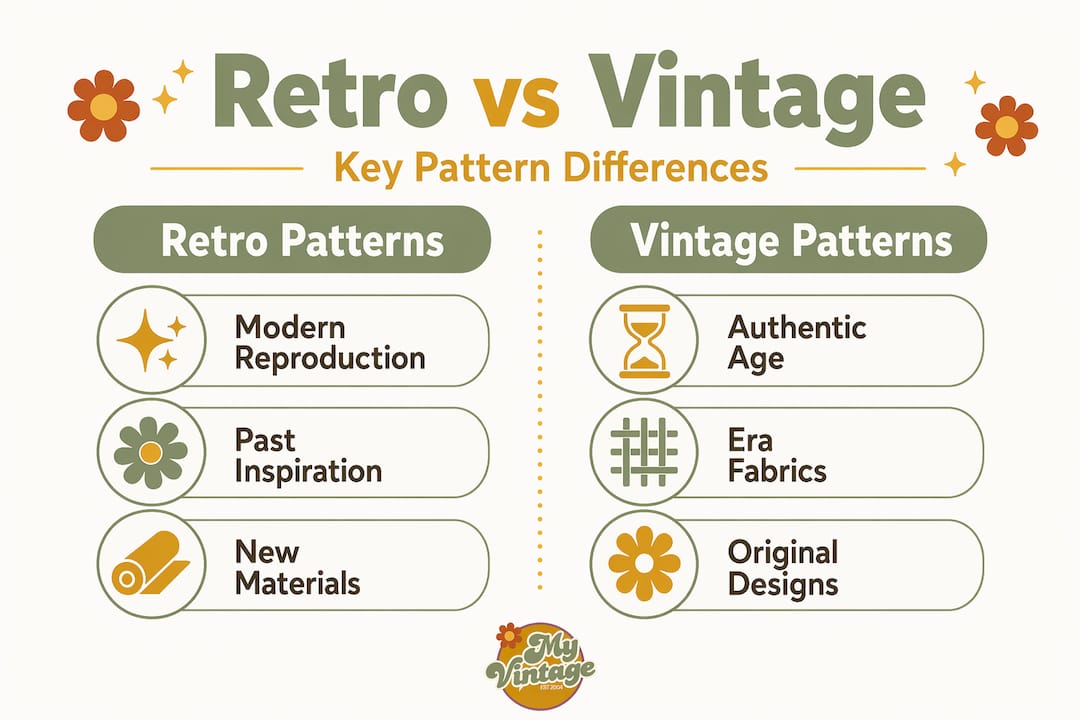
Retro patterns appear across fashion, homeware, stationery, and graphic design. Think of a brand new tea towel printed with atomic-age starbursts, or a modern dress cut from fabric woven with 1960s-style Op Art geometry. Neither is vintage, but both are unmistakably retro. The retro style definition encompasses a whole spectrum of decades and motifs, each with its own visual language.
What drives retro patterns back into popularity? Largely nostalgia. When a generation reaches adulthood, it tends to romanticise the visual culture it grew up with, or the decade its parents fondly remember. This cyclical pull means that fashion history evolution shows predictable revivals every 20 to 30 years. The 1970s resurfaces in the 1990s; the 1980s returns in the 2000s and again in the 2020s. Retro patterns are, in short, nostalgia made visible.
Key characteristics of a true retro pattern include:
Colour palettes that reference a specific decade (avocado greens and harvest golds for the 1970s; neon brights for the 1980s)
Motifs with identifiable era associations (atomic starbursts, Op Art spirals, psychedelic florals)
Reproduction materials, such as modern synthetic blends printed to mimic period textiles
Intentional styling that signals a look rather than simply being an old item
A Brief History of Iconic Retro Patterns Explained
Now that we have separated retro from vintage, it is worth appreciating just how rich and storied these patterns truly are. They are not simply decorative choices. They are, in many ways, visual records of human history.

Take paisley, arguably the most globally travelled pattern of all time. The paisley motif originates in ancient Persia roughly 2,000 years ago, where it was called “boteh” or “buta” and symbolised life, eternity, and fertility. It spread through Kashmir shawls and eventually arrived in Europe via trade routes in the 18th and 19th centuries. When the Scottish town of Paisley began weaving affordable versions of these coveted shawls, the pattern adopted its now-famous name. By the 1960s, paisley had become the defining motif of the counterculture movement, worn by rock musicians and peacenik protesters alike. Today, a paisley print garment signals bohemian confidence and cross-cultural appreciation simultaneously.
Here is a timeline of some of the most beloved retro patterns:
Decade | Pattern | Cultural significance |
1940s–1950s | Atomic prints, polka dots | Post-war optimism, space age wonder |
1960s | Op Art, paisley, psychedelic florals | Counter-culture, peace movement |
1970s | Geometric, earth-toned florals | Environmental awareness, disco era |
1980s | Bold graphic checks, Memphis design | Individualism, pop art influence |
1990s | Grunge plaids, minimalist stripes | Anti-establishment, minimalist cool |
Polka dots deserve special mention here. A pattern that seems almost childishly simple, the polka dot carries a surprisingly complex history. Its name is believed to derive from the Polish polka dance craze of the 19th century. The polka dot history stretches from Victorian novelty to Minnie Mouse iconography to high-fashion statements by designers like Yayoi Kusama and Christian Dior. Few patterns have managed to feel simultaneously classic, playful, and sophisticated across so many decades.
“Patterns are not decoration. They are documents. Each print reflects the technology, politics, and dreams of the era that created it.”
Atomic prints, popular in the 1950s, are another fascinating case. Inspired by the newly visible world of molecular biology and the excitement (and anxiety) surrounding nuclear science, these prints featured starbursts, boomerang shapes, and abstract molecular forms. They appeared on everything from kitchen linoleum to cocktail dresses, capturing a moment when humanity was giddy about science and slightly terrified of it at the same time.
Retro Pattern Application: Fashion and Home Decor
Understanding the history of retro patterns is deeply satisfying. Actually using them well, however, is where the real fun begins. Whether you are styling an outfit or refreshing a living room, the principles for mixing retro patterns are similar.
For home decor, mixing vintage patterns requires a thoughtful approach. A neutral base is your best starting point: cream walls, natural wood floors, or plain upholstery create breathing room. From there, introduce one dominant large-scale pattern, perhaps a bold geometric wallpaper or an oversized floral curtain fabric. Layer in smaller-scale patterns on cushions, throws, or rugs. The key rule is to maintain a shared colour palette of three to four colours across your patterns, so everything feels cohesive rather than chaotic. Aim for 40 to 50 per cent solids in any room, giving the eye places to rest.
One important nuance: avoid placing same-scale patterns next to each other, as this creates visual noise rather than considered eclecticism. If you love maximalism, you can push further, but you will still need those solid anchors. Contrast structured patterns like stripes with organic ones like florals or paisley for the most dynamic effect. Explore our retro living room ideas for real inspiration on bringing these principles to life.
For fashion, the same logic applies. When combining retro prints:
Choose a dominant print for your main garment (a bold floral dress or wide-leg geometric trouser)
Add a secondary pattern in a smaller scale (a thin striped blouse, a checked scarf)
Anchor with solids in one of the dominant print’s colours (a plain blazer, simple leather shoe)
Keep your colour family consistent so the overall look reads as intentional
Pro Tip: When sourcing retro print fabric for fashion, look at the repeat size. A large repeat (over 10cm) works best on bigger garments like skirts and blouses, where the full motif can be appreciated. Smaller repeats work beautifully on collars, cuffs, and accessories.
Retro patterns also translate beautifully in textiles used decoratively, such as textile-inspired wall art that brings colour, rhythm, and cultural depth to a room without overwhelming it. Keep an eye on our latest vintage arrivals for pieces that demonstrate these pattern combinations in real vintage and retro items.
Methodology: Recreating and Adapting Retro Patterns
Perhaps you have fallen for a particular era’s aesthetic and want to go further than simply buying ready-made pieces. Recreating retro patterns for your own clothing or soft furnishings is a genuinely rewarding project, though it does require some patience and a methodical approach.
When working with vintage sewing patterns, the most important step is to trace the original rather than cut it. Original patterns are irreplaceable. Use pattern paper or greaseproof paper to trace each piece accurately, preserving notches and grainlines exactly as marked. These tiny details are not optional extras; they are the difference between a garment that drapes correctly and one that twists and pulls.
Follow these steps for a successful retro pattern recreation:
Trace the original pattern onto fresh paper, marking all notches, grainlines, and instructions.
Make a muslin test garment using inexpensive calico fabric before cutting into your good material.
Adjust sizing as needed, bearing in mind that vintage sizing runs approximately 2 to 4 inches smaller in the bust and waist than modern equivalents.
Re-trace with adjustments before cutting the final fabric.
Use period-appropriate sewing techniques such as hand basting seams before machining, for authenticity and control.
Press each seam as you go, as vintage garment construction relied heavily on careful pressing for sharp, professional results.
Pro Tip: Never skip the muslin test. Retro and vintage fabrics, especially authentic period textiles, can be expensive and impossible to replace if you make a cutting error. A muslin costs very little but can save you from a costly and heartbreaking mistake.
Sizing adjustments are particularly important. The standard vintage sizing shift of 2 to 4 inches means that a pattern labelled size 14 in a 1950s catalogue would align more closely with a modern size 10 or 8. Always measure your body and compare to the pattern’s actual measurements rather than relying on the size label.
Our retro pattern reproduction resources and sustainable vintage patterns articles offer further guidance for those keen to explore this creative path more deeply.
Why Retro Patterns Matter More Today: Sustainability and Storytelling
Here is something I genuinely believe, and it is a perspective you will not often find in mainstream style guides: retro patterns are not simply a nostalgic indulgence. They are one of the most quietly radical responses to the crisis of fast fashion we have available to us right now.
The evidence supports this view. Retro patterns are experiencing sustained revivals in 2025 and into 2026, driven substantially by fast fashion fatigue. Google Trends data shows some retro design trends maintaining elevated interest for over ten months, far longer than typical fast fashion micro-trends which often peak and collapse within six to eight weeks. People are not just briefly nostalgic. They are genuinely searching for alternatives to disposable design.
What most mainstream guides overlook is that retro patterns carry an inherent sustainability argument. A vintage garment bearing an original 1960s geometric print, or a retro reproduction made to last, represents far less environmental cost than a cheaply made throwaway piece. When you choose a vintage sustainability perspective, you are making a choice that is simultaneously aesthetic and ethical.
Beyond sustainability, retro patterns matter because they are honest. They wear their era openly. A 1970s earth-toned floral tells you something real about what people valued, feared, and celebrated in that decade. In an age of algorithmically generated, culture-free design, there is something profoundly grounding about a pattern with genuine human history behind it. Collectors and fashion historians understand this instinctively. The rest of us are catching up.
Discover Authentic Retro Patterns For Your Home and Wardrobe
If reading this has sparked a desire to bring genuine retro patterns into your life, you are in exactly the right place. At My Vintage, we have been curating authentic vintage clothing and retro homeware since 2004, and we genuinely love connecting people with pieces that carry real history and personality.
Whether you are hunting for an original 1960s Op Art shift dress, a 1970s paisley blouse, or retro-patterned homeware to transform your living room, our collection is constantly updated with carefully selected pieces from across the decades. We also supply vintage costume pieces to television, film, and theatre productions, so you can trust that our understanding of authentic period style runs deep. Explore our curated range and find the retro pattern that speaks to you.
Frequently asked questions
What is the main difference between retro and vintage patterns?
Retro patterns are modern reproductions that imitate styles from 20 to 40 years ago, while vintage patterns are authentic originals from their respective eras. The distinction matters most for collectors and those seeking genuine period pieces.
How can I mix different retro patterns in home decor without clutter?
Use a neutral base, combine large- and small-scale patterns, and maintain a shared colour palette of three to four colours throughout, balancing everything with 40 to 50 per cent solid tones to give the eye room to rest.
Why do historians care about retro patterns?
Patterns act as visual documents, with the Library of Congress noting that fashion history from 16th-century tailoring manuals to modern pattern packets reflects technological and social shifts of their eras. Retro patterns preserve and transmit that cultural knowledge.
Are retro patterns sustainable to use in modern fashion?
Yes. Retro patterns are increasingly valued for their sustainability credentials, as design trend research shows they endure far longer than fast fashion micro-trends, encouraging reuse and considered consumption over disposable style.
How do I recreate retro patterns for clothing at home?
Trace the original pattern carefully, make a muslin test garment, adjust sizing by 2 to 4 inches to account for vintage size differences, match notches and grainlines precisely, and use period sewing techniques such as hand basting for the most authentic and accurate results.
Recommended

Comments