


Vintage Cameos: A Collector's Guide to Style and Value
- 6 days ago
- 8 min read

Vintage cameos are defined as cameo jewellery pieces crafted between 50 and 100 years ago, distinguished from antique cameos (over 100 years old) by their era, materials, and stylistic hallmarks. These miniature relief carvings, typically worked in shell, hardstone, or agate, represent some of the most skilled and intimate artistry in the history of decorative jewellery. Right now, in 2026, collector interest is surging, driven by red-carpet appearances, archival fashion influence, and a growing appetite for pieces with genuine provenance. Whether you are drawn to a carved shell cameo brooch from the 1940s or a hardstone portrait pendant from the 1960s, understanding what makes these pieces special is the first step to collecting with real confidence.
How to identify authentic vintage cameos
Knowing how to tell a genuine vintage piece from a reproduction is the single most important skill any collector can develop. The good news is that hallmarks, clasps, and material all tell a story, and once you know what to look for, that story becomes surprisingly readable.
What the clasp and hallmarks reveal
The clasp style is one of the most reliable age indicators on any cameo brooch or pendant. C-catches without a safety mechanism are typical of pre-1950s pieces, while later mid-century Italian shell cameos frequently carry clear hallmarks stamped into the metal mount. Many 19th-century and early 20th-century pieces, by contrast, are entirely unmarked, which means expert examination becomes necessary for confident dating. Gold mounts marked 9ct, 14ct, or 18ct point to British or European origin and add both authenticity and value.

Shell versus hardstone: knowing the difference
The two most common materials in vintage cameo jewellery are shell and hardstone, and they are not difficult to distinguish once you know the signs. Shell cameos, carved from helmet or bull-mouth shells, show a warm, translucent quality and a slightly layered appearance. Hardstone cameos, cut from agate, sardonyx, or onyx, are denser, heavier, and display a more opaque, mineral richness. Hardstone pieces are generally more valuable than shell cameos, reflecting the greater skill and time required to carve them.
Craftsmanship details that separate originals from reproductions
Authentic vintage cameos are hand-carved, and under a loupe or magnifying glass, you can see the fine tool marks that confirm this. Moulded or cast reproductions, which flooded the market from the 1980s onwards, show uniform mould lines, a slightly plastic sheen, and a lack of depth in the relief detail. The facial features on a genuine piece have a softness and individuality that no mould can replicate. Look closely at the hair, the drapery, and the profile: these are where a skilled carver’s hand is most visible.
Here is a quick checklist to guide your examination:
Clasp style: C-catch without safety suggests pre-1950s; roller catches indicate mid-century or later
Hallmarks: Look for metal purity stamps (9ct, 14ct, 18ct) and maker’s marks inside the mount
Material: Hold the piece to the light; shell shows translucency, hardstone does not
Tool marks: Visible under magnification on authentic hand-carved pieces; absent on reproductions
Relief depth: Genuine vintage carving has layered, three-dimensional depth; moulded pieces look flat
Provenance: Any accompanying documentation, receipts, or family history adds significant weight
Pro Tip: If you are buying at auction or from a dealer, always ask for a condition report and, where possible, request an independent appraisal before committing to a significant purchase.
What determines the value of vintage cameo jewellery?
Valuation is where collecting gets genuinely fascinating, because so many factors interact to produce a final price. Material, setting, motif, condition, and documentation all play a role, and understanding each one helps you spot both bargains and overpriced pieces.
Factor | Lower value | Higher value |
Material | Shell | Hardstone (agate, sardonyx) |
Metal setting | Silver-plated or base metal | 14ct or 18ct gold, platinum |
Motif | Generic portrait | Classical allegory, mythological figure |
Condition | Chips, cracks, replaced mount | Original mount, no damage |
Documentation | None | Hallmarks, appraisal, provenance |
Set completeness | Single piece | Full parure or demi-parure |
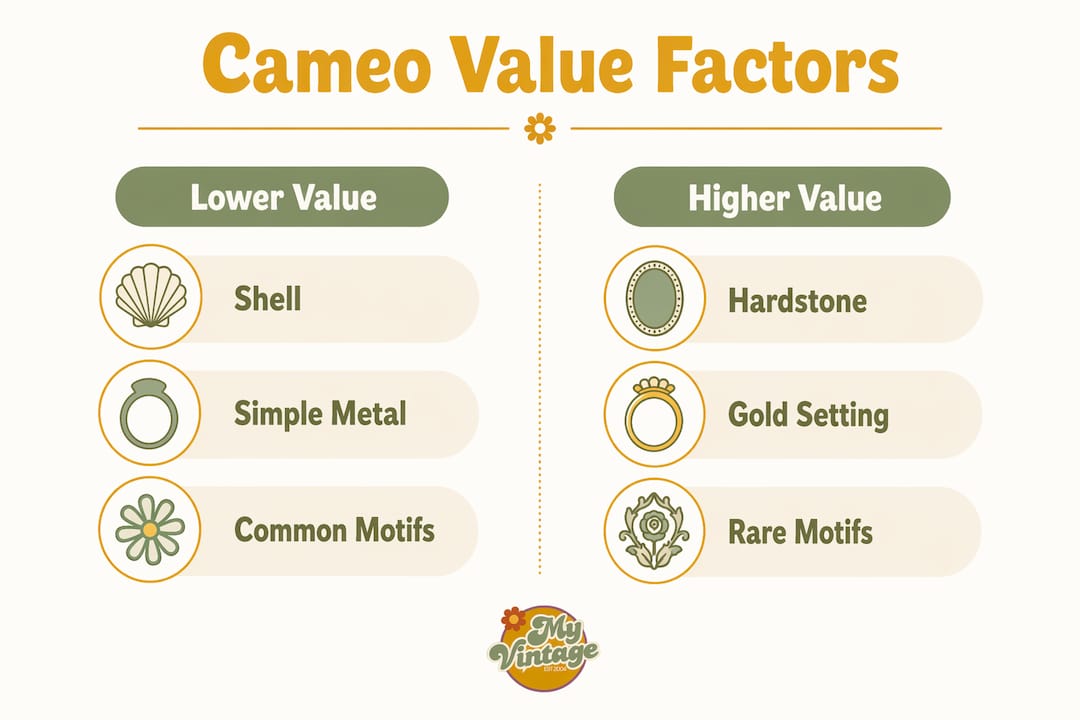
The material of the cameo itself sets the baseline. Hardstone cameos carved from sardonyx or layered agate require far more skill and time than shell carving, and this is reflected in their market price. The metal setting matters enormously too: a cameo mounted in 18ct gold with fine filigree work is a fundamentally different object from the same carving set in a silver-plated frame.
Motif rarity is perhaps the most underappreciated factor. Original classical allegorical motifs that escaped later conservative alterations are especially prized by serious collectors. Many Victorian-era cameos depicting mythological scenes or allegorical figures were modified or softened during more conservative periods, meaning that unaltered originals are genuinely rare today. A cameo depicting a classical muse in full allegorical detail will consistently outperform a standard female portrait at auction.
Condition and originality of the mount are equally critical. Vintage cameos set in parures, where the brooch, earrings, bracelet, and necklace all match, command a significant premium over single pieces, but only when the original mounts are intact. Replaced or repaired mounts reduce value considerably, even when the carving itself is exceptional.
Pro Tip: A professional appraisal not only confirms authenticity but can also support insurance coverage. Some specialist jewellery insurers cover up to 125% of replacement value, making documentation genuinely worthwhile for any significant piece.
Styles, motifs, and the history behind vintage cameo art
The history of cameo art stretches back to ancient Greece and Rome, but the pieces most collectors encounter today reflect the tastes and techniques of the Victorian, Edwardian, and Art Deco periods. Each era left a distinct visual signature.
Victorian cameos (1837 to 1901): Rich, romantic, and often deeply symbolic. Portraits of classical figures, mythological goddesses, and allegorical scenes were the dominant motifs. Shell cameos became widely accessible during this period as Italian craftsmen in Torre del Greco perfected the art of helmet-shell carving.
Edwardian cameos (1901 to 1910): Lighter, more delicate, and frequently set in platinum or white gold with fine milgrain edging. The motifs shifted towards softer portraits and floral frames, reflecting the era’s taste for lace-like elegance.
Art Deco cameos (1920s to 1930s): Geometric settings, bold contrasts, and a move away from classical subjects towards stylised, modernist imagery. Hardstone cameos in onyx and agate suited the era’s graphic sensibility perfectly.
Mid-century cameos (1940s to 1960s): Italian shell cameos dominated this period, often set in yellow gold with simple, clean mounts. These are the pieces most frequently encountered by new collectors and represent an excellent entry point into the market.
Parure sets: Across all these eras, cameos were frequently produced as part of matching sets. A complete Victorian parure comprising a brooch, earrings, bracelet, and necklace in matching hardstone is among the most desirable finds in the entire antique cameo jewellery market.
The joy of collecting across these periods lies in how clearly each piece reflects its moment. A 1920s Art Deco hardstone cameo in a geometric platinum mount tells you something specific and irreplaceable about the culture that produced it.
How to wear and collect vintage cameos today
The 2026 trend towards vintage brooches and pieces with permanence has brought cameos firmly back into the style conversation, and not just as nostalgic curiosities. Collectors and fashion enthusiasts are wearing them in genuinely fresh ways.
As a brooch on a lapel or collar: The most traditional placement, but still one of the most striking. A hardstone cameo brooch on a tailored blazer or wool coat is a statement that no mass-produced accessory can match.
Pinned to a ribbon or velvet choker: A mid-century shell cameo worn on a black velvet ribbon makes an elegant vintage cameo necklace without altering the piece itself.
Layered with contemporary jewellery: Mixing a Victorian portrait cameo with modern gold chains creates a personal, eclectic look that reflects individual style rather than any single trend.
As a ring or pendant centrepiece: Many cameos were originally set as rings or pendants and wear beautifully in their original form.
Collecting by theme or era: Building a focused collection, such as all Art Deco hardstone pieces or all Italian mid-century shell cameos, gives depth and coherence to what you acquire.

The move towards sustainable jewellery is a genuine cultural shift, not a passing moment. Choosing a vintage piece over a newly manufactured one is a meaningful decision, and cameos carry that meaning with particular grace. Each one represents hours of skilled hand work and decades of survival. For guidance on collecting vintage jewellery with real confidence, it is worth reading widely and handling as many pieces as possible before spending seriously.
When it comes to care, keep cameos away from ultrasonic cleaners and harsh chemicals. A soft, barely damp cloth is all most pieces need. Store them individually, wrapped in soft fabric, to protect the relief carving from scratches.
Why vintage cameos matter more than ever
I have been surrounded by vintage pieces for a long time now, and cameos occupy a particular place in my affection. They are not simply decorative objects. Each one is a miniature portrait of a moment in history, carved by hand with tools and skills that took years to master. When I hold a 1940s Italian shell cameo, I think about the craftsman in Torre del Greco who spent hours on that profile, and the woman who first wore it. That connection is not something you can manufacture.
What strikes me most about the current collector market is how vintage brooches and cameos are being embraced not as costume or nostalgia but as genuine personal expression. People are choosing them because they want something that says something specific about who they are, not just what is currently on trend. That feels like a healthy and lasting shift. The benefits of buying vintage go well beyond aesthetics: you are choosing craft over convenience, and history over homogeneity. For those of us who love these pieces, that has always been the point.
Explore authentic vintage pieces at My Vintage
If reading this has sparked a desire to find your own piece of wearable history, My Vintage is a wonderful place to start.

My Vintage has been curating exceptional vintage pieces since 2004, with a genuine commitment to quality, individuality, and timeless style. From jewellery and accessories to original vintage homeware, every item is carefully selected to reflect the craftsmanship and character of its era. Browsing the collection is a pleasure in itself, and each piece comes with the assurance of authenticity that serious collectors and style-conscious shoppers deserve. Visit My Vintage to discover what is currently available.
Frequently Asked Questions
What is the difference between vintage and antique cameos?
Vintage cameos are pieces produced between 50 and 100 years ago, while antique cameos are over 100 years old. The distinction matters for both valuation and collecting purposes.
How do I know if a cameo is hand-carved or moulded?
Examine the piece under magnification: hand-carved cameos show fine tool marks and three-dimensional depth in the relief, while moulded reproductions display uniform mould lines and a flatter, less detailed surface.
Which cameo materials are most valuable?
Hardstone cameos carved from sardonyx, agate, or onyx are generally more valuable than shell cameos, reflecting the greater skill and time required to carve them. A hardstone piece in a gold or platinum setting commands the highest prices.
Are vintage cameo brooches fashionable to wear in 2026?
Absolutely. The 2026 trend towards vintage brooches and pieces with permanence has placed cameos firmly at the centre of contemporary style conversations, worn as personal expression rather than costume.
Do I need a professional appraisal when buying vintage cameos?
For any significant purchase, a professional appraisal is strongly recommended. It confirms authenticity, establishes value for insurance purposes, and provides documentation that protects your investment over time.
Recommended


Comments