


Defining Vintage Clothing Eras

There is a common misconception that any old-looking garment can be called vintage. In truth, vintage clothing is at least 20 years old but less than 100 years old, a definition that immediately excludes a great deal of what gets mislabelled in charity shops, online marketplaces, and even fashion editorials. For collectors and style enthusiasts, getting the era right is everything. It affects value, authenticity, and the story a piece tells. In "Defining Vintage Clothing Eras" we give you the clear frameworks and hands-on tools to date and identify vintage clothing with genuine confidence, from the 1940s through to the 1990s.
Table of Contents
Defining Vintage Clothing Eras - Key Takeaways
Point | Details |
Age defines vintage | Vintage clothing must be at least 20 years old but less than 100 years old. |
Go beyond style | Structured analysis using construction and label clues is more reliable than visual guesses. |
Construction reveals era | Seam finishes and fastenings provide clear signals for dating garments accurately. |
Label reading is key | Care labels and union tags can precisely anchor pieces in time when compared to official benchmarks. |
Not all old is vintage | Understanding ‘archival’ versus ‘vintage’ prevents mislabelling and informs smart collecting. |
What makes clothing vintage?

Before you can begin identifying eras, you need a firm grasp of the language. The word “vintage” is used so loosely these days that it has almost lost its meaning in casual conversation. But for serious collectors and enthusiasts, precision is non-negotiable.
Vintage clothing is defined as at least 20 years old but less than 100 years old. That gives us a rolling window. In 2026, a garment made in 2005 has just crossed the threshold, while anything made before 1926 tips into antique territory. Understanding where a piece sits within this window has real implications for vintage fashion eras explained, resale pricing, and how collectors assess authenticity.
Here is a quick breakdown of the key terms:
Term | Age range | Key characteristic |
Retro | Under 20 years old | Inspired by older styles, not original |
Vintage | 20 to 99 years old | Authentic original garment |
Antique | 100 years or older | Rare, fragile, museum-quality |
Archival | Varies | Designer pieces held from runway collections |
It is worth knowing these distinctions for a practical reason: resale value. A dress described as “retro-inspired” has very different worth to a confirmed 1968 original. Getting comfortable with key vintage definitions is the first step to buying and selling with confidence.
The concept of “archival” is also worth noting. An archival piece is typically a designer garment held back from a runway collection for reference or preservation. It may be decades old, but it is categorised differently from market-traded vintage. Knowing this prevents costly misidentification when buying high-end or designer pieces.
How to identify vintage eras: The method that works
Now that you know what qualifies as vintage, here is how enthusiasts and experts get specific about dating their finds. Era identification should be approached as a structured process using multiple signals rather than a single gut-feeling about style. Relying only on the “look” of a garment leads to mistakes. Structured assessment does not.
The three-step identification process
Establish the age window. Use what you know about the garment’s provenance, acquisition history, or broad style period to set an initial bracket. Is it pre-1960s or post? This narrows things immediately.
Assess physical signs. Examine silhouette, fabric composition, sewing construction, closures, colour palette, and surface motifs. Each of these carries era-specific fingerprints.
Verify through labels. Cross-reference care labels, union marks, country-of-origin tags, and fibre content labels against known timelines.
When identifying vintage clothing confidently, the combination of all three steps is what separates a reliable date from a hopeful guess. Each signal corroborates or contradicts the others, building a coherent picture.
Here is a quick-reference comparison of era signals:
Era | Silhouette | Common fabrics | Typical closures | Key motifs |
1940s | Boxy shoulders, midi length | Wool, rayon | Metal zip, hooks | Utility styling, floral |
1950s | Full skirt, nipped waist | Nylon, cotton | Nylon zip, buttons | Polka dots, novelty prints |
1960s | A-line, mini | Polyester, PVC | Metal or nylon zip | Op-art, geometric |
1970s | Flared, maxi | Polyester, denim | Wide lapels | Paisley, earth tones |
1980s | Power shoulders, oversized | Lycra, synthetic blends | Shoulder pads, velcro | Bold graphic, neon |
1990s | Slip dress, grunge layers | Jersey, viscose | Invisible zip | Minimalist, plaid |
Being familiar with identifying authentic vintage means recognising not just what something looks like, but what the era’s manufacturing realities looked like from the inside out. You can also explore spotting sustainable fashion to understand how era-aware buying connects to responsible consumption habits.
Pro Tip: Always check the inside seams and the closure type before assigning a decade. A garment can have a 1950s silhouette but a nylon coil zip that was not commercially used until the mid-1960s, which changes everything.
Physical clues: Uncovering construction secrets

With this method in mind, you can look even closer for physical hallmarks that anchor an era. The construction of a garment, how it was sewn, finished, fastened, and lined, tells you a great deal about when and where it was made.
What to examine
Seam finishes: Unfinished or pinked seams (cut with zigzag shears but left raw) are characteristic of pre-1960s garments. Serged seams mark mid-1960s production and later, reflecting the industry-wide adoption of overlock machines. If you find a serged seam, the garment is almost certainly post-1965.
Zippers: Metal zippers dominate 1940s and early 1950s pieces. Nylon coil zips arrived in the 1960s. Invisible zips became widespread from the 1970s onwards.
Hems: Hand-rolled hems are common in high-quality 1940s and 1950s garments. Machine-stitched blind hems reflect post-1960s mass manufacturing.
Buttons: Bakelite buttons are a reliable 1930s to 1950s marker. Plastic buttons became dominant from the 1960s onwards. Pearl or shell buttons on a blouse suggest pre-war or early post-war production.
Shoulder construction: Padded shoulders with a defined, structured look scream the 1940s or the 1980s. The difference lies in the fabric weight and overall silhouette accompanying them.
Lining: Fully lined garments were the norm in quality 1940s and 1950s pieces. Partial or unlined garments became more common as ready-to-wear production sped up through the 1960s and 1970s.
Pro Tip: Use a small magnifying glass or your phone’s camera zoom to inspect stitch density and thread type. Finer, tighter stitching often signals older, higher-quality production, while looser chain stitching can indicate budget manufacturing from the 1970s onwards.
The shift from handcraft to machine production happened rapidly in the mid-20th century. Understanding these manufacturing realities helps you avoid misidentifying a skilled reproduction as an original. For guidance on ethical wardrobe steps, including why buying genuine vintage beats reproduction pieces for sustainability, it is worth exploring the broader picture of conscious fashion choices.
Interpreting labels: Care instructions and union marks
Physical traits are only half the story. Labels are your chronological map for proper dating and authenticating pieces, and they are remarkably precise when you know what to look for.
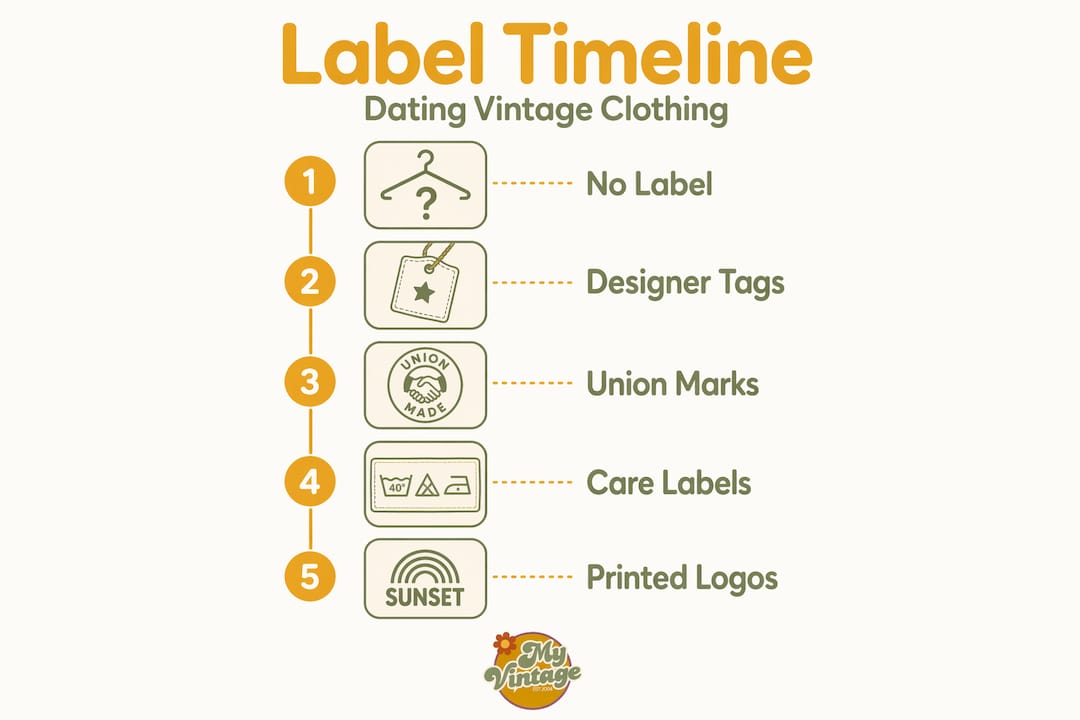
Label type | Date significance | What to look for |
No care label | Pre-1971 (US-made) | Absence of washing instructions suggests pre-FTC ruling |
Permanent care label | Post-1971 | Washing, drying, ironing instructions in text |
Pictogram care label | Post-1986 approx. | Symbol-based washing instructions |
ILGWU union label | 1900 to 1995 | Design changed multiple times, useful for narrowing date |
Country of origin only | Common post-1971 | “Made in Taiwan”, “Made in Hong Kong” narrows window |
Fibre content label | Post-1960 (UK), post-1971 (US) | “100% Polyester” etc. confirms modern synthetic era |
Standardised care-label rules began with the US Federal Trade Commission’s 1971 requirement for permanently attached care labels. This is one of the most useful single dating tools available. If a garment has no care label at all, it was most likely made before 1971.
“Union labels provide strong dating evidence and should be compared against reference charts to narrow their age.” The ILGWU (International Ladies’ Garment Workers’ Union) label is particularly useful, as its design changed across multiple decades, effectively creating a built-in dating system for American-made womenswear.
How to use labels for dating, step by step
Check whether a permanent care label is present. If absent, the garment is likely pre-1971.
Identify the union label type if present. Cross-reference the ILGWU design against a known reference chart.
Look for country-of-origin information. “Made in England” with no fibre content suggests pre-1960s British production.
Assess fibre content labels. Synthetic fibre names like “Terylene” or “Crimplene” place a garment firmly in the 1960s to 1970s.
Combine your label findings with physical and silhouette clues to confirm or challenge your initial date estimate.
For more on reading period-specific vintage label lingo, it is genuinely fascinating how much history is stitched into a few square centimetres of fabric. And understanding eco-friendly fashion terminology can further contextualise why authentic vintage labelling matters for sustainable fashion choices today.
Archival versus vintage: Not all old clothing is equal
With the toolkit for era identification established, it is also vital to avoid common semantic pitfalls that affect value and authenticity. This is where even experienced buyers can come unstuck.

Archive runway pieces are not necessarily vintage under the strict 20-plus years definition. An archival Versace piece stored since 2010 might be culturally significant, but in 2026 it does not yet qualify as vintage by age. The distinction matters enormously in terms of pricing, insurance, and collecting strategy.
Here is how these terms compare in practice:
Vintage: Original garment, 20 to 99 years old. Authenticated through physical and label evidence. Often traded in collector or curated retail markets.
Retro: New or nearly new garment designed to evoke an older era. No age qualification. Often lower in value and collectability.
Archival: Designer-held piece from a specific runway season. Age variable. Value driven by designer prestige and cultural moment rather than age alone.
Antique: Over 100 years old. Extremely rare in wearable condition. More likely found in museum or estate sale contexts.
Deadstock: Unused vintage merchandise, sometimes still in original packaging. Highly prized because of condition and originality.
“The word ‘vintage’ should never be used as shorthand for ‘old and stylish.’ It is a precise term with real implications for value and authenticity.”
The temptation to call something “vintage Prada” when it is merely a few years old is understandable, but misleading. When you are exploring decades of vintage, the integrity of the label is what makes a collection meaningful and trustworthy.
Our take: Why accurate era knowledge is the vintage enthusiast’s edge
We have seen a lot of beautiful pieces come through over the years, and we will say this plainly: the collectors and stylists who develop a rigorous, evidence-based approach to era identification are the ones who consistently find the best pieces, avoid costly mistakes, and build collections that genuinely appreciate in value.
There is a tempting shortcut that many people take. They look at something, get a feeling, and call it “very 1970s.” Sometimes they are right. But more often than not, they are looking at a 1980s piece made in a 1970s-inspired style, or a 1990s reproduction of a 1950s silhouette. The “vibe” approach is unreliable, and the market has enough savvy sellers who know that most buyers rely on it.

What genuinely separates the experienced collector from the casual buyer is the habit of triangulating multiple clues. Label plus construction plus silhouette. Never one alone. A 1950s-looking dress with a synthetic fibre label is post-1960 at the earliest, full stop. Relying only on the full skirt and nipped waist would have led you astray.
Era knowledge also protects you against reproductions and deliberate fakes. The vintage market has grown enormously, and with demand comes the temptation to pass off skilled reproductions as originals. Knowing that serged seams did not appear in garments before the mid-1960s, or that Velcro was not widely used in clothing before the 1970s, gives you a reliable filter that no amount of stylistic charm can fool.
Finally, and this is something we feel strongly about, accurate era identification deepens the joy of wearing and collecting vintage. When you put on a 1948 wool coat and you know it is from 1948, confirmed through three independent lines of evidence, the experience is entirely different. That coat has a real story. A fashion tour through the decades is so much richer when you are wearing the genuine article.
Explore and collect with confidence at My Vintage
Armed with a robust framework for identifying and dating vintage pieces, the next step is finding a source you can trust entirely. At My Vintage, we have been curating authentic vintage clothing since 2004, with every piece rigorously assessed for era, condition, and provenance before it reaches our shelves.
Our collections are organised by decade, from the 1940s through to the 1990s, making it straightforward to find exactly the era you are after. Whether you are building a personal wardrobe, sourcing pieces for a film or theatre production, or developing a serious collection, you will find that each listing reflects the same evidence-based approach to dating and authentication that we have explored in this article. Browse our era-led collections at My Vintage and discover pieces that truly stand up to scrutiny.
Frequently Asked Questions
What is the definition of vintage clothing in 2026?
Vintage clothing in 2026 is defined as items that are at least 20 years old but less than 100 years old, meaning garments made in 2006 or earlier now qualify.
How do care labels help identify a clothing era?
Care labels can date a garment precisely, as US clothing required permanent labels after 1971, meaning the absence of any care label strongly suggests a pre-1971 piece.
Why is it important to check seams when dating vintage clothes?
Checking seam finishes is a reliable dating signal because serged seams indicate mid-1960s production onwards, while pinked or unfinished seams are characteristic of earlier decades.
Can a 15-year-old garment be called vintage?
No, a garment must be at least 20 years old to qualify as vintage, so a 15-year-old piece is technically still too recent to carry the label legitimately.
What makes a piece ‘archival’ but not vintage?
Archival refers to designer pieces stored from runway collections, and these may not meet the 20-year age threshold required to qualify as vintage under the standard definition.
Recommended


Comments