


Exploring Iconic Hairstyles from the Seventies

Few decades have left such a lasting mark on hair as the 1970s. Those gloriously expressive styles, from Farrah Fawcett’s windswept feathered waves to the bold, magnificent Afro, keep returning to runways, red carpets, and social media feeds with remarkable regularity. Far from being relics of a distant past, these looks speak to something timeless: the desire for hair that says something meaningful about who you are. In this guide, we are going to walk you through the cultural roots of seventies hairstyles, the most iconic looks of the decade, practical advice for recreating them at home, and the reasons they continue to captivate us all these years later.
Table of Contents
Key Takeaways
Point | Details |
Freedom of self-expression | Seventies hairstyles broke conventions and encouraged individuality across genders and hair types. |
Timeless retro inspiration | Iconic looks such as the feathered wave and afro remain stylish, adaptable, and frequently revived. |
Accessible DIY styling | With the right tools and tips, it’s easy to recreate authentic seventies hairstyles at home. |
Connection to wider trends | 1970s hairstyles not only shaped beauty but also reflected societal and fashion changes still relevant today. |
Understanding the Cultural Context of Seventies Hairstyles
To truly appreciate seventies hair, you first need to understand the world that created it. The 1970s were a decade of profound social transformation. Civil rights movements, second-wave feminism, and a growing counter-culture were all reshaping what it meant to be an individual. Hair became one of the most visible and powerful ways to signal your values, your community, and your sense of self.
Music played an enormous role in shaping the visual language of the era. Disco brought glamour, sequins, and voluminous, sculpted curls to dancefloors across the world. Punk arrived mid-decade with jagged, asymmetric cuts and deliberately shocking colour choices. Soul and funk music celebrated natural Black hair texture in ways that carried deep political significance. These weren’t simply aesthetic choices; they were declarations.
“Hair is the richest ornament of women.” That famous observation has never felt more true than in the seventies, when a hairstyle could communicate your entire philosophy of life.

The connection between hair and fashion during this period was inseparable. Exploring 1970s fashion trends reveals just how completely the two worlds fed each other. Flared trousers and flowing maxi dresses called for hair that was equally free and expressive. Structured, sculptural fashion demanded structured, sculptural hair. The vintage fashion trends of the sixties and seventies formed a continuous conversation between clothes, hair, and cultural identity.
Key cultural forces shaping seventies hairstyles included:
Disco culture: Encouraging volume, shine, and dramatic glamour
The Black Power movement: Celebrating natural Afro texture as a proud political and personal statement
Punk: Rejecting mainstream beauty standards with spiky, coloured, and deliberately “wrong” styles
Hollywood and television: Spreading aspirational looks through mass media faster than ever before
The women’s liberation movement: Encouraging women to wear their hair as they chose, not as convention dictated
With the context set, let’s explore the most memorable and influential hairstyles that defined the seventies.
The Most Iconic Hairstyles from the Seventies
The seventies produced an extraordinary variety of signature hairstyles, each carrying its own cultural weight and aesthetic appeal. Understanding which styles emerged from which movements helps you wear them with genuine feeling rather than simply as costume.
Farrah Fawcett’s feathered waves stand as perhaps the single most recognised hairstyle of the entire decade. Fawcett’s layered, blow-dried waves, swept back from the face and feathered at the sides, became a cultural phenomenon after her appearance in Charlie’s Angels in 1976. Millions of women walked into salons clutching her photograph. The style required skill and the right tools, but it offered something genuinely flattering: movement, softness, and a sense of effortless confidence.

The Afro is without question one of the most significant hairstyles in history, not just in the seventies. Growing out of the Civil Rights and Black Power movements of the late 1960s, the Afro reached its peak cultural visibility during the seventies. Wearing your natural texture unapologetically was a bold, beautiful act of self-assertion. Icons including Angela Davis, Diana Ross, and Jimi Hendrix made the style globally recognisable and deeply powerful.
The shag cut deserves its own mention. Pioneered by hairdresser Paul McGregor for Jane Fonda in the early seventies, the shag combined heavy layering, a razored finish, and often curtain-style fringe. It worked beautifully on straight and wavy hair alike, adding texture and movement without requiring perfect condition.
Sleek centre partings with long, natural locks offered a softer alternative to the more sculpted styles. Artists like Joni Mitchell and Carly Simon wore their hair this way, emphasising a natural, unforced beauty that felt like a counterpoint to disco glam. If you want to understand how dressing 70s style works as a complete aesthetic, the centre-parted, flowing look pairs perfectly with peasant blouses and suede accessories.
Here is a quick comparison of the era’s most popular looks:
Hairstyle | Best for | Key technique | Style personality |
Feathered waves | Straight to wavy hair | Blow-dry with round brush | Glamorous, confident |
Afro | Natural coily/curly hair | Moisturise, pick out gently | Bold, powerful, proud |
Shag cut | Most hair types | Razor layering, blow-dry | Edgy, relaxed, creative |
Centre part, long | Straight or fine hair | Natural dry or gentle blow-dry | Natural, free-spirited |
Pixie/crop | All hair types | Scissor or razor cut | Daring, modern, chic |
Understanding what 70s style really means helps you choose the right hairstyle to match your full vintage look. Each of these styles connects to a particular facet of the decade’s identity.
Pro Tip: If your hair doesn’t naturally suit the iconic style you love, don’t be discouraged. The seventies were genuinely about creative self-expression, so a modern interpretation that flatters your specific texture and face shape is actually more in the spirit of the decade than a rigid imitation.
Having highlighted the styles that shaped the decade, let’s break down how to recreate these looks at home using both vintage and modern techniques.
How to Achieve Seventies-Inspired Hairstyles at Home
The good news is that recreating seventies hair at home is entirely achievable with the right tools and a little patience. You don’t need a professional salon or expensive products. What you need is an understanding of the techniques involved and a willingness to experiment.
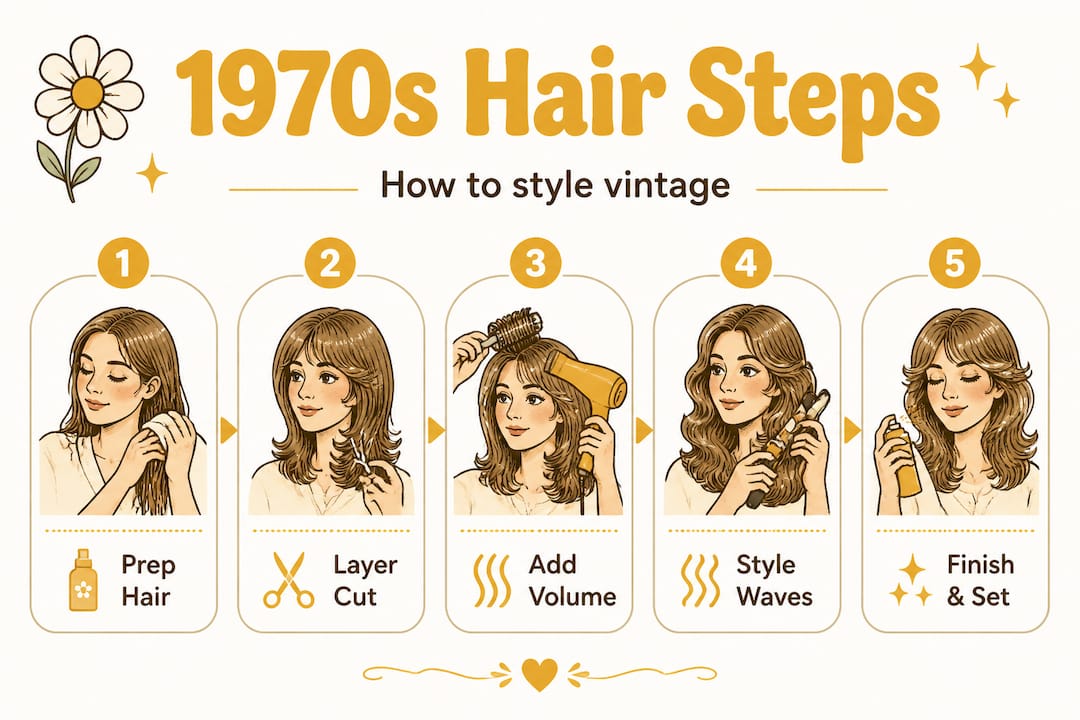
Essential tools and products to gather first:
Heated rollers are your best friend for feathered or voluminous styles. A wide-barrel curling iron (38mm or larger) will help you create loose, sweeping waves. A wide-tooth comb is essential for Afro styling and for gently detangling without disrupting natural curl patterns. Mousse and light-hold hairspray give you that characteristically airy seventies volume without the rigid crunch of more modern holding products. A good quality boar-bristle round brush is invaluable for blow-drying feathered waves.
Step-by-step guide: creating feathered waves
Wash and towel-dry your hair until it is damp but not dripping.
Apply a small amount of volumising mousse from roots to mid-lengths, avoiding the ends.
Using a round brush and blow-dryer on a medium heat setting, lift sections at the root and roll the brush away from your face as you dry each section.
Once dry, take large sections and wrap them loosely around a wide-barrel curling iron for 10 to 15 seconds, directing the curl backwards and away from your face.
Allow the curls to cool completely before gently brushing through with a soft-bristle brush to break the curl into a wave.
Finish with a light mist of flexible-hold hairspray and use your fingers to feather the sections at the sides of your face backwards.
Step-by-step guide: styling an Afro
Begin with freshly washed, well-conditioned hair. Deep conditioning is genuinely important for maintaining healthy natural curls.
Apply a generous amount of leave-in conditioner or a curl-defining cream while the hair is still wet.
Allow the hair to air-dry as much as possible before using a diffuser attachment on a low heat setting to encourage volume without frizz.
Once fully dry, use an Afro pick comb to gently lift and expand the hair from the roots outwards, working in small sections.
Shape the outline for symmetry, then lightly mist with a shine serum or oil for that characteristically rich, healthy finish.
Pairing your hairstyle with the right beauty choices makes all the difference. The 1970s makeup trends guide offers brilliant advice on the bronzed skin, earthy eyeshadow, and glossy lips that complete any authentic seventies look. For a broader overview of getting the whole aesthetic right, the vintage beauty tips section on our site is a wonderful resource.

Pro Tip: For an easy modern shortcut to feathered waves, try sleeping in a loose plait on slightly damp hair. In the morning, undo the plait, gently finger-comb, and add a touch of shine serum. The result is an effortlessly bohemian wave that channels seventies spirit beautifully.
Now that you know how to experiment with these looks, let’s examine why these seventies styles keep coming back into fashion and how they have evolved.
Why Seventies Hairstyles Remain Influential Today
The cyclical nature of fashion is well documented, but the seventies seem to return with unusual frequency and enthusiasm. This isn’t simply nostalgia at work. There are genuine aesthetic and cultural reasons why this particular decade keeps reasserting itself.

Modern designers and celebrities draw heavily from the era. Runway collections from major fashion houses regularly feature feathered layers, natural curls, and centre-parted sleek styles. Celebrities including Beyoncé, Zendaya, and Florence Pugh have all been photographed in looks that owe a clear debt to seventies styling. The 1970s influence on modern trends is visible everywhere once you start looking for it.
Social media has dramatically accelerated the revival and adaptation of classic looks. TikTok and Instagram tutorials dedicated to seventies hairstyles collectively attract hundreds of millions of views each year. Younger audiences are discovering these styles without the nostalgic attachment their parents might feel, simply because the looks are genuinely beautiful and expressive. A fashion focus on the 1970s makes it clear that the decade’s influence has never really gone away.
The relationship between retro hairstyles and sustainable fashion is also worth noting. As more people move away from fast fashion towards vintage and second-hand clothing, the hairstyles that complement those wardrobes become relevant again. A perfectly worn shag cut or a set of loose feathered waves feels like a natural match for a genuine 1970s suede jacket or a vintage wrap dress.
Consider these facts about the enduring seventies influence:
Runway presence: Major fashion weeks in London, Paris, and New York have featured seventies-inspired collections every year since 2018
Search data: Online searches for “seventies hair” and “Farrah Fawcett waves” consistently spike each spring and summer season
Vintage clothing growth: The global secondhand clothing market is growing eight times faster than mainstream retail, driving renewed interest in period-accurate styling
Celebrity endorsement: Shag cuts and natural Afro styles have appeared on virtually every major red carpet since 2020
The techniques have evolved too. Modern heated tools offer far greater precision and lower heat damage than their seventies equivalents. What used to take an hour at the salon can often be achieved at home in twenty minutes with today’s tools, meaning these looks are more accessible than ever.
What Most Guides Miss about Seventies Hairstyles
Most articles on this subject give you a list of looks and a set of instructions. That is genuinely useful, but it misses something important. The seventies hairstyle wasn’t primarily an aesthetic choice. It was a personal and political one. When someone wore a large, proud Afro in 1972, they weren’t simply following a trend; they were making a statement about dignity, identity, and belonging. When a young woman had her hair feathered in a suburban salon in 1977, she was participating in a wider cultural moment about femininity and freedom.
We think this matters enormously when you wear these styles today. There is a difference between wearing a look because it is fashionable and wearing it because you genuinely connect with what it represents. The clothes and hair of 70s fashion worked together as a complete statement of selfhood, and that spirit is worth carrying forward.
The other thing most guides overlook is the value of imperfection. Seventies hair was rarely pristine. It was lived-in, slightly undone, and absolutely individual. Modern tutorials sometimes iron out all the character in pursuit of a “perfect” recreation. But the joy lies in making these styles your own, adding your personality, your texture, your twist. That is actually the most authentic thing you can do.
We would always encourage you to research the cultural roots of any style you choose to wear, particularly where those styles carry specific historical meaning for particular communities. Wearing these looks with knowledge and respect is what transforms a hairstyle from costume into genuine style.
Bring Authentic Seventies style into your life
There is something genuinely wonderful about putting together a complete vintage look, hair, clothing, accessories, and all. If this guide has inspired you to explore seventies styling further, we think you will love seeing how the right pieces of clothing and decor can bring the whole vision to life.
At My Vintage, we have been curating authentic vintage clothing and retro homeware since 2004, and our love for the 1970s runs particularly deep. Whether you are searching for the perfect suede jacket to pair with your new shag cut, a genuine wrap dress to complement your feathered waves, or retro homeware that captures the warm, earthy spirit of the decade, you will find carefully selected pieces waiting for you. Browse our full 1970s vintage collection and discover the authentic pieces that speak to your personal style. We think once you start exploring, you won’t want to stop.
Frequently Asked Questions
What was the most popular hairstyle in the seventies?
The feathered wave, popularised above all by Farrah Fawcett, was arguably the most iconic and widely worn hairstyle of the decade, though the Afro carried equal cultural significance.
How can I make my hair look authentically seventies today?
Use heated rollers or a wide-barrel curling iron for soft waves, focus on natural volume and gentle layers, and finish with a flexible-hold hairspray rather than anything too rigid or structured.
Were seventies hairstyles suitable for all hair types?
Absolutely. From the Afro celebrating natural coily texture to sleek, straight centre-parted looks and razored shag cuts, the decade offered genuinely diverse styles that suited a wide range of hair types and personalities.
How do seventies hairstyles influence modern trends?
Runway collections and celebrity styling continue to revive seventies shapes, textures, and techniques regularly, blending them with contemporary approaches to create looks that feel both nostalgic and entirely fresh.
Recommended


Comments