


Ossie Clark: The Designer Who Defined an Era

Ossie Clark is defined as one of the most gifted British fashion designers of the twentieth century, a visionary whose mastery of the bias cut and fluid silhouette transformed how women dressed in the 1960s and early 1970s. Born Raymond Clark in 1942 in Warrington, he studied at the Royal College of Art in London and quickly became the defining talent of Swinging London’s fashion scene. His partnership with textile artist Celia Birtwell produced some of the most recognisable garments in British fashion history, pieces so distinctive that the Fashion and Textile Museum credits their duo with shaping an entire era through Clark’s cutting and Birtwell’s prints. For collectors, students, and researchers, understanding his work means understanding a moment when British fashion genuinely led the world.
What made Ossie Clark’s design philosophy so distinctive?
Clark’s genius lay in his extraordinary skill as a pattern cutter, a technical ability that set him apart from almost every other designer working in Britain at the time. He understood how fabric moved across the body in three dimensions, not just how it looked flat on a table. This gave his garments a quality that is immediately recognisable: they flow, they drape, and they seem to respond to the wearer’s movement rather than constrain it.
His greatest technical influence was the French couturière Madeleine Vionnet, who pioneered the bias cut in the 1920s and 1930s. Clark absorbed Vionnet’s principle that cutting fabric on the diagonal grain allows it to stretch and cling in ways that straight-grain cutting never can. He then applied this understanding to the looser, more romantic silhouettes of the late 1960s and early 1970s, producing dresses that were simultaneously sensual and free.
What distinguished Clark further was his ability to enhance the female form without ever restricting movement. His sleeves were cut to allow the arms to lift without pulling the bodice. His necklines often plunged in ways that required precise internal construction to sit correctly. These were not accidents of style but deliberate technical achievements, the result of a designer who had genuinely mastered his craft at a level rarely seen in British ready-to-wear.

Pro Tip: When examining an Ossie Clark garment, look at the seam lines and how the fabric falls when the piece is held up. Authentic Clark cuts show a characteristic spiral drape at the hem and a bias-influenced pull across the bodice. If the fabric hangs stiffly or the seams run perfectly straight, treat the attribution with caution.
His iconic vintage designs also drew on a wide range of cultural references, from Art Nouveau to rock and roll, giving his collections an energy that felt genuinely contemporary rather than derivative. That combination of technical rigour and cultural awareness is what made his work so enduring.
How did the Ossie Clark and Celia Birtwell collaboration work?
The partnership between Ossie Clark and Celia Birtwell is one of the great creative collaborations in British fashion history. Their collaboration began in 1966, and the two married in 1969 before divorcing in 1974. Their joint output during this concentrated period produced the garments that define both their reputations.
Birtwell’s prints drew directly from Ballet Russe and Art Deco sources, producing designs that were simultaneously historical and entirely fresh. Her colour sense was extraordinary: she combined muted, dusty tones with unexpected accents in ways that felt organic rather than calculated. When placed on Clark’s fluid silhouettes, her prints moved with the fabric rather than sitting on top of it, which is precisely what made the combination so powerful.
The Clark and Birtwell design system is best understood as a unified whole rather than two separate contributions. Clark’s cuts were often designed with specific Birtwell prints in mind, and the prints were scaled and placed to work with the movement of the bias-cut fabric. Treating them as independent elements misses the full picture entirely.
Key characteristics of their collaborative pieces include:
Birtwell’s signature floral and botanical prints, often rendered in chiffon or crepe, with motifs drawn from early twentieth-century decorative arts
Clark’s bias-cut bodices and sleeves, which created a spiral drape that animated the print as the wearer moved
Deep, plunging necklines with carefully constructed internal support, a Clark hallmark that required considerable technical skill
Midi and maxi lengths that allowed the full effect of both the cut and the print to be appreciated
Soft, natural fibres including silk chiffon, crepe de chine, and moss crepe, chosen to respond to the bias cutting
Authenticating an Ossie Clark piece today depends heavily on recognising this interplay. A garment bearing a Clark label but featuring a generic print, or a Birtwell-style print on a poorly constructed silhouette, should prompt careful scrutiny. The print and cut together are the signature, not either element alone.
How did Ossie Clark’s career evolve from the 1960s onwards?
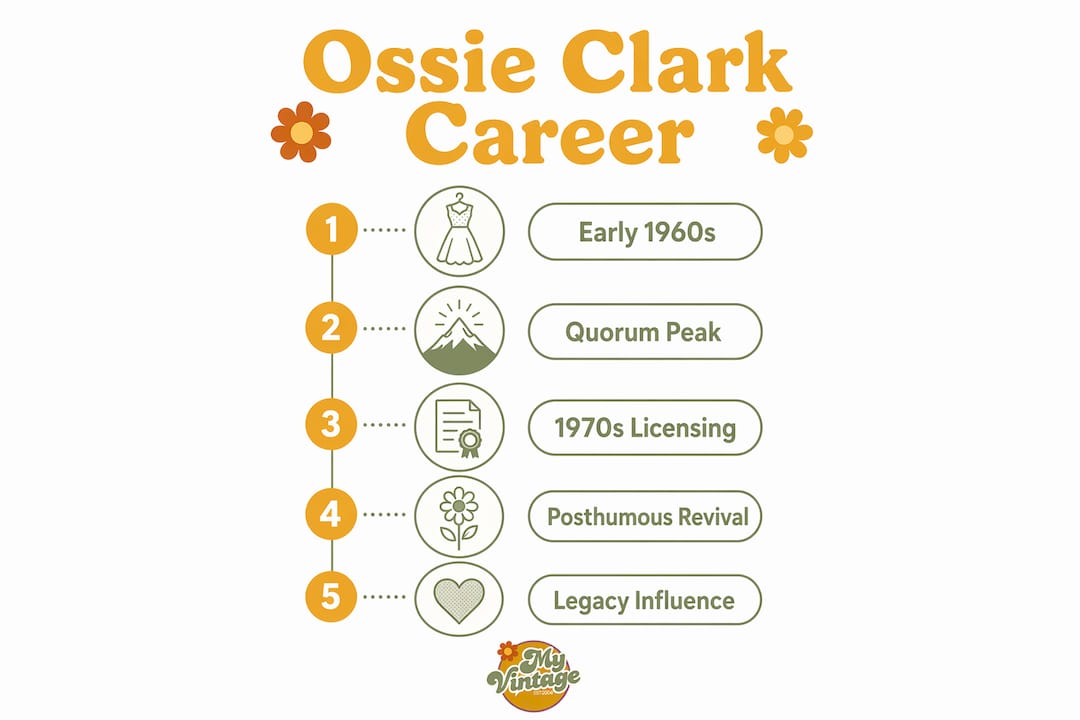
Clark’s career followed a trajectory that was brilliant, complicated, and ultimately tragic. Understanding its different phases is genuinely useful for anyone researching or collecting his work, because the garments produced at each stage differ considerably in character and construction.
Period | Key context | Characteristics |
Early 1960s | Royal College of Art, early Quorum pieces | Experimental, heavily influenced by Vionnet and Balenciaga |
1966 to 1974 | Quorum boutique, peak collaboration with Birtwell | Bias-cut dresses, Birtwell prints, rock-and-roll clientele |
Mid to late 1970s | Alfred Radley licensing deal | Diffusion line, wider distribution, variable quality |
1980s to 1990s | Declining commercial success, personal difficulties | Fewer collections, inconsistent output |
2009 | RTW brand revival | Brand name reused for new collections, not original Clark work |
The Quorum boutique years, from the mid-1960s through the early 1970s, represent the peak of Clark’s creative output. Quorum, based in the King’s Road in Chelsea, was the shop where his most celebrated pieces were sold and where his celebrity clientele, including Mick Jagger, Marianne Faithfull, and Bianca Jagger, came to buy. These are the pieces that command the highest prices at auction and the most attention in museum collections today.

The Alfred Radley licensing arrangement in the mid-1970s produced a diffusion line that reached a much wider audience but at the cost of some of the handcraft quality that defined the earlier work. These pieces are genuine Ossie Clark products and have their own historical interest, but they should not be confused with the Quorum originals when assessing value or significance.
The 2009 RTW collections used the Ossie Clark name but were produced after his death in 1996 and represent a brand revival rather than a continuation of his personal creative vision. Researchers must keep this distinction clearly in mind. A retrospective at the Victoria and Albert Museum from 2003 to 2004 helped cement his place in the canon of British fashion history and remains a key reference point for understanding his legacy.
How do you identify authentic Ossie Clark vintage pieces?
Identifying genuine Ossie Clark garments requires a methodical approach that goes well beyond checking for a label. The Fashion and Textile Museum’s archival research makes clear that a research-driven approach, using documented collections as reference points, is far more reliable than relying on provenance stories or label presence alone.
Here is a practical framework for approaching identification:
Assess the cut first. Clark’s garments have a distinctive bias-influenced drape. Hold the piece up and look at how the fabric falls. Authentic pieces from the peak period show a characteristic movement and spiral quality that is very difficult to replicate.
Examine the print carefully. If the piece features a print, compare it against documented Birtwell designs using museum catalogues or the Fashion and Textile Museum’s exhibition records. Birtwell’s prints have a specific character: organic, slightly faded in palette, and drawn from identifiable historical sources.
Check the label and its typography. Labels changed across different periods and licensing arrangements. An Alfred Radley label indicates a diffusion piece rather than a Quorum original. Post-1996 labels indicate a brand revival piece.
Look at the construction quality. Peak-period Clark pieces are beautifully finished internally, with French seams or carefully bound edges. The internal construction of a genuine Quorum piece reflects couture-level attention to detail.
Cross-reference with documented collections. The private collection at the Fashion and Textile Museum covers Clark’s career from early to later work and provides the most reliable reference for stylistic development.
Pro Tip: Auction house catalogues from Christie’s, Sotheby’s, and Kerry Taylor Auctions are invaluable research tools. Kerry Taylor in particular has handled significant Ossie Clark pieces and their catalogue descriptions include construction details that help build a reliable mental picture of what authentic examples look like.
Collectors should also be aware that later brand revivals and licensed diffusion lines differ markedly from original 1960s and 1970s works. Separating historical originals from brand reissues is not pedantry. It is the foundation of responsible collecting and research.
What is Ossie Clark’s lasting influence on fashion?
Clark’s influence on fashion extends well beyond the garments he produced. He helped establish the idea that British ready-to-wear could operate at a level of technical sophistication previously associated only with Parisian couture. That shift had lasting consequences for how the British fashion industry understood itself.

His celebrity clientele and his presence at the centre of Swinging London’s cultural life meant that his clothes appeared in photographs, films, and on stage in ways that embedded them deeply in the visual memory of the era. David Hockney’s 1970 painting Mr and Mrs Clark and Percy, which depicts Ossie Clark and Celia Birtwell in their flat, now hangs in the Tate Modern and has introduced their story to generations of visitors who may never have encountered their clothes directly.
“Clark’s work represents the moment when British fashion stopped being derivative and started being genuinely original. His technical mastery gave the cultural energy of the 1960s a form it could wear.” This view, shared by fashion historians and curators who have studied his archive, captures why his legacy persists so strongly in museum retrospectives and vintage markets alike.
The persistence of the Ossie Clark name in fashion media decades after his death underscores an ongoing cultural influence that few British designers of his generation have matched. Contemporary designers continue to reference his silhouettes, and his approach to the collaborative design model, where a cutter and a print designer work as genuine creative equals, remains a template that the industry returns to repeatedly.
Why Ossie Clark’s story still moves me
I have spent a long time around vintage fashion, and I find that the designers who genuinely move me are always the ones where craft and vision arrived together in the same person at the same moment. Clark is the clearest example of that in British fashion history. What strikes me most, looking at his peak-period pieces, is how much technical intelligence is hidden inside what appears to be effortless romanticism. Those dresses look free and easy. They are anything but, in terms of the skill required to make them.
The commercial complications of his later career, the licensing deals, the personal difficulties, the brand revivals after his death, are a reminder of how rarely creative genius translates smoothly into sustainable business. Clark’s story is not unusual in that respect, but it is particularly vivid. The gap between the Quorum years and what came after is genuinely striking when you see the pieces side by side.
For collectors and researchers, I think the most rewarding approach is to treat his work as a unified system, as the Fashion and Textile Museum’s exhibition so rightly frames it. Cut and print together. Clark and Birtwell together. When you start seeing the pieces that way, the whole thing clicks into focus, and you understand why these garments still feel so alive.
Discover original vintage fashion at My Vintage
If reading about Ossie Clark has sparked a desire to explore authentic vintage fashion for yourself, My Vintage is a wonderful place to start. Founded in 2004, My Vintage is a curated UK-based vintage retailer with a genuine passion for quality and provenance, stocking pieces from the 1940s through to the 1990s with the care and knowledge that serious collectors deserve.

Whether you are researching original Ossie Clark pieces or simply looking to build a wardrobe with real character, the site offers carefully selected garments and accessories that reflect the same spirit of individuality that defined Clark’s work. And if you love the idea of surrounding yourself with vintage style beyond fashion, do take a look at beautifully curated finds like this 1950s atomic magazine rack, a perfect example of the quality and originality that My Vintage brings to every corner of your life.
Frequently Asked Questions
Who was Ossie Clark?
Ossie Clark was a British fashion designer born in 1942, celebrated for his mastery of the bias cut and his long creative partnership with textile artist Celia Birtwell. His peak work during the Quorum boutique years in the late 1960s and early 1970s defined the visual identity of Swinging London.
What made Ossie Clark’s dresses so special?
Clark’s dresses combined expert bias-cut pattern cutting with Celia Birtwell’s distinctive prints inspired by Ballet Russe and Art Deco, creating garments that moved beautifully and enhanced the female form without restricting it. The cut and print together form a unified design system that is the true hallmark of his work.
How can I tell if an Ossie Clark piece is authentic?
Authentic pieces from his peak period show a characteristic bias-influenced drape, high-quality internal construction, and, where present, a Birtwell print that matches documented designs. Cross-referencing with museum catalogues and auction house records, particularly the Fashion and Textile Museum’s archival collection, is the most reliable method.
What is the difference between original Clark pieces and later revivals?
Original Ossie Clark garments were produced during his lifetime, primarily through Quorum and later via the Alfred Radley diffusion line. Post-1996 pieces bearing the Ossie Clark name, including the 2009 RTW collections, are brand revivals produced after his death and differ markedly from his personal creative output.
Where can I see Ossie Clark’s work in person?
The Victoria and Albert Museum held a major retrospective from 2003 to 2004, and the Fashion and Textile Museum has exhibited work from a significant private collection covering his full career. Auction houses including Kerry Taylor Auctions regularly handle authenticated pieces and their catalogues serve as valuable research references.
Recommended
Brilliant