


The Style and Allure of 70s Disco Clothes Explained

Few fashion movements are as instantly recognisable as 1970s disco, yet so frequently misunderstood. Many people write off 70s disco clothes as pure fancy dress, something you reach for only when a theme party looms. The reality is far more interesting. Disco fashion was a genuinely radical moment in clothing history, where nightlife, politics, and self-expression collided on the dancefloor. From the glittering clubs of New York to the UK’s own vibrant scene, the looks that emerged continue to shape what we wear today. In this guide, we explore what truly defines disco style, break down the essential looks for women and men, and show you how to source the real thing.
Point | Details |
Signature disco elements | Flared trousers, wrap dresses, bold colours, and shimmering fabrics define 70s disco style. |
Wearable nostalgia | Many 70s disco pieces work with modern wardrobes for a unique vintage touch. |
Authentic sourcing | Specialist retailers and careful verification are key to finding true vintage disco clothes. |
Iconic styling | Both men and women can channel disco glamour with statement garments and bold accessories. |
What Defines 70s Disco Clothes?
At its heart, disco fashion was built around movement and spectacle. The clothes needed to perform under flashing lights and hold up through an entire evening of dancing. That combination of function and flamboyance produced a look unlike anything that came before it.
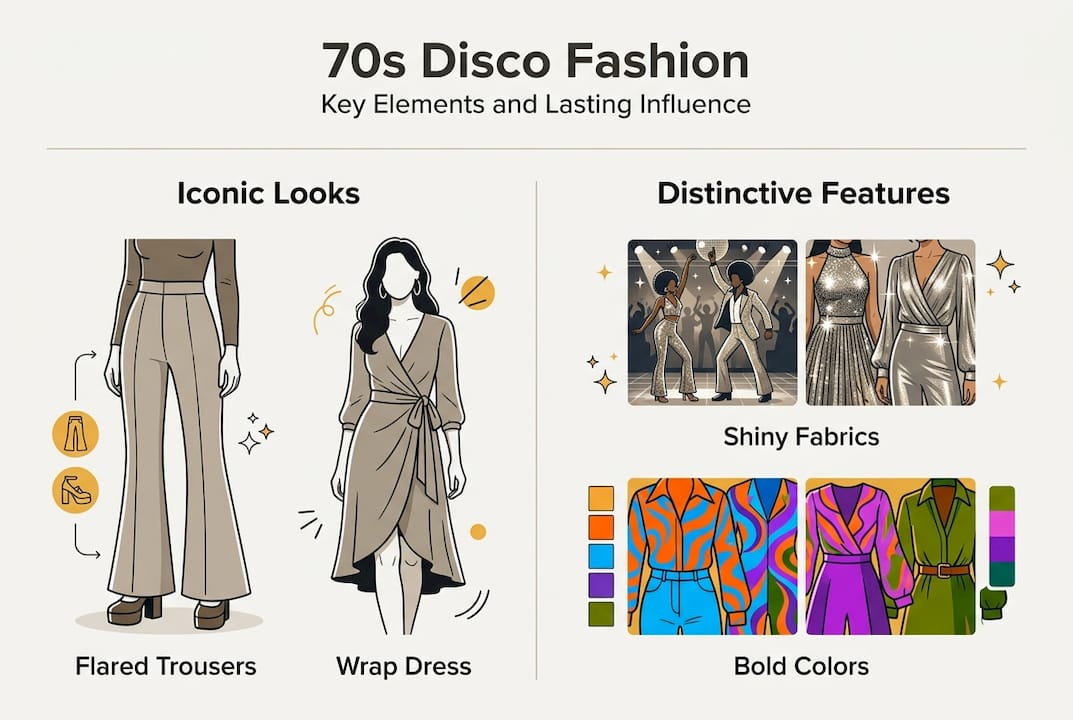
Disco fashion is characterised by bold colours, shimmering fabrics, and flamboyant silhouettes. Polyester was king, and not in a cheap way. The material offered stretch, durability, and a surface that caught and reflected light beautifully. Alongside polyester, you would find satin, Lycra, and metallic jersey woven into everything from halter-neck tops to full-length gowns.

The silhouettes themselves were equally distinctive. Flared trousers widened dramatically from the knee, creating that iconic bell shape. Wrap dresses, popularised by Diane von Fürstenberg, became a staple for women. Jumpsuits in bold prints or solid metallics offered a one-piece solution that moved effortlessly on the dancefloor. Wide collars, often pointing well beyond the shoulder seam, were a signature detail on both shirts and jackets.
Key characteristics of 70s disco clothes at a glance:
Fabrics: polyester, satin, Lycra, metallic jersey, and silk
Silhouettes: flared trousers, wrap dresses, jumpsuits, and wide-leg cuts
Details: wide collars, halter necks, plunging necklines, and sequin embellishment
Footwear: platform shoes and boots adding height and drama
Colours: electric blues, burnt oranges, gold, silver, hot pink, and deep burgundy
Feature | Disco era original | Modern disco-inspired |
Fabric | Genuine polyester, satin | Polyester blends, recycled fabrics |
Colour palette | Bold, saturated primaries and metallics | Similar, sometimes more muted |
Silhouette | True flare, wide collar | Approximated flare, streamlined collar |
Embellishment | Hand-sewn sequins, real metallic thread | Machine-applied sequins, printed metallics |
The colour palette deserves special mention. Disco dressing was never shy. The choices, gold lame, electric blue, hot pink, burnt orange, were deliberate signals of confidence and hedonistic joy. Wearing disco clothes was a statement. The 70s style influences that shaped this aesthetic drew on everything from the psychedelic 1960s to Afro-Caribbean and Latin American culture, creating something genuinely diverse and vibrant. It is also worth noting that 70s hippy culture and disco were not entirely separate worlds; the free-spirited, anti-establishment energy of the earlier decade fed directly into disco’s celebration of pleasure and individuality.
Essential 70s Disco Looks for Women

Diana Ross, Donna Summer, and other icons shaped women’s disco style with glamorous dresses and sparkling accessories. These women showed that disco was not simply about dressing up. It was about commanding a room.
The wrap dress is perhaps the single most enduring item from this era. Simple to wear, flattering on many body shapes, and infinitely adaptable, it became the everyday-disco staple. Pair one in a bold print or solid jewel tone with strappy platforms and a metallic clutch, and you have an authentic reference point right there.
For those who want to go further, sequinned hotpants worn with a floaty chiffon blouse were a club-night favourite. The contrast of tiny, embellished shorts with a billowing, lightweight top captured disco’s playful sense of drama perfectly. Jumpsuits, particularly those with wide legs and a deep V or halter neck, offer another complete look in one garment. These work brilliantly for events or themed shoots.
How to build an authentic women’s disco look:
Start with the base garment: wrap dress, jumpsuit, or halter top with flared trousers
Choose a fabric with sheen, sequins, or metallic thread
Add platform shoes or boots (the higher, the better for authenticity)
Layer on jewellery: large hoop earrings, a chunky bracelet, and a pendant necklace
Finish with a metallic or beaded clutch bag
Keep hair big and bold, voluminous curls or a sleek centre part both work beautifully
Original look | Modern interpretation |
Sequinned floor-length gown | Midi sequin skirt with fitted top |
Hotpants with chiffon blouse | High-waisted shorts with satin shirt |
Wide-leg jumpsuit in metallic | Tailored wide-leg trousers with camisole |
Wrap dress with platform sandals | Wrap-effect midi dress with block heel |
A pitfall to avoid is over-accessorising in a way that reads more as costume than style. Choose two or three statement pieces and let them breathe. We have some wonderful options in the collection, including blue flared trouser suits and checkered disco suits that strike exactly the right balance.
Pro Tip: If you are wearing a heavily embellished top, keep the trouser or skirt more understated so the eye has somewhere to rest. Disco was bold, but the best outfits always had an anchor.
Staples of 70s Disco Style for Men

John Travolta’s Saturday Night Fever suit is the most recognised men’s disco outfit, and while it is an obvious touchstone, men’s disco fashion extended far beyond that one white suit. The real joy lies in the breadth and creativity of what men were wearing from the mid-1970s onward.
The foundation of men’s disco dressing was the wide-lapel jacket. These lapels often spread well across the chest, sometimes meeting collar points that pointed almost to the shoulder. Underneath sat an open-necked silk or polyester shirt, frequently in a bold print, paisley, geometric patterns, or abstract florals. The shirt would be worn with several buttons undone, often revealing a chunky gold medallion or a layered chain necklace.
Essential men’s disco wardrobe pieces:
Wide-lapel jacket in cream, burgundy, navy, or bold check
High-waisted flared trousers with a slight sheen
Open-neck silk or polyester shirt in a statement print
Platform shoes or boots in leather or suede
Chunky medallion, neck chain, or layered necklaces
Wide leather belt with a large buckle
“The best men’s disco looks were never accidental. They were carefully assembled expressions of confidence, with every element, the collar width, the trouser break, the jewellery, chosen to create maximum visual impact.”
For collectors and re-enactors, the key is proportion. The wide lapel only works when the trouser flare matches in scale. A subtle flare with a dramatic lapel looks mismatched. Similarly, the shirt print should complement, not compete with, the jacket. Check our guide to men’s vintage accessories for detailed advice on finishing a period-accurate look. We also stock genuine pieces like these men’s cream flares, which are perfect as a starting point.
Pro Tip: When buying men’s vintage disco jackets, check the shoulder seam carefully. If the seam sits at or slightly beyond the natural shoulder, the garment is likely authentic to the era. Modern cuts tend to pull the seam inward.
Where to find and shop authentic 70s disco clothes today
Vintage boutiques and specialist online platforms offer the best chance of finding true 1970s disco pieces. But knowing where to look and what to look for makes all the difference between a genuine find and an expensive disappointment.
Step-by-step guide to sourcing authentic disco clothes:
Begin with reputable specialist retailers who curate and authenticate their stock. This saves time and protects your investment.
Browse physical vintage markets, but go early. The best pieces go fast, and a crowded rail benefits nobody.
Use online auction platforms, searching for specific terms like “1970s flared trousers” or “vintage polyester jumpsuit” rather than generic terms like “disco outfit.”
When shopping online, always request detailed photographs of labels, seams, and fabric texture before committing.
Compare your find against verified vintage references. Books, museum collections, and trusted retailer catalogues all help.
Spotting a genuine 1970s piece:
Look for labels from UK or US manufacturers active in that period
Genuine polyester from this era has a distinctive weight and drape
Check seams for period-appropriate stitching techniques
Zips on authentic pieces are often metal rather than plastic
The interior finishing on quality disco garments is surprisingly neat
On the vintage versus reproduction question, both have their place. Originals offer irreplaceable authenticity and, for collectors, long-term value. Reproductions can be a practical choice for regular wear or themed events. Our guide to sustainable 70s retro costume tips explores how choosing vintage is also an environmentally responsible decision.
Pro Tip: Sign up to stockist newsletters so you are notified of new arrivals immediately. Pieces like these sell quickly. You can browse new vintage arrivals and check vintage arrivals December for a sense of what comes through our doors regularly.
What Most People Miss about 70s Disco Fashion
Here is a perspective that often gets lost in the conversation about disco clothes: they were never really fancy dress. Not then, and not now. Disco fashion was a serious sartorial movement, born from communities, particularly Black, Latino, and LGBTQ+ communities in New York, who used clothing as a form of visibility and celebration. Reducing it to a costume misses that story entirely.
What is also overlooked is just how much of disco lives in mainstream fashion right now. Wide-leg trousers, sequin embellishment, wrap silhouettes, satin finishes. These are not retro curiosities. They are current. The lasting style influences of the disco era resurface every few years precisely because they were built on principles of joy, movement, and self-expression that never go out of fashion.
For collectors and stylists, this means the opportunity is not simply to recreate the past. It is to draw from it intelligently and build something that feels both rooted and fresh. That is where the real creativity lives.
Discover Your Own Piece of Disco History
There is something genuinely thrilling about wearing a piece of clothing that danced through the 1970s. At My Vintage, we have been curating exactly these kinds of finds since 2004, sourcing authentic vintage garments from across the decades with a particular love for the boldness of the 70s disco era.
Whether you are building a collector’s wardrobe, styling a shoot, or simply want to wear something that turns heads, our collection has something for you. Alongside our clothing range, you can explore vintage homeware and accessories to complete the aesthetic from floor to ceiling. Come and shop My Vintage and let us help you find your perfect piece of disco history.
Frequently Asked Questions
What materials were most common in 70s disco clothes?
Polyester, Lycra, satin and metallic fabrics dominated disco fashion for their stretch, shine and comfort on the dancefloor, making them ideal for long nights of dancing.
How can I tell if a disco outfit is original 1970s?
Check labels for period manufacturers, examine fabric weight and drape, and look for metal zips. Verified vintage sellers and trusted specialist boutiques are your best resource for comparison.
Are 70s disco clothes suitable for everyday wear today?
Absolutely. Modern vintage trends include core disco features such as wide-leg trousers, wrap dresses, and satin finishes, all of which integrate naturally into contemporary wardrobes.
What are some key accessories for a disco look?
Think large sunglasses, chunky jewellery, medallions, retro belts, and platform shoes. Our guide to men’s vintage accessories covers how to use these details to finish a period-accurate ensemble with confidence.
Recommended


Comments