


Coco Chanel: Designer Legacy and Vintage Icon
- May 20
- 8 min read

Gabrielle “Coco Chanel” is one of the most studied and misunderstood figures in fashion history. People often assume the Coco Chanel designer story is one of glamour and femininity in the conventional sense. It wasn’t. It was a story of radical simplicity, deliberate rule-breaking, and an almost stubborn insistence that women deserved to feel comfortable without sacrificing elegance. Her designs were not decorative flourishes. They were quiet acts of defiance that reshaped what luxury could mean, and the ripple effects of that are still felt in every fashion studio, editorial shoot, and vintage market today.
Table of Contents
The Coco Chanel designer story begins
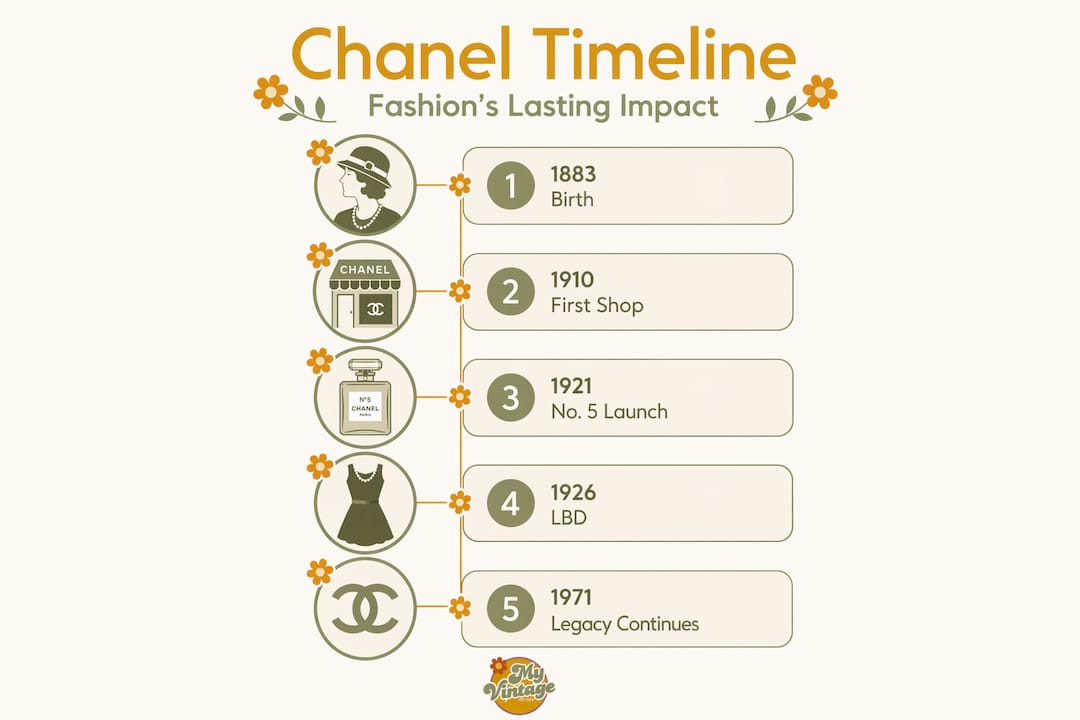
Gabrielle Chanel was born in 1883 in Saumur, France, and spent much of her early life in an orphanage after her mother’s death. That upbringing shaped everything. She grew up without excess, without ornament, without the kind of gilded comfort that defined Edwardian fashion. And when she entered the world of fashion, she brought those spare, practical instincts with her.
Her nickname’s complex origins reflect the layered social realities she navigated before becoming a household name. She was not handed a platform. She built one, starting with hats.
Chanel opened her first boutique at 21 Rue Cambon, Paris, in 1910, initially working as a milliner before expanding into clothing by 1913. The location mattered. Rue Cambon placed her at the heart of Parisian society, where she dressed wealthy women who were tired of the rigid, corseted silhouettes of the era. Her clientele wanted freedom of movement. She gave it to them.
What made her approach genuinely revolutionary was the materials she chose. Chanel brought jersey fabric into womenswear at a time when it was almost exclusively used for men’s undergarments. The result was clothing that moved with the body rather than against it. She borrowed freely from menswear aesthetics: clean lines, practical pockets, unfussy cuts. These were radical choices in an era when women’s fashion was still largely about restriction and display.
Here are some of the key early innovations that defined her design ethos:
Jersey fabric introduced into womenswear for ease and fluidity
Millinery focused on simple, unadorned hat shapes over elaborate constructions
Practical, comfortable silhouettes borrowed from masculine tailoring
Coastal resort wear developed during her time in Deauville and Biarritz
Pro Tip: If you’re studying Chanel’s early work, look closely at photographs from 1910 to 1925. The contrast between her designs and what other women were wearing tells you more than any biography can.
Her philosophy was articulated simply: luxury as comfort was the guiding principle. She rejected corsetry not as a political statement, but as a practical one. Women were working, travelling, living differently. Fashion, she believed, needed to catch up.
Revolutionary design: the LBD, tweed suits, and beyond
No single piece defines the Coco Chanel designer legacy quite like the little black dress. When she introduced it in 1926, black was largely associated with mourning. Wearing it outside that context was, socially speaking, bold. The true innovation of the LBD was its democratisation of elegance. A simple black dress required no status markers. It was accessible, adaptable, and endlessly wearable. This year, 2026, marks its centenary, and it has never left a single fashion season since its creation.

The tweed suit tells a parallel story. Chanel adapted masculine Scottish tweed into something unmistakably feminine, using precise tailoring and what became a signature detail: weighted chains sewn into the hem to create a structured drape that moved beautifully. The construction of these suits is a masterclass in craft. The chain-weighted hem technique ensures the jacket sits perfectly against the body without stiffness or pulling. It looks effortless. It is anything but.
Here is a quick comparison of how Chanel’s key pieces transformed conventional fashion norms:
Design piece | What came before | Chanel’s change |
Little black dress | Black reserved for mourning | Democratic, everyday elegance |
Tweed suit | Masculine workwear fabric | Feminine tailored suiting |
Costume jewellery | Real gems as status display | Bold, affordable style for all |
Quilted bag with chain | Clutches and handbags with handles | Hands-free, shoulder-worn practicality |
Beyond the LBD and tweed suit, Chanel’s design innovations shaped modern fashion in ways we often take for granted today:
Costume jewellery worn unapologetically alongside couture pieces
The camellia flower as a recurring motif and house symbol
The quilted 2.55 handbag, introduced in 1955, with its practical shoulder chain
Simplified, functional shapes that allowed women to move, sit, and work
Pro Tip: When studying Chanel’s collections from the 1920s to 1960s, notice how consistently she returned to the same design codes. The vocabulary barely changed. The genius was in the refinement, not the reinvention.
Chanel understood instinctively that women needed clothing that worked for their lives. She was not designing for the male gaze or for the theatre of social performance. She was designing for the woman herself.

From haute couture to fragrance and lifestyle
Chanel’s ambitions were never limited to fabric and cut. She understood, decades before it became standard practice in luxury branding, that a fashion house could extend far beyond its clothing collections.
Chanel No. 5, launched in 1921, was a deliberate break from everything the perfume industry was doing at the time. Traditional fragrances were built around a single floral note, mimicking nature. Chanel No. 5 was an abstract, synthetic composition. It smelled of nothing in nature and everything in modernity. It was, in many ways, a fragrance that matched her design philosophy: stripped of excess, bold in its simplicity, unmistakable.
“A woman who doesn’t wear perfume has no future.” Whether or not Chanel said these exact words, the sentiment captures her understanding of fragrance as an extension of identity, not an afterthought.
The launch of Chanel No. 5 did something no fashion house had quite managed before. It turned the brand into a lifestyle. Owning a bottle was not just about how you smelled. It was a declaration of modernity and taste. This approach to brand extension set the template that almost every luxury fashion house has followed since. Think of how leather goods, cosmetics, and fragrances now anchor the revenue of nearly every major maison in Paris. Chanel got there first.
She also cultivated a personal image that was inseparable from her brand: austere, disciplined, modern. She wore her own designs. She was photographed in them. She understood that she was not just selling clothes. She was selling an idea of what a woman could be.
Chanel’s enduring influence on contemporary fashion
Coco Chanel remained active until her death in 1971, reportedly working on a new collection in the days before she passed away at the age of 87. That dedication was itself a statement. Fashion was not a phase for her. It was a lifelong practice.
The question of how her legacy survives today is a fascinating one, and it comes down to something quite rare in fashion: a set of design codes so clearly defined that every creative director who follows her can both honour and reinterpret them. Matthieu Blazy, who took over as creative director in 2024, has been praised for bringing emotional depth and modern storytelling to collections while keeping Chanel’s visual language intact. The tweed is still there. The double C monogram is still there. But the context, the casting, the energy around them is deliberately fresh.
Here is how Chanel’s core design codes have translated across decades:
The little black dress remains a staple of Chanel haute couture and ready-to-wear, reinterpreted each season but never retired.
The tweed suit continues to anchor every major collection, with new textures, proportions, and colour palettes keeping it from feeling like a museum piece.
The double C monogram has become one of the most recognised luxury symbols globally, appearing on everything from belt buckles to sunglasses.
Costume jewellery remains central to how Chanel styles its runway looks, always mixing scales and materials in ways that feel bold rather than safe.
The quilted bag is one of the most coveted pieces in luxury fashion, its waiting lists stretching into years.
What is particularly striking about the impact of Coco Chanel is how thoroughly she changed the rules without ever needing to explain herself. Her designs spoke clearly. Simplicity was not the absence of thought. It was the result of relentless editing. That lesson resonates with every generation of designers who come after her.
The Chanel brand today operates across haute couture, ready-to-wear, fragrance, cosmetics, eyewear, and fine jewellery. Its evolution from couture to lifestyle is the direct result of a blueprint Chanel herself drew up over a century ago.
My take on why Chanel still matters
I’ve spent years studying and writing about fashion history, and I keep returning to Chanel not because she is the most celebrated designer, but because she is the most instructive one.
What strikes me most is how practical her rebellions were. She didn’t remove the corset to make a philosophical point. She removed it because it made no sense for how women were actually living. That grounded, functional approach to design is something I wish more fashion students would absorb. Great design doesn’t announce itself. It solves a problem so elegantly that you forget there was ever a problem.
The other thing I find genuinely useful about studying Chanel is the lesson of restraint. She understood that taking something away is often more powerful than adding to it. The little black dress works not because of what it contains but because of what it omits. That editing instinct is harder to teach than any technical skill.
For fashion students especially, I’d encourage you to look at her earliest collections as carefully as her most famous ones. The 1910s and 1920s work is where you see her thinking most clearly. It’s raw, purposeful, and completely original. That is where the real education lives.
Explore timeless Chanel-era style with My Vintage
If Coco Chanel’s world has sparked something in you, the best way to connect with that era is through the real thing. At Myvintage, we’ve been sourcing and curating authentic vintage pieces since 2004, with a particular love for the mid-century decades that Chanel’s style helped define.
Whether you’re drawn to the clean lines of 1950s fashion, the elegance of early 1960s silhouettes, or the retro homeware that captures the spirit of that era, our collection brings it all together. Our vintage homeware pieces are especially lovely if you want to bring a sense of mid-century refinement into your home. Like Chanel herself, we believe that quality and simplicity never go out of style. Explore the full Myvintage collection and find something that feels timeless.
FAQ
What made Coco Chanel a revolutionary designer?
Chanel rejected the restrictive fashions of her era, introducing jersey fabric, practical silhouettes, and comfort-focused designs that gave women freedom of movement without sacrificing elegance.
When did Coco Chanel open her first shop?
Chanel opened her first boutique, Chanel Modes, at 21 Rue Cambon in Paris in 1910, initially as a milliner before expanding into clothing by 1913.
What is the significance of the little black dress?
Introduced in 1926, the little black dress transformed black from a colour associated with mourning into a symbol of democratic, everyday elegance. Its centenary falls in 2026.
How did Chanel No. 5 change the fashion industry?
Launched in 1921, Chanel No. 5 was the first major abstract, synthetic fragrance and turned the Chanel brand into a lifestyle, setting the template for how luxury fashion houses expand beyond clothing.
Who continues Coco Chanel’s design legacy today?
Matthieu Blazy, who became Chanel’s creative director in 2024, reinterprets Chanel’s core design codes with modern storytelling while honouring the house’s original visual language.
Recommended


Comments