


Tretchikoff: The Artist Who Made Art for Everyone

Vladimir Tretchikoff is defined as one of the most commercially successful artists of the 20th century, a self-taught Russian-born painter whose vividly coloured portraits became cultural icons in millions of ordinary homes. Born in 1913 in Petropavlovsk, Siberia, he eventually settled in South Africa, where he built a remarkable career that bypassed the traditional art world entirely. His most famous work, “Chinese Girl” (also known as “The Green Lady”), became one of the best-selling prints in art history. Critics labelled him the “King of Kitsch,” yet the public adored him. That tension between popular love and critical dismissal defines his legacy to this day.
What defines Tretchikoff’s artistic style?
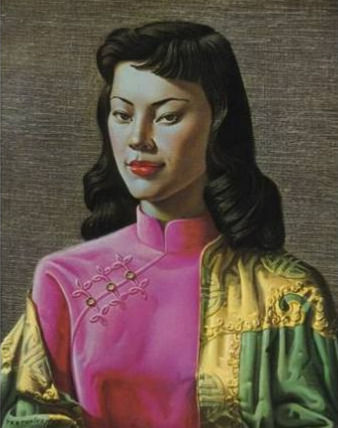
Tretchikoff’s style is immediately recognisable. His portraits combine luminous, high-contrast colour with simplified backgrounds, creating an almost theatrical sense of drama. Art historians describe his work as possessing mass-market accessibility and an advertising-like immediacy that bridges high art and popular taste. That quality is not accidental. It reflects a deliberate choice to paint images that feel both technically accomplished and emotionally direct.
His subject matter drew heavily from Asian, African, and Caribbean influences. Works like “Chinese Girl,” “Balinese Girl,” and “Miss Wong” feature women of colour rendered in his signature palette of deep teals, warm ochres, and vivid greens. The backgrounds are sparse, almost abstract, which forces the viewer’s eye straight to the face. This simplicity is part of what made his paintings so reproducible and so recognisable on a print.
Several qualities define the Tretchikoff style:
Luminous colour palettes with bold contrasts, particularly his use of green and blue skin tones
Simplified, dark backgrounds that isolate the subject and create immediate visual impact
Realistic facial detail combined with stylised, almost illustrative composition
Cross-cultural subject matter drawing on Asian, African, and Caribbean figures
Emotional accessibility that communicates mood without requiring art-world knowledge
Pro Tip: If you are trying to identify an authentic Tretchikoff print, look for the characteristic dark background and the luminous quality of the skin tones. His colour choices are unlike almost any other mid-century painter.
His cross-cultural influences and accessible style help explain why his work resonated with such diverse audiences. He painted beauty in a way that felt universal, even when his choices later attracted criticism.

How did Tretchikoff achieve such extraordinary commercial success?
Tretchikoff’s commercial success came from a deliberate decision to work outside the traditional gallery system. He understood that most people would never visit a gallery, so he brought his art directly to them through prints, exhibitions in department stores, and licensed merchandise.

His strategy unfolded in several key stages:
Mass-produced prints. Tretchikoff sold over 500,000 large-format reproductions of “Chinese Girl” worldwide. That figure made it one of the most widely distributed art prints of the 20th century.
Department store exhibitions. His 1962 show at Harrods in London attracted over 205,000 visitors, surpassing attendance figures for exhibitions by Pablo Picasso and Mark Rothko in the same era.
Merchandising. Tretchikoff personally managed a print empire that extended to mugs, wallpaper, cushions, and licensed products of all kinds, sustaining his visibility far beyond any gallery wall.
Bypassing gatekeepers. He strategically avoided traditional galleries, using public venues and print merchandising to reach broad middle and working-class audiences who had never bought art before.
The Harrods attendance figure is particularly striking. Over 205,000 visitors in a single exhibition is a number most major museums would envy today. It tells you everything about the appetite that existed for art when it was presented accessibly and without pretension.
His prints offered something post-war audiences genuinely craved. They were escapist, colourful, and aspirational, a vivid contrast to the drab palettes of post-war Britain and South Africa. Buying a Tretchikoff print was an act of optimism as much as decoration.
What controversies surround Tretchikoff’s legacy?

Tretchikoff’s relationship with the art establishment was never comfortable. Critics dismissed him as producing kitsch, a term that implies decorative superficiality over genuine artistic merit. The label stung. He reportedly disliked being called the “King of Kitsch” and felt it reduced his technical skill and genuine ambition to a punchline.
The debates around his work touch on several distinct issues:
The kitsch question. Critics argued his work prioritised decorative appeal over intellectual depth, placing it outside serious art discourse.
Exoticism and representation. His portraits of Asian and African women have attracted scrutiny for presenting non-Western subjects through a Western, male gaze. These are legitimate conversations that modern scholarship continues to explore.
Democratisation of art. His defenders argue that making art available to working-class homes was a genuinely radical act, one that the art establishment found threatening precisely because it succeeded.
The reframing by the Tretchikoff Foundation. The Foundation now refers to him as “the people’s painter,” a title that captures his pioneering role in making art part of everyday life.
“The framing as ‘kitsch’ has overshadowed Tretchikoff’s role in democratising art, a point increasingly recognised by recent scholarship and the artist’s own foundation.”
The tension between these views is what makes Tretchikoff so interesting to study. He was not simply a populist painter who got lucky. He was a technically skilled artist who made a conscious choice to reach the widest possible audience, and the art world never quite forgave him for succeeding.
What is the current market value of Tretchikoff’s works?

The market for Tretchikoff originals and prints has grown considerably since his death in 2006. The clearest signal of that growth came in 2013, when the original 1952 oil painting “Chinese Girl” sold at Bonhams in London for £982,050, more than doubling its pre-sale estimate of £300,000–£500,000. That result confirmed what collectors had suspected for years: original Tretchikoff canvases are serious investments.
Work type | Market position | Key factors |
Original oil paintings | Highest value, museum and serious collector level | Provenance, condition, exhibition history |
Signed limited prints | Mid-range collector market | Signature authenticity, print quality, framing |
Mass-produced vintage prints | Entry-level collecting, strong nostalgia demand | Age, condition, original framing |
Licensed merchandise | Decorative value, low financial investment | Rarity of specific items, condition |
Authentic mid-century mass-produced prints have themselves become sought-after vintage items. A well-preserved original print from the 1960s in its original frame carries genuine collector appeal, particularly as the nostalgia market for mid-century homeware continues to grow.
Provenance matters enormously. A print or painting with a clear ownership history, original documentation, or exhibition records commands a premium over an undocumented piece. Condition is equally critical. Fading, foxing, or damage to the original frame reduces value significantly.
Pro Tip: When assessing a vintage Tretchikoff print, check the reverse of the frame for original publisher labels or date stamps. These details confirm authenticity and period, and they make a real difference to value.
The 2013 auction record also triggered renewed collector interest in his wider body of work. Paintings beyond “Chinese Girl,” including “Balinese Girl,” “Miss Wong,” and “Zulu Maiden,” have all seen increased attention at auction since that sale.

Where can you see, buy, or learn more about Tretchikoff art today?
Tretchikoff’s work appears in several permanent and temporary collections, and there are practical routes for collectors at every level to engage with his art.
South African museums. The Iziko South African National Gallery in Cape Town holds works connected to Tretchikoff’s career and the broader South African art scene he inhabited.
The Tretchikoff Foundation. The official Foundation maintains records, promotes his legacy, and is the most reliable source for authentication queries and biographical information.
Auction houses. Bonhams, Strauss & Co in South Africa, and various regional auction houses regularly handle Tretchikoff originals and vintage prints. Setting up alerts with these houses is a practical way to track availability.
Online vintage retailers. A growing number of reputable vintage homeware and art retailers stock original mid-century prints. Quality varies, so buying from established sellers with clear return policies is always the safer choice.
Interior design context. Tretchikoff prints sit beautifully within mid-century modern and retro interior schemes. If you are building a vintage living room with period character, a well-chosen print adds genuine authenticity.
For collectors interested in the broader mid-century aesthetic, pairing Tretchikoff prints with period homeware creates a cohesive and visually striking interior. A retro kitchen or sitting room furnished with authentic 1950s and 1960s pieces provides exactly the right context for his work to shine.
Key Takeaways
Tretchikoff’s enduring appeal rests on his rare ability to combine genuine technical skill with mass-market accessibility, making him one of the most culturally significant artists of the 20th century.
Point | Details |
Defining style | Luminous colour, dark backgrounds, and cross-cultural portraits create an instantly recognisable look. |
Commercial reach | Over 500,000 prints of “Chinese Girl” sold, and 205,000 visitors at his 1962 Harrods exhibition. |
Critical controversy | The “King of Kitsch” label overshadowed his role in democratising art for working-class audiences. |
Auction value | The original “Chinese Girl” sold for £982,050 in 2013, confirming strong market demand for originals. |
Collector advice | Provenance, condition, and original framing are the three key factors that determine print and painting value. |
Tretchikoff prints and mid-century style at My Vintage
If Tretchikoff’s world of vivid colour and mid-century glamour has caught your eye, the good news is that the aesthetic translates beautifully into real interiors. At My Vintage, we stock a carefully curated range of authentic vintage homeware from the 1950s, 1960s, and 1970s that complements
the retro spirit of his prints perfectly.

From original period pieces to retro decorative accessories, our collection brings the warmth and character of mid-century style into your home. Take a look at our 1950s vintage homeware for pieces that sit beautifully alongside a classic print. Whether you are a seasoned collector or simply drawn to the era’s bold aesthetic, there is something at My Vintage that will feel just right.
Frequently Asked Questions
Who was Tretchikoff and why is he famous?
Vladimir Tretchikoff was a Russian-born, South Africa-based artist best known for “Chinese Girl,” one of the most widely reproduced art prints of the 20th century. His fame rests on his ability to combine technical skill with mass-market appeal, reaching audiences far beyond the traditional gallery world.
What is the most famous Tretchikoff painting?
“Chinese Girl,” also known as “The Green Lady,” is his most famous work. The original 1952 oil painting sold at Bonhams in London in 2013 for £982,050.
Are Tretchikoff prints worth anything?
Original mid-century mass-produced prints have become genuinely sought-after vintage items, with value depending on age, condition, and original framing. Signed or limited prints command higher prices, while original oil paintings represent the top of the market.
What is the Tretchikoff style?
The Tretchikoff style is defined by luminous colour palettes, dark simplified backgrounds, and realistic portrait subjects drawn from Asian, African, and Caribbean cultures. His work has an advertising-like immediacy that made it instantly accessible and widely loved.
Where can I find Tretchikoff artwork for sale?
Original works appear at major auction houses including Bonhams and Strauss & Co. Vintage prints are available through reputable online vintage retailers and specialist art dealers, with the Tretchikoff Foundation serving as the authoritative source for authentication.
Recommended

Comments