


Vintage Attire for Men: Style Guide for a Unique Wardrobe

Forget the idea that vintage menswear belongs only at fancy dress parties. The reality is that pieces from the 1940s through to the 1990s offer something modern fashion simply cannot replicate: genuine craftsmanship, rarity, and a story worth wearing. Vintage attire allows unique expression through craftsmanship and history, and with proper care, these pieces outlast anything churned out by fast fashion today. This guide walks you through the key eras, how to spot authentic pieces, where to shop, how to care for your finds, and how to style them for everyday life.
Table of Contents
Key Takeaways
Point | Details |
Unique style identity | Vintage attire helps you stand out with history and character in every outfit. |
Sustainable wardrobe | Vintage clothing purchases reduce waste and encourage thoughtful fashion. |
Decades of inspiration | Each era offers specific looks from tailored suits to casual streetwear. |
Authenticity tips | Learning to check labels, construction, and hardware helps you find genuine pieces. |
Care and longevity | Proper cleaning and storage make your vintage clothes last for years. |
Why Choose Vintage Attire for Men?

Vintage menswear is not a trend. It is a deliberate choice to stand apart from the crowd. When every man on the high street is wearing the same slim-fit chino from the same three brands, a well-chosen 1960s suede jacket or a 1970s corduroy blazer makes a statement that no amount of money spent at a chain store can replicate.
The sustainable style impact of choosing vintage is significant too. Every vintage purchase is one fewer new garment manufactured, which means less water consumption, fewer carbon emissions, and less textile waste. The vintage shopping advantages extend beyond the environmental: quality vintage pieces often cost less than their modern equivalents while being built to a far higher standard.
Here is why men are increasingly turning to vintage:
Unique style: No two vintage pieces are identical. You are wearing something genuinely one of a kind.
Superior construction: Pre-1980s garments were often made with heavier fabrics, reinforced stitching, and real metal hardware.
Investment value: Iconic pieces from sought-after eras appreciate in value over time.
Ethical consumption: Buying vintage supports a sustainable wardrobe and reduces reliance on exploitative fast fashion supply chains.
Personal expression: Vintage lets you channel a specific era, aesthetic, or cultural moment that resonates with your personality.
Pro Tip: When browsing vintage menswear, pay close attention to buttons, stitching, and lining. These details reveal construction quality that mainstream brands stopped prioritising decades ago.
Now that we understand why vintage menswear is more than just nostalgia, let’s explore the defining features and styles from each era.
Key Eras and Styles in Vintage Menswear
Each decade from the 1940s to the 1990s produced a distinct visual language in men’s fashion. Understanding these eras helps you shop with purpose and wear with confidence.
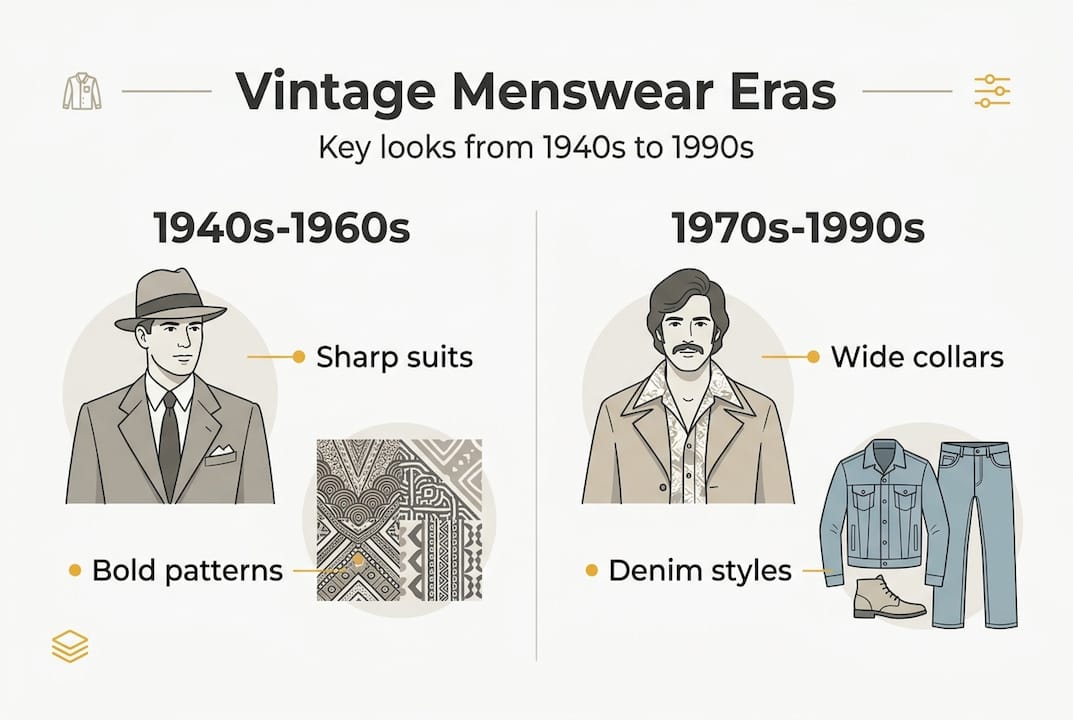
The 1940s were defined by wartime austerity. Suits were structured and practical, with broad shoulders and tapered trousers. Fabrics were often wool or tweed, and the silhouette was sharp. Think utility over excess, but with a quiet elegance.
The 1950s brought prosperity and rebellion in equal measure. Tailored suits with broad shoulders and defined waists dominated the office, while leather jackets and denim jeans became the uniform of youth culture. Neutral tones for business, bold colours for leisure.
The 1960s saw the rise of mod culture. Slim-cut suits in bold patterns, polo necks, and Chelsea boots defined the era. Italian tailoring had a huge influence, and synthetic fabrics began to appear alongside traditional wool and cotton.
The 1970s went wide. Bell-bottom trousers, wide-collared shirts, and leisure suits in polyester and earth tones captured the decade’s spirit. Disco glamour and bohemian styles coexisted, giving men more freedom of expression than any previous era.
The 1980s and 1990s pushed boundaries in opposite directions. 1980s power dressing brought oversized blazers and bold colours, while the 1990s responded with minimalism, grunge, oversized denim, and the early rise of streetwear.
Era | Signature pieces | Key fabrics | Cultural influence |
1940s | Structured suits, utility coats | Wool, tweed | Wartime austerity |
1950s | Leather jackets, tailored suits | Denim, wool | Rock and roll, prosperity |
1960s | Mod suits, polo necks | Cotton, synthetics | Mod culture, Italian tailoring |
1970s | Bell-bottoms, leisure suits | Polyester, corduroy | Disco, bohemian |
1980s | Oversized blazers, bold prints | Synthetic blends | Power dressing, pop culture |
1990s | Oversized denim, grunge layers | Denim, flannel | Streetwear, minimalism |
“The most compelling thing about vintage menswear is that every era was reacting to something. Understanding that context turns a jacket into a conversation.” — Men’s vintage styles explored at My Vintage

Explore vintage menswear trends and menswear essentials to deepen your knowledge of each era’s defining pieces.
Having an eye for different eras is key, but how can you tell authentic vintage pieces from modern reproductions? The next section explains how to identify genuine vintage menswear.
How to Identify Authentic Vintage Attire

The vintage market is full of reproductions and mislabelled items. Knowing what to look for protects your money and your wardrobe.
Authenticating vintage menswear comes down to a handful of reliable clues. Follow these steps every time you inspect a potential purchase:
Check the label: Look for outdated country names such as “Made in West Germany” or “Made in Czechoslovakia.” Union tags, common pre-1990s in American-made garments, are a strong indicator of age.
Examine the fabric content label: Natural fibres such as wool, cotton, and silk dominated pre-1960s clothing. Synthetic blends became more common from the 1960s onwards. No fibre content label at all often suggests pre-1971 manufacture in the UK.
Inspect the zip: Metal zips, particularly those branded “Talon” or “Lightning,” are typical of pre-1960s garments. Plastic zips became standard later.
Look at the stitching and seams: Pinked seams (zigzag-cut edges) and heavy, even stitching are hallmarks of quality vintage construction. Modern reproductions often cut corners here.
Assess the silhouette: Wide lapels, exaggerated flares, and bold collars are era-specific. If the cut matches the supposed decade, that is a good sign.
Feel the weight: Genuine vintage fabrics tend to be heavier and more substantial than modern equivalents.
Check for repairs: Small, hand-stitched repairs are common in authentic vintage pieces and are not a red flag. They are evidence of a garment that was valued and maintained.
For more practical guidance, the tips on finding and styling men’s vintage clothing and the vintage style spotlight are excellent starting points.
With an understanding of authenticity, you can confidently shop for real vintage pieces rather than being caught out by fakes. Let’s now turn our focus to practical shopping tips.
Where and How to Shop for Vintage Menswear

Knowing where to look is half the battle. The other half is knowing what to do when you find something promising.
The best sources for quality vintage menswear include:
Specialist vintage retailers: Curated shops, both physical and online, offer authenticated pieces with accurate dating. The quality control is far higher than general charity shops.
Charity and thrift shops: Patience pays off here. Visit regularly, as stock turns over constantly. Focus on areas with older populations for better finds.
Online marketplaces: Platforms like eBay and Depop offer enormous range, but require careful scrutiny. Always request additional photos and ask about measurements.
Vintage fairs and markets: These events concentrate multiple sellers in one place, making comparison easy and negotiation possible.
Estate sales and auctions: Often the source of the most authentic and well-preserved pieces, particularly for 1940s and 1950s garments.
For more targeted advice, the top men’s vintage shopping tips and guidance on vintage accessories are well worth reading before your next shopping trip.
Shopping method | Pros | Cons |
Online specialist shops | Curated, authenticated, convenient | Cannot try before buying |
Physical vintage shops | Try on, inspect in person | Limited stock, location-dependent |
Charity shops | Low cost, surprise finds | Inconsistent quality, time-consuming |
Online marketplaces | Huge range, competitive pricing | Risk of mislabelling, condition issues |
Pro Tip: Build a relationship with your favourite vintage retailer. Regular customers often get first access to new stock, honest condition reports, and advice tailored to their taste and size.
Once you’ve sourced your pieces, proper care ensures they last for decades more. The following section offers essential maintenance tips.
Caring for Your Vintage Attire
A 1960s blazer that has survived sixty years deserves to survive sixty more. The way you handle, clean, and store vintage clothing determines whether it remains wearable or deteriorates.

Proper vintage care involves gentle handling, temperature-controlled storage, and professional cleaning for delicate items. Avoid frequent washing, which weakens fibres and fades colours over time.
Follow this routine to keep your pieces in excellent condition:
Air garments after wearing: Hang pieces in a well-ventilated space for several hours before returning them to storage. This removes moisture and odour without washing.
Use padded hangers: Wire hangers distort shoulders over time. Padded or wooden hangers preserve the shape of jackets and coats.
Store in a cool, dry place: Heat and humidity accelerate fabric degradation. Avoid attics and damp basements.
Wrap delicate items in acid-free tissue: This prevents colour transfer and protects embellishments during storage.
Spot clean where possible: Address small stains with a damp cloth and mild soap rather than a full wash.
Take fragile pieces to a professional cleaner: Dry cleaning is preferable for wool, silk, and heavily structured garments. Always inform the cleaner that the item is vintage.
Avoid direct sunlight: Prolonged exposure fades fabric and weakens fibres. Store away from windows.
With these care methods in place, your vintage pieces will look sharp for years. Finally, let’s see how to work vintage finds into your personal style.
Styling Vintage: Making Classic Attire Modern
The most common mistake men make with vintage is wearing it head to toe in one era. The result looks like a costume. The goal is integration, not imitation.

Here are practical ways to build outfits that feel current while honouring the past:
Anchor with one statement piece: A 1970s suede jacket or a 1980s oversized blazer works best when the rest of the outfit is simple and modern. Let the vintage piece do the talking.
Mix eras intentionally: A 1950s workwear shirt paired with contemporary slim trousers creates contrast that feels deliberate rather than accidental.
Accessorise for authenticity: Period-appropriate accessories such as a 1960s watch, a 1940s fedora, or vintage leather brogues add depth without overwhelming the look. Explore vintage styling tips for ideas on how accessories transform an outfit.
Use vintage for subtle touches: Not every vintage piece needs to be the focal point. A 1990s graphic tee worn under a modern suit jacket adds character without commitment.
Match the occasion: A 1940s double-breasted suit is perfect for a formal event. A 1980s track top is ideal for casual weekends. Context matters.
Consider fit above all else: Vintage sizing differs significantly from modern sizing. A tailor can adjust a vintage jacket to fit perfectly, transforming a good find into a great one. Check menswear style inspiration for real examples of how vintage integrates into modern wardrobes.
With inspiration to start styling, countless options open up for your wardrobe. For curated selections and further guidance, explore the resources below.
Discover and Build your Vintage Wardrobe

Now with a strong foundation in vintage menswear, you’re ready to start your own collection. At My Vintage, we have been curating authentic pieces since 2004, and our passion for quality and individuality runs through everything we stock.
Whether you are searching for a sharp 1950s suit, a 1970s leather jacket, or the perfect 1990s denim piece, our men’s vintage collection is updated regularly with carefully selected finds. If you want to extend your vintage aesthetic beyond clothing, our mid-century homeware brings the same era-defining style into your living space. Browse, explore, and find pieces that genuinely reflect who you are.
Frequently Asked Questions
How do I know if an item is truly vintage?
Authentic vintage menswear shows specific clues including old union tags, outdated country names on labels, metal zips, natural fibres, and era-specific construction details like pinked seams. These indicators together build a reliable picture of a garment’s age.
Is vintage attire fashionable for everyday wear?
Absolutely. 1980s oversized blazers and 1990s minimalist pieces integrate seamlessly with modern wardrobe staples, creating looks that feel current and distinctive rather than dated.
Why is vintage clothing considered sustainable?
Vintage pieces last longer with proper care and reduce demand for new manufacturing, making each purchase a meaningful step away from the waste generated by fast fashion.
What’s the difference between vintage and second-hand?
Vintage refers specifically to clothing from a recognised past era, typically at least 20 years old, whereas second-hand simply means previously owned, regardless of when it was made.
How should I clean vintage menswear?
Gentle handling and professional cleaning are the safest approaches, particularly for wool and structured garments. Avoid machine washing, which can permanently damage vintage fabrics and construction.
Recommended


Comments