


Vintage Laura Ashley: Complete Collectors Guide

Vintage Laura Ashley pieces, particularly those produced during the brand’s golden era from the 1960s through to the 1990s, are hugely sought after by collectors and interior enthusiasts who recognise something modern production simply cannot replicate. The construction, the botanical prints, the unmistakably British pastoral charm. All of it adds up to pieces that feel as relevant today as they ever did. If you have been curious about where to start, this guide covers the history, the styles, the market, and everything in between.
Table of Contents
The story behind vintage Laura Ashley
The Laura Ashley story begins in 1953, when Laura and Bernard Ashley started their business in a small London flat with just £10 for printing equipment, dyes, and linen. Those early hand-printed headscarves, sold to retailers including John Lewis, were just the beginning. What grew from that modest flat became one of the most recognisable British design houses of the 20th century.
The brand’s signature aesthetic drew heavily from Victorian and Edwardian traditions. Floral sprigs, pastoral scenes, delicate botanical repeats, all rendered in soft, natural colours. By the late 1960s and through the 1970s, Laura Ashley had become synonymous with a very particular English country vision. Prairie dresses, smock tops, and flowing maxi skirts became cultural shorthand for a romantic alternative to the sharper fashions of the decade.

The 1980s brought commercial expansion across Europe and North America, and the home decor range grew to match. Wallpapers, bedding, upholstery fabrics, and accessories carried that same botanical sensibility into domestic interiors. It was a cohesive world, and people bought into it completely.
The brand’s later years were considerably less triumphant. Poor adaptation to digital retail and the rise of fast fashion left the business struggling. Laura Ashley filed for administration in 2020, closing all UK retail stores and transitioning to a licensed model. That transition is precisely why vintage pieces now carry so much weight.
Key milestones to know:
1953: Business founded in London with hand-printed headscarves
1960s: First retail expansion and the development of signature floral clothing
1970s: Peak cultural influence with prairie and maxi silhouettes
1980s: International expansion and home decor dominance
1990s: Gradual commercial decline as fast fashion grew
2020: Administration filed, stores closed, licensing model adopted
Pro Tip: When dating a vintage Laura Ashley piece, look at the label typography and country of manufacture. Labels from the 1970s typically feature simple lettering and say “Made in Wales” or “Made in Great Britain,” which is a strong indicator of authenticity and era.
Style and design: what makes it distinctive
Walk into any room styled with vintage Laura Ashley and you feel it immediately. There is a quietness to it, a softness, that comes from the combination of natural materials and botanical motifs rooted in the British countryside.
In clothing, the hallmarks are easy to spot once you know them. Prairie dresses with gathered skirts and fitted bodices, Victorian-style blouses with lace-trimmed collars, maxi skirts in ditsy florals, puffed sleeves, pintuck detailing. The silhouettes consistently reference a pre-industrial pastoral world, which is exactly what made them so appealing as a counterpoint to synthetic 1970s and 1980s fashion. This 1980s rose print dress in our collection is a beautiful example of the brand’s signature approach to floral print at its most confident.
In the home, the aesthetic translated into ruffled bedding, deeply upholstered sofas, floral wallpapers, and coordinating cushions and curtains. Vintage bedding used 100% cotton percale and cotton sateen, materials that simply feel different to modern blended alternatives. The weight and drape of the fabric is distinctive. You notice it the first time you handle an original set.
Feature | Vintage Laura Ashley | Modern licensed products |
Fabric composition | 100% cotton percale or sateen | Often cotton/polyester blends |
Print method | Traditional roller or screen printing | Digital printing on varied substrates |
Construction | Hand-finished details, quality seams | Factory standard construction |
Longevity | Decades with proper care | Typically a few years |
Collector value | Appreciates or holds value | Minimal secondary market value |
Quality indicators worth knowing in vintage pieces include fabric weight (heavier is generally better), the clarity and registration of the print, the construction of seams and hems, and whether buttons and trims are natural materials like mother of pearl or wood.
Pro Tip: Hold a vintage Laura Ashley fabric piece up to natural light. Genuine cotton percale shows an even, tight weave with good density. If it looks thin or uneven, it may be a later reproduction or an inferior piece.

Collecting vintage Laura Ashley: sourcing and authentication
The market for vintage Laura Ashley is healthy and, in some areas, growing. Understanding where to look and what to look for makes a genuine difference to what you bring home.
The best sources break down into a few categories. Charity shops remain one of the most rewarding hunting grounds, particularly in rural areas and affluent suburbs where original owners are more likely to have kept pieces in good condition. eBay UK and Etsy UK are the dominant online platforms, and both carry reliable vintage stocks including apparel, bedding, and accessories. Specialist vintage dealers, including curated platforms like Myvintage, offer the advantage of pre-screened condition and verified authenticity.
Here is a step-by-step process for authenticating a piece before you buy:
Check the label. Original vintage labels will reference Great Britain, Wales, or specific UK factories. Post-2000 labels often include licensing information or overseas manufacturing.
Examine the print. Vintage floral fabrics have a depth and registration that comes from traditional printing processes. Digital reproductions tend to look flatter.
Feel the fabric. Natural cotton has a particular hand feel. If the fabric feels slippery or synthetic, question the period.
Look at the construction. Hand-finished seams, French seams on fine blouses, and quality zip placements are all signs of era-appropriate craftsmanship.
Research the pattern. Many collectors have catalogued known Laura Ashley prints. Cross-reference the pattern name if the seller provides one.
For furniture, original sofas from the 1970s to 1990s command premium prices and for good reason. Vintage Laura Ashley sofas can last 15 to 20 years or more beyond their original purchase date with proper care. Valuing them involves assessing the frame condition, original upholstery, and rarity of the model.
Condition grade | What to expect | Typical price range |
Excellent | Minimal wear, original upholstery intact | Premium |
Good | Light wear, colours bright, no damage | Mid-range |
Fair | Some fading or wear, fully functional | Budget friendly |
Restoration needed | Structural or fabric issues | Low cost, but restoration adds expense |
Pro Tip: When buying vintage Laura Ashley clothing online, always ask for measurements rather than relying on the stated size. Vintage sizing runs considerably smaller than modern UK sizing, and a stated size 14 from the 1970s may correspond to a modern size 10 or 12.
Vintage versus modern pieces
This is where things get genuinely interesting for collectors. The transition to a licensed model post-2020 means that modern Laura Ashley products, while visually similar, are not made to the same standards as vintage originals. The construction details, the material sourcing, the sheer quality of the finished product. All of it differs considerably.
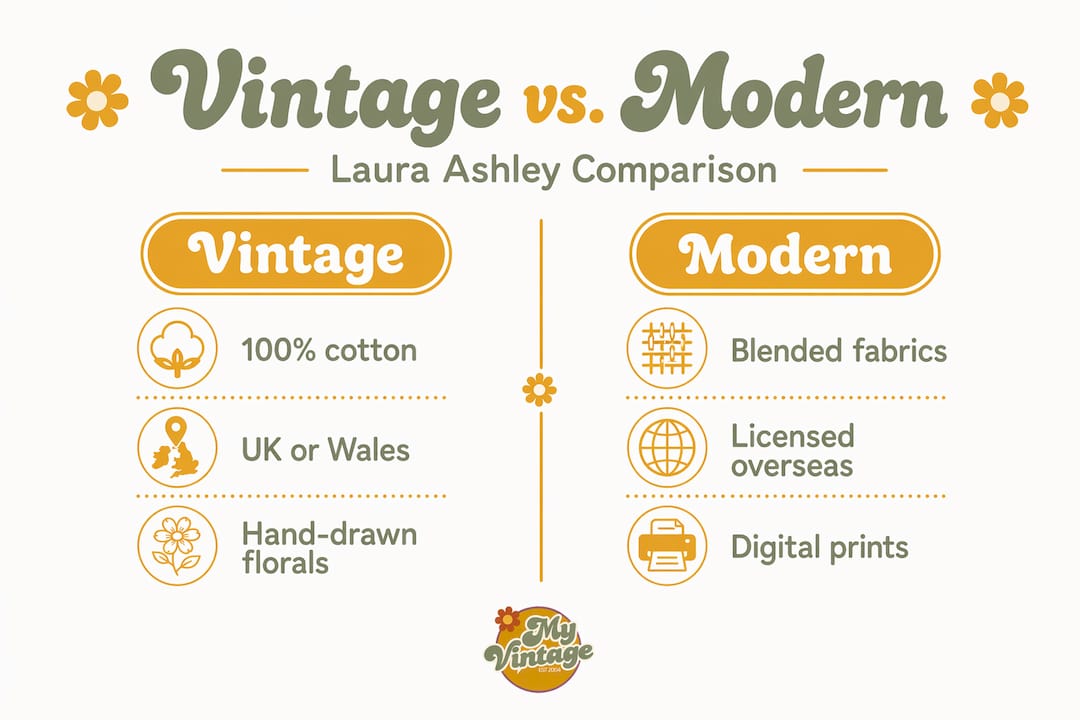
The honest comparison is this: modern licensed products use different manufacturing methods and materials that simply do not replicate the durability or the tactile experience of vintage pieces. A vintage cotton sateen duvet cover from 1985 will outlast a modern blended equivalent by years, and it will feel better throughout.
Where modern pieces still make sense is in situations where authenticity of era is not the priority. If you want the Laura Ashley look for a spare room without collector-grade investment, modern licensed homeware can work for you. But if you are building a collection, furnishing a space with genuine heritage pieces, or simply want the quality that original production offered, vintage is the only sensible choice.
Reasons why collectors consistently prefer vintage originals:
Natural fibre construction ages beautifully rather than degrading
Original prints have depth and variation that digital reproduction cannot match
Vintage pieces hold secondary market value; modern pieces generally do not
The craftsmanship is simply evident when you handle both side by side
For those interested in exploring related heritage aesthetics, The Chic Collection Co offers a curated range of Laura Ashley-influenced prints and designs worth browsing alongside your vintage search.
Styling and caring for your pieces
The joy of vintage Laura Ashley lies in how naturally it fits into contemporary spaces and wardrobes. You do not need to commit to head-to-toe 1970s nostalgia. A prairie dress pairs beautifully with a modern blazer and ankle boots. A floral blouse from the 1980s works just as well with jeans as it did with a period-appropriate skirt.

For home decor, mixing vintage Laura Ashley bedding or cushions with neutral contemporary furniture actually makes the pieces stand out more. The botanical prints become focal points rather than period details.
Care guidelines for vintage textiles:
Wash cold. Most vintage cotton pieces should be washed at 30°C maximum to prevent shrinkage and colour fading.
Avoid tumble drying. Line dry or lay flat to maintain shape and prevent fabric stress.
Hand wash delicates. Fine blouses with lace trim or pintuck detailing deserve gentle hand washing.
Store in cotton bags. Acid-free tissue and cotton storage bags protect fabric from light and moisture damage.
Never use bleach. Even on white or cream pieces, bleach degrades vintage cotton fibres rapidly.
For vintage furniture, professional reupholstery using period-appropriate fabrics is worth the investment. It extends the life of the piece significantly and, done well, preserves the heritage character that makes it valuable.
Pro Tip: For vintage clothing storage, hang natural fibre pieces on padded hangers rather than wire, and keep them away from direct light. UV exposure fades vintage floral fabrics faster than almost anything else.

My honest take on collecting vintage Laura Ashley
I have spent years sourcing and wearing vintage pieces, and I will tell you something that does not often get said plainly: a lot of what drives the vintage Laura Ashley market is nostalgia, and nostalgia is not always a reliable guide to quality. Some pieces from the 1990s are genuinely inferior to earlier examples. The brand was already beginning to stretch itself thin before administration, and pieces from that era can reflect it.
What I genuinely love, and what keeps me coming back, are the earlier examples. A 1970s cotton floral maxi in good condition is a thing of real beauty. The weight, the print, the cut. Nothing produced today comes close. I also think the home decor pieces are undervalued by the wider vintage market, which still skews heavily towards clothing. Original Laura Ashley bedding in excellent condition, or a well-preserved sofa, represents remarkable value compared to what you get from current retail.
My advice to newcomers is simple. Do not buy on brand name alone. Buy the piece. Handle it where you can, ask for detailed photographs online, and prioritise condition over rarity. A beautiful dress in excellent condition will bring you more pleasure than a rare print that has faded beyond recognition. And keep an eye on My Vintage. We take condition seriously, which makes a real difference when you are collecting at any level.
Discover curated vintage pieces at My Vintage
Whether you are just beginning to explore vintage Laura Ashley or you already know exactly what you are looking for, My Vintage has you covered. We hand-select every piece in our collection for quality, condition, and authentic period character.
From original Laura Ashley coats to floral fine knit jumpers, our vintage clothing range reflects the very best of British heritage style. And if you are furnishing as well as dressing, our vintage homeware collection features carefully chosen pieces that bring genuine character to any room. Browse the full range at Myvintage and find something worth keeping for another generation.
Frequently Asked Questions
What years count as vintage Laura Ashley?
Vintage Laura Ashley typically refers to pieces produced between the 1960s and the 1990s, with items from the 1970s and 1980s considered the most desirable by collectors due to their quality and design significance.
How do I tell if a Laura Ashley piece is genuinely vintage?
Check the label for UK or Welsh manufacturing details, examine the fabric for natural fibre construction, and look for traditional print depth and hand-finished construction details. Labels reading “Made in Wales” are a strong indicator of pre-1990s origin.
Where can I find vintage Laura Ashley items today?
Reliable sources include eBay UK, Etsy UK, charity shops in rural and affluent areas, and specialist vintage retailers like Myvintage. Discontinued and pre-owned pieces can also surface through clearance retailers.
Are vintage Laura Ashley pieces worth buying as investments?
Vintage pieces, particularly furniture and clothing from the 1970s and early 1980s, hold and sometimes appreciate in value. Original sofas and quality bedding in good condition command premium prices on the secondary market.
How should I care for vintage Laura Ashley fabrics?
Wash at 30°C maximum, avoid tumble drying, store in cotton or acid-free bags away from direct light, and never use bleach. These steps preserve natural cotton fibres and protect the print quality for years to come.
Recommended


Comments